
The satellite image is dated March 26, 2026. Two enormous flying-wing aircraft sit on the apron of a secretive test facility in the deserts of Xinjiang, western China. One has a wingspan analysts estimate at 173 feet — roughly the width of a Northrop Grumman B-2 Spirit stealth bomber. The other, slightly smaller, is parked outside a newly built high-security hangar complex on the far side of the base. Nearby, a smaller stealth fighter-like drone and a Xi’an Y-20 transport complete the scene.
This is Malan Air Base. And China’s unmanned stealth ambitions are no longer theoretical.
Quick Facts
What: Satellite imagery reveals two massive stealth flying-wing drones at China’s Malan test facility
Date of imagery: March 26, 2026
Largest drone: ~173-foot wingspan — roughly equal to a B-2 Spirit (172 ft)
Location: Malan Air Base, Xinjiang — China’s primary site for nuclear weapons tests and advanced drone development
Also visible: A stealth fighter-like drone and a Y-20 transport aircraft on the main apron
Designation: Unofficial — dubbed “WZ-X” and “The Monster of Malan” by analysts
The Monster of Malan
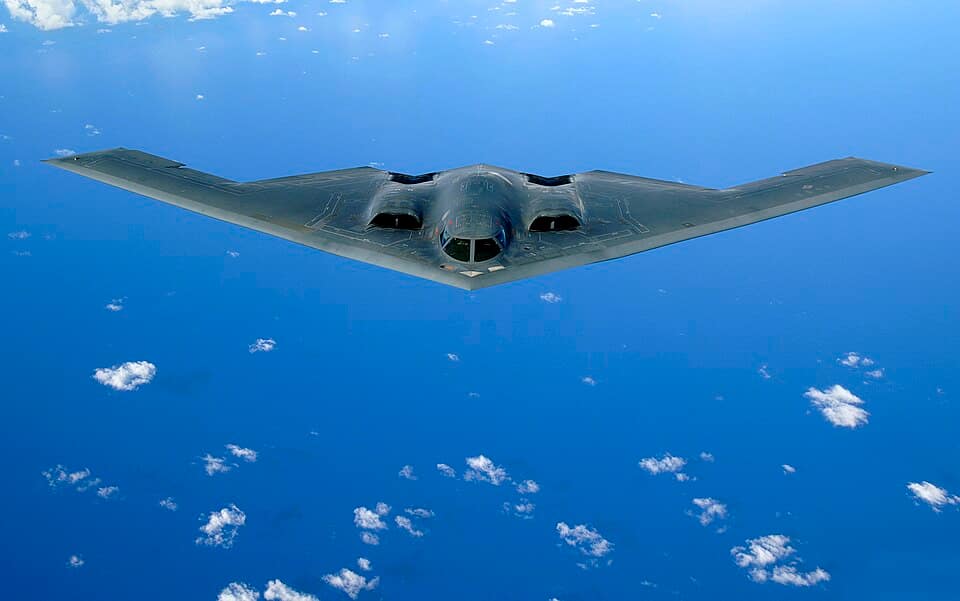
The larger flying wing — unofficially dubbed “WZ-X” and known among open-source intelligence analysts as “The Monster of Malan” — first appeared in satellite imagery in late 2024. At 173 feet, its wingspan places it in a class occupied by only one other aircraft in the world: the B-2 Spirit. But where the B-2 carries a crew of two and a 40,000-pound bomb load, the Chinese aircraft appears to be fully unmanned.
Its mission profile is almost certainly high-altitude, long-endurance (HALE) intelligence, surveillance, and reconnaissance — the unmanned equivalent of the U-2 or Global Hawk, but with stealth shaping designed to operate in contested airspace that would be suicidal for a conventional drone. At B-2 scale, it could carry sensors, communications equipment, or weapons payloads far exceeding anything in China’s current drone fleet.
The March 2026 image is significant because it is the first time both large flying wings have been observed simultaneously, parked in proximity on the same facility. This suggests that at least two airframes exist — possibly more — and that a structured test programme is underway rather than a single experimental prototype gathering dust.

A Growing Drone Test Complex
Malan Air Base has a long and classified history. Originally built in the 1960s as the logistical hub for China’s nuclear weapons testing at Lop Nur, the facility was repurposed in the 2000s as a test centre for advanced drone programmes. Its remoteness — surrounded by hundreds of kilometres of desert — provides both operational security and the vast airspace needed for experimental flight testing.
Over the past two years, commercial satellite imagery has documented a significant expansion at Malan. New hangars, taxiways, and a high-security compound have been constructed. The compound, located on the opposite side of the runway from the main apron, appears specifically designed for sensitive aircraft — its enclosed hangars and restricted road access suggest programmes that China wants to keep hidden even from its own satellite-tracking adversaries.
The smaller stealth fighter-like drone visible in the March image adds another dimension. While less is known about this design, its angular planform is consistent with a combat-oriented unmanned aerial vehicle — something closer to the U.S. Collaborative Combat Aircraft concept than a surveillance platform.
What This Means for the Pacific
Beijing is pursuing flying-wing drones across a range of sizes and mission sets. The GJ-11 Sharp Sword, a smaller tactical stealth drone, has been displayed at airshows and is believed to be in limited service. The CH-7, a medium-altitude flying wing, is being marketed for export. The monsters at Malan represent the high end of this spectrum — strategic-range platforms that could surveil the entire Western Pacific from altitudes above 60,000 feet, or deliver precision strikes deep into contested territory without risking a single Chinese pilot.
For U.S. and allied defence planners, the implications are straightforward. China is building the kind of unmanned stealth capability that, a decade ago, only the United States possessed. The B-2 once gave America an asymmetric advantage — the ability to penetrate any air defence network on Earth undetected. Malan suggests that advantage is eroding, one massive flying wing at a time.
The desert of Xinjiang keeps its secrets well. But satellites, as always, see everything.
Sources: The War Zone, satellite imagery analysis (March 26, 2026)


 English
0 Comments