
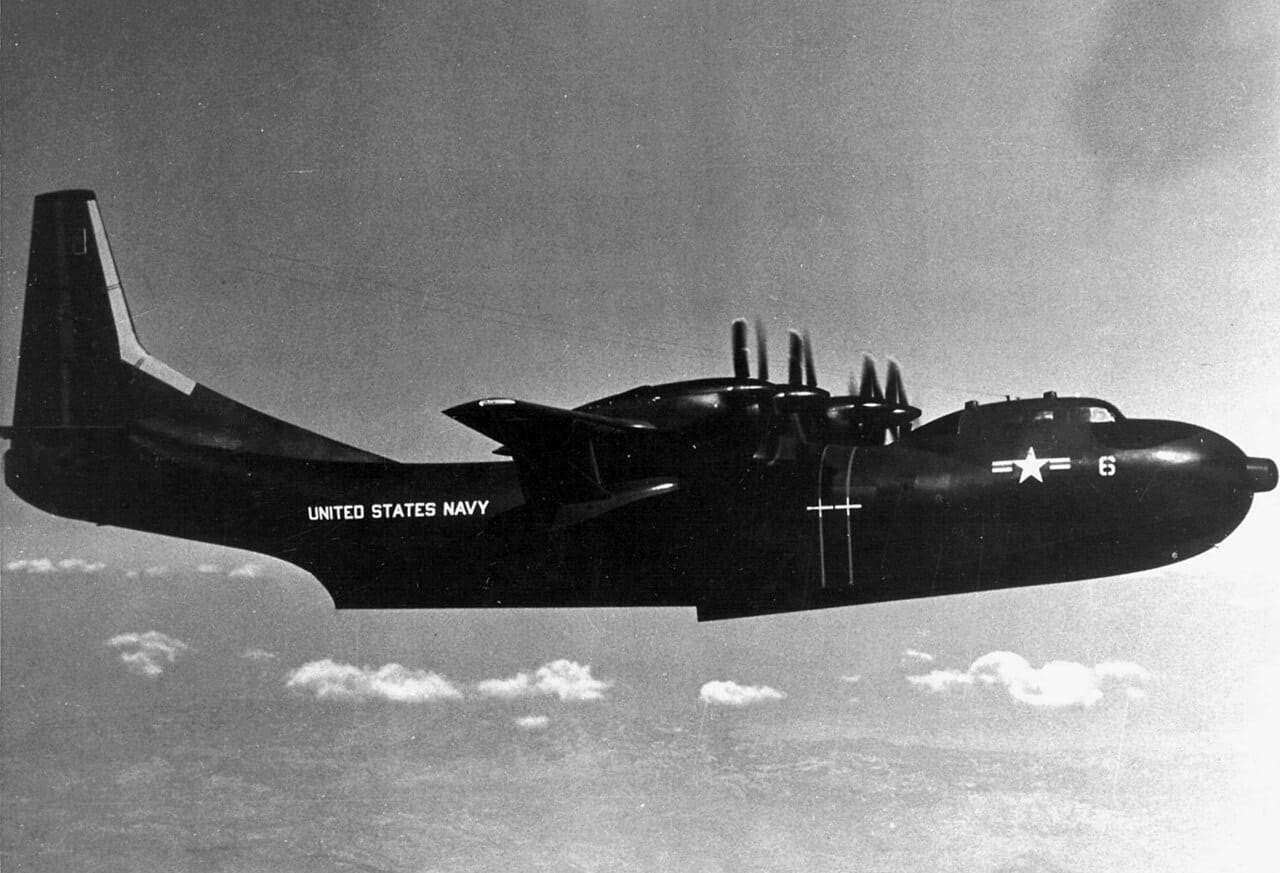
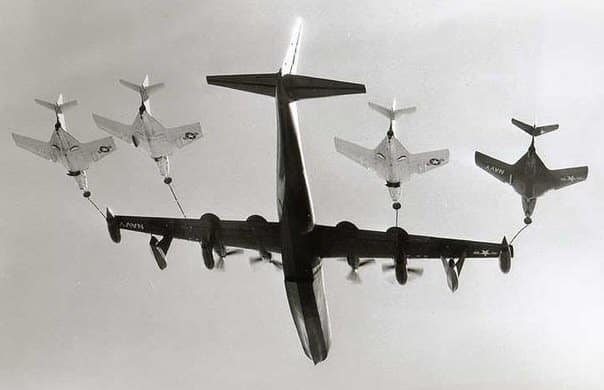
For four short years in the mid-1950s, the U.S. Navy operated the strangest aerial-refuelling tanker it ever owned. It was a four-engined turboprop flying boat. It landed on water. It nose-loaded vehicles. It could refuel four jet fighters simultaneously from probe-and-drogue baskets streamed from each wing. It cruised at around 560 km/h — faster than any flying boat before it. And it carried out routine transpacific cargo flights from Naval Air Station Alameda to Hawaii.
The aircraft was the Convair R3Y Tradewind. The Navy ordered 13 of them. They built 11. They flew them in operational service for less than 36 months. By the end of 1958, all surviving airframes were sitting in the desert at Litchfield Park, Arizona, awaiting scrap. The R3Y is one of those aircraft that the world stopped wanting just slightly before it arrived.
Quick Facts
- Aircraft: Convair R3Y Tradewind — transport variant of the P5Y patrol bomber
- First flight: 25 February 1954 (R3Y-1) / 22 October 1954 (R3Y-2)
- Length / Wingspan: 42.6 m / 44.4 m
- Engines: 4 × Allison T40 turboprops, contra-rotating propellers
- Cruise speed: 560 km/h (350 mph) — about as fast as a Boeing B-29 at top speed
- Range: 4,500 km with full payload
- Role: Transport, aerial-refuelling tanker, vehicle delivery to forward bases
- Built: 11 airframes — retired 1958 after Allison T40 unreliability problems
The last great flying boat of the U.S. Navy
By 1950, the U.S. Navy had decided that the next generation of patrol bombers and long-range transports needed to land on water. Land-based runways were vulnerable in a Pacific war. Coral-island airstrips were short. Aircraft carriers were full of fighters. A long-range flying boat — one fast enough to outrun most fighters, big enough to carry tanks — would be invaluable. Convair, which had built the Catalina and the PB2Y Coronado, won the contract.
The aircraft Convair delivered was the most modern flying boat ever built. The hull was hydrodynamically refined to plane cleanly at takeoff speeds above 220 km/h. The cantilever wing was high-aspect-ratio for cruise efficiency. The four-engine arrangement used the most powerful turboprops the U.S. Navy had ever specified. The whole airframe was magnesium-and-aluminium, light enough that empty weight was a remarkable 35 tonnes.
The R3Y could nose-load vehicles. The whole forward fuselage hinged upward, opening a 4-metre-square loading aperture. Trucks, jeeps, ammunition pallets — everything that a forward Marine garrison needed — could be driven into the aircraft from a beach or seaplane ramp. The Navy intended to use the R3Y to keep advanced Pacific bases supplied during a wartime cut-off from carrier-based delivery.
The engine that killed it
The Achilles heel of the R3Y was the Allison T40 turboprop. The T40 was, on paper, an elegant solution: two T38 turbojets coupled into a single contra-rotating propeller gearbox, producing more than 5,000 horsepower per engine. In practice, the T40 was a mechanical nightmare. The combining gearbox failed repeatedly. Propellers oversped and shed blades. Three aircraft were lost to engine failures over the course of the programme.
A useful career, briefly
What flying the R3Y did manage was extraordinary. Squadron VR-2 at NAS Alameda operated regular cargo flights to Hawaii, Wake Island and Japan from 1956 to 1958. R3Ys participated in the first turboprop-to-turboprop in-flight refuelling experiments. One Tradewind, in a 1956 publicity demonstration, refuelled four F9F Cougar jet fighters simultaneously in a single pass — a feat no other aircraft of the era could match. Another Tradewind set a transcontinental speed record by flying from Alameda to NAS Patuxent River in less than six hours.
The Navy ended Tradewind operations in April 1958, citing the unreliability of the Allison T40. The truth was broader: the shift to land-based jet airlifters (the new C-130 Hercules) and the increasing operational reliability of long-range carrier aviation had made the flying-boat-transport concept obsolete. The R3Y was the last U.S. Navy flying boat ever to enter operational service. After it left the inventory, the Navy never introduced another new flying boat type.
The Tradewind was an aircraft that arrived just slightly too late to find a job. It performed magnificently for barely two years, then quietly disappeared into the desert. No R3Y Tradewinds survive. The last airframes were scrapped at NAS Litchfield Park. Little survives beyond drawings, manuals and photographs in archives. That is the only physical evidence left of an aircraft that, for one short stretch of the Cold War, was the fastest flying boat the world had ever built.
Sources: National Museum of Naval Aviation Archives, Putnam Aeronautical — Convair Aircraft Since 1916, Naval Aviation News (April 1958 issue), Aviation Week archive.
Related Questions
What was the Convair R3Y Tradewind?
The Convair R3Y Tradewind was a 1950s American turboprop flying boat developed for the U.S. Navy as a fast transport and tanker. Powered by four Allison T40 turboprops, it was advanced for its day but was quietly retired after just a few years due to chronic engine troubles.
Why was the R3Y Tradewind retired so quickly?
Its Allison T40 turboprop engines, with complex contra-rotating propellers, were unreliable and dangerous. Persistent engine failures undermined the otherwise capable flying boat, and the Navy withdrew all 11 aircraft from service by 1958, only a few years after they entered use.
How fast was the R3Y Tradewind?
It cruised at about 560 km/h (350 mph) — roughly as fast as a B-29 bomber's top speed, and very quick for a large flying boat. Combined with a 4,500 km range, this made it an impressively capable transport on paper.
What was the R3Y Tradewind used for?
It served as a transport, an aerial-refuelling tanker and a delivery aircraft for vehicles and supplies to forward bases, able to land on water near shorelines. Its varied roles showcased the flying boat's potential before engine problems ended its career.
How many R3Y Tradewinds were built?
Only 11 airframes were built. Despite the aircraft's promising performance, its troublesome engines led the Navy to retire the entire small fleet by 1958.
Related Posts
PBY Catalina: The Flying Boat That Won’t Die

0 Comments