
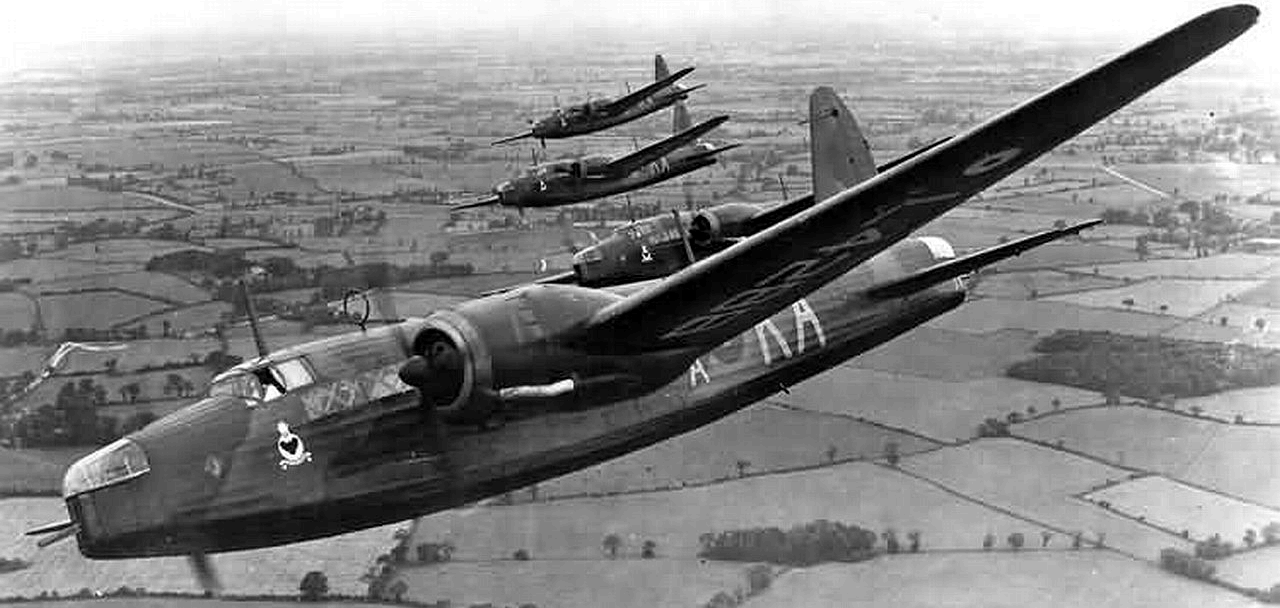
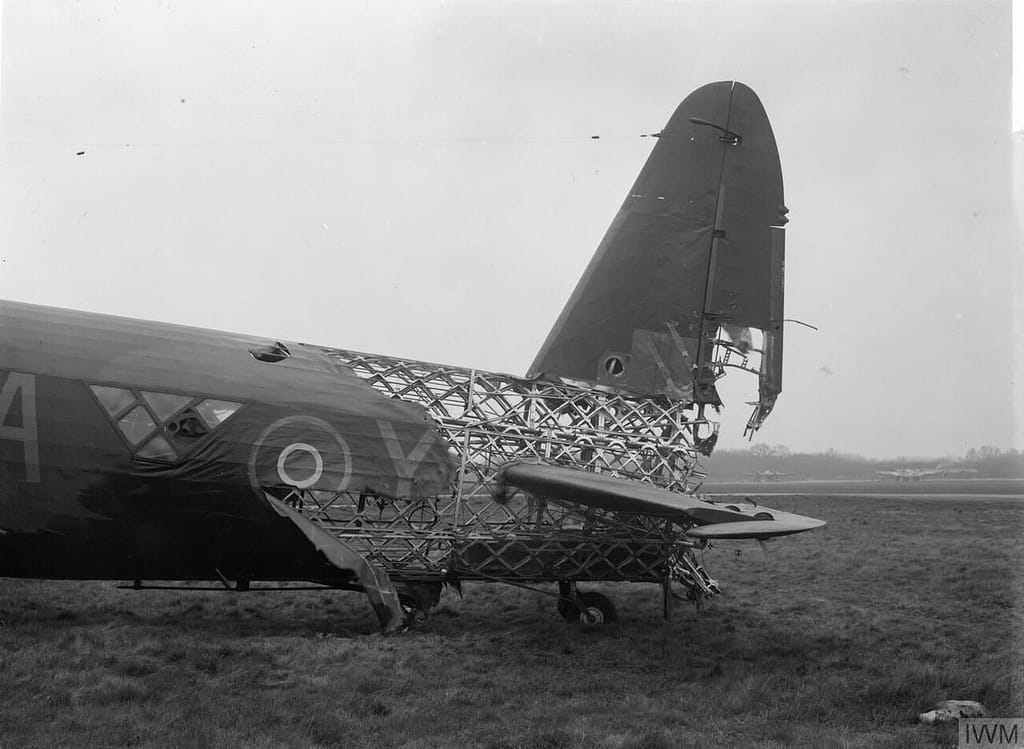
The photographs are almost hard to believe: Wellingtons limping home with whole sections of fuselage burned or shot away, the fabric skin hanging in ribbons and the aircraft’s metal skeleton showing through like the bones of a fish. And still they flew. That, more than any bomb tonnage, is why crews loved the “Wimpy.”
The Vickers Wellington was Britain’s most important bomber in the first years of the Second World War, and its secret was not speed or bombload but the strange, brilliant way it was built.
Kurzinfo
- Flugzeug: Vickers Wellington (“Wimpy”)
- Designer: Barnes Wallis (structure) with Rex Pierson (layout)
- Erster Flug: 1936; into Bomber Command service 1938
- Gebaut: more than 11,400 — the most-produced British bomber
- Der Trick: a geodetic “basket-weave” airframe that shrugged off battle damage
- Crew: up to six; bombload ~4,500 lb
- Later life: Coastal Command U-boat hunter, trainer, minesweeper; retired 1953
A basket woven from metal
Most aircraft of the 1930s were built like a box: a rigid frame carrying a skin. Barnes Wallis, fresh from designing the R.100 airship, had a different idea. He spun the Wellington’s fuselage and wings out of a lattice of light-alloy strips — a geodetic “basket-weave” in which every member shared the load with its neighbours. The result was light, roomy inside, and astonishingly tough.
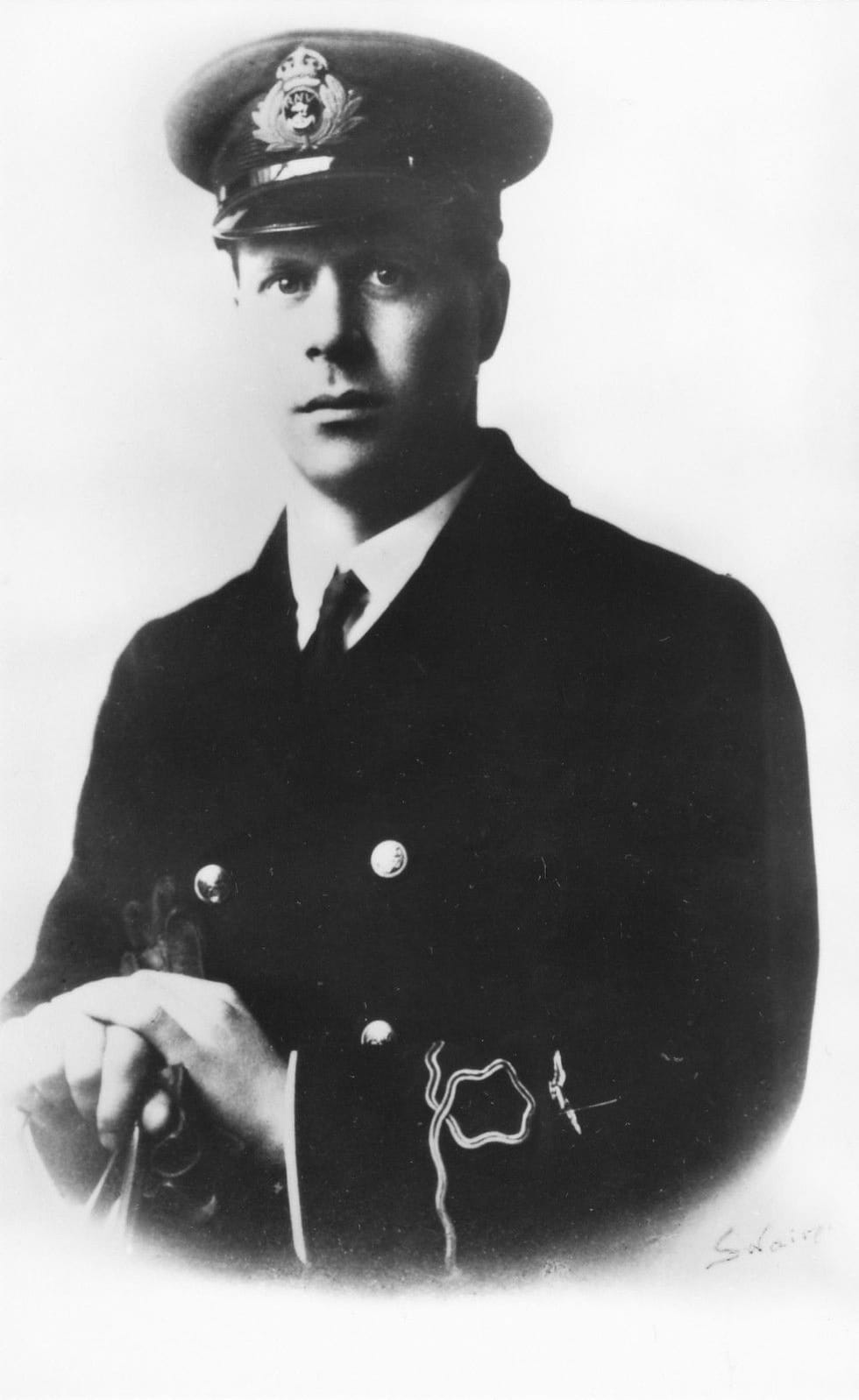
Chief designer Rex Pierson laid out the aircraft; Wallis wove its bones. First flown in 1936 and in Bomber Command service by 1938, the Wellington went on to be built in greater numbers than any other British bomber — more than 11,400 of them.
Damage it could not care less about
The pay-off came over Germany. When cannon shells or flak tore a hole in a conventional bomber, they could sever a load path and the airframe would fail. The Wellington’s lattice simply routed the stress around the wound. Crews brought aircraft home with rear turrets shot away and huge patches of skin gone — damage that would have killed almost any other bomber.
The toughness invited its own kind of heroism. On the night of 7 July 1941, a New Zealand sergeant named James Ward climbed out onto the wing of his burning Wellington in flight, kicking holds in the fabric, to smother an engine fire with a canvas cover. He got it out, the crew got home, and Ward was awarded the Victoria Cross. You could only try something that mad on an aircraft you trusted absolutely.
From daylight disaster to night workhorse
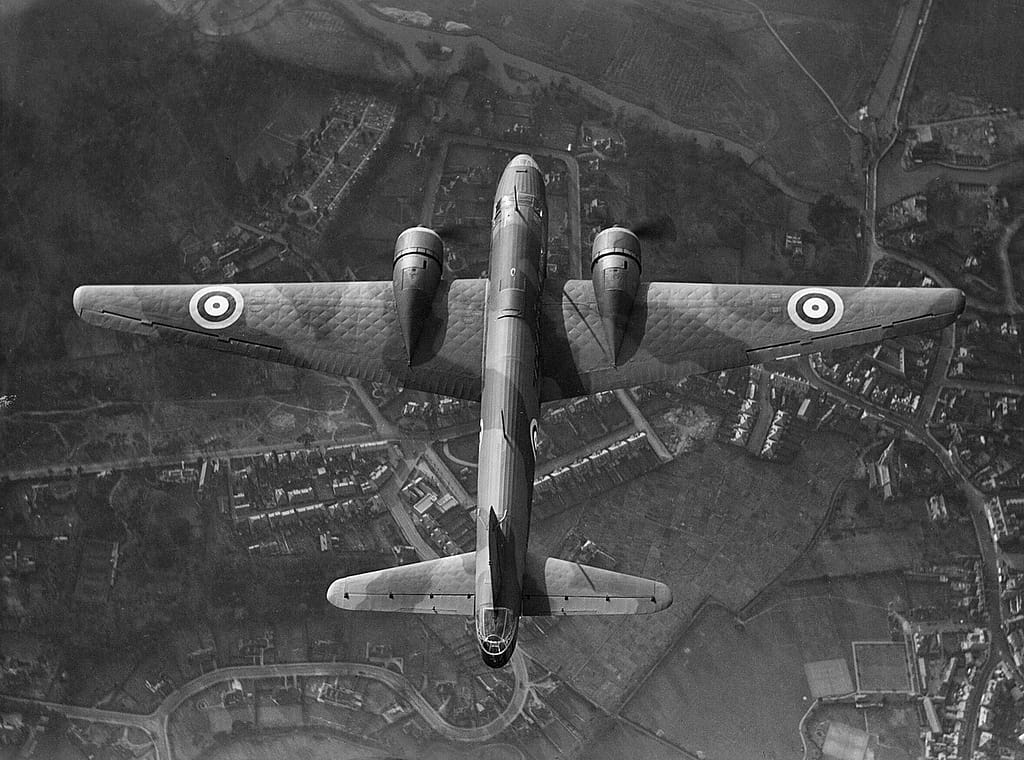
The Wellington also taught the RAF a hard lesson. On 18 December 1939, a formation sent to attack shipping off the Heligoland Bight was mauled by German fighters, and roughly half never came home. The dream that “the bomber will always get through” in daylight died over the North Sea, and Bomber Command turned to the cover of darkness. Through 1940 to 1942 the Wellington was the backbone of that night offensive; nearly 600 of them flew in the first 1,000-bomber raid on Cologne in May 1942.
The jobs nobody remembers
By late 1943 the four-engined Lancaster had taken over the bombing of Germany, and the Wellington flew its last Bomber Command raid. But the “Wimpy” refused to retire. It hunted U-boats for Coastal Command, lit by the Leigh Light; it flew as a transport and a trainer; and in one of the war’s stranger machines, a Wellington fitted with a huge magnetic ring flew low over the sea to detonate enemy mines. It stayed in RAF service until 1953 — seventeen years after its first flight.
Its designer, meanwhile, had already moved on to a bigger idea.
That thought became the bouncing bomb of the Dam Busters raid, and later the Tallboy and Grand Slam “earthquake” bombs. But it began with a bomber woven like a basket — the plane that kept flying when it had every reason to fall.
Sources: Barnes Wallis Foundation, The Collector, Brooklands Museum, Imperial War Museums.

0 Kommentare