
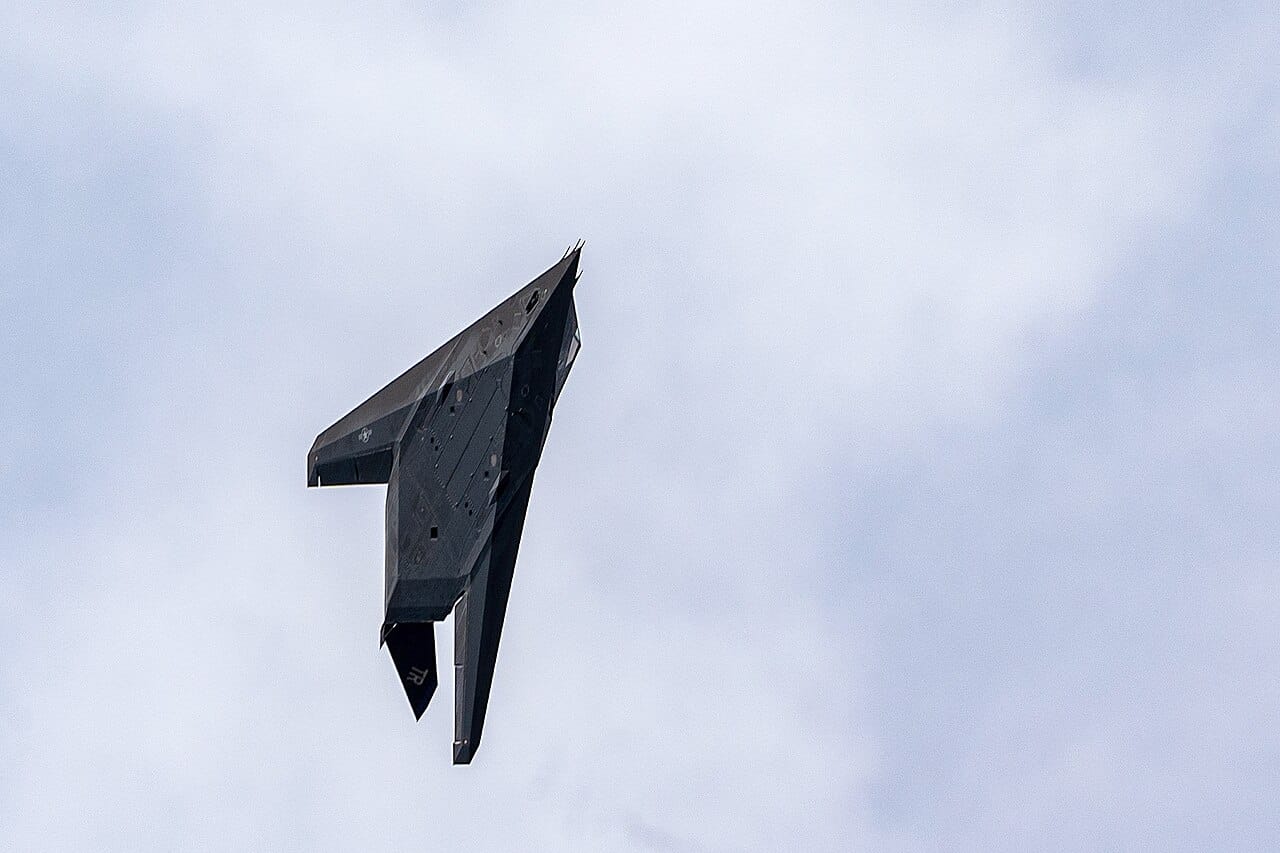
Retired jets are supposed to sit quietly in a desert, gathering dust and pigeons. Somebody forgot to tell the Nighthawk. Eighteen years after the US Air Force officially waved goodbye, a dry-as-toast government contracting notice has just outed one of the fleet's stranger habits: it still needs fresh explosives.
Not for bombs. For its tailhook. The Black Jet carries an emergency hook that fires out of its own belly with the help of small pyrotechnic charges, and those charges, like all explosives, have a shelf life. So the USAF is quietly shopping for new ones.
It is the most 2026 aviation story imaginable: a stealth attack aircraft that was declared dead before the iPhone existed, still flying, still eating munitions, still refusing to take the hint.
Kurzinfo
| Flugzeug | Lockheed F-117 Nighthawk (single-seat, twin-engine, subsonic stealth attack jet) |
| Rolle | First operational stealth combat aircraft; now aggressor, cruise-missile surrogate and test platform |
| Im Ruhestand | Officially 2008, on paper |
| Immer noch im Flug | Yes, a small pocket fleet projected through at least 2034 |
| Operator/base | US Air Force, Tonopah Test Range Airport, Nevada |
| The news | A contracting notice orders fresh explosive charges for the jet's emergency tailhook |
The retired jet that keeps buying explosives
The story, broken by The War Zone, starts with paperwork. Earlier in August 2026 the Air Force posted extra detail on a planned sole-source contract for CAD/PAD hardware, the cartridge-actuated and propellant-actuated devices, to support the F-117 fleet. CAD/PADs are the little explosive and pyrotechnic components that make dramatic things happen fast: firing ejection seats, blasting canopies clear, and, in this case, deploying a tailhook.
Here is the clever bit. On an ordinary fighter, the emergency tailhook just bolts on under the tail. On a stealth jet, a hook dangling in the breeze wrecks the whole point, the radar signature. So Lockheed buried the Nighthawk's hook inside a compartment behind a flush, fixed panel. When a pilot needs to grab the arresting cable on a runway, explosive charges blow that panel off, the hook drops, and the jet screeches to a halt. Afterwards the whole thing has to be reset by hand on the ground. Elegant, brutal, and very much still in the maintenance budget.
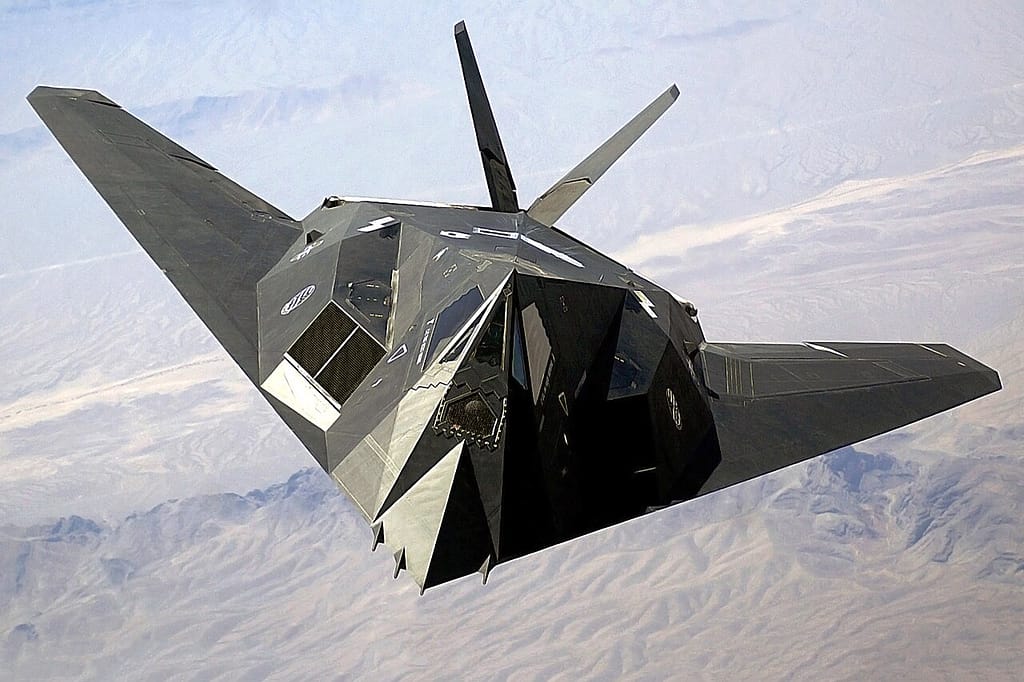
Which raises the obvious question: why is a retired aircraft still in the maintenance budget at all? Because it never really left. Since 2008 a handful of Nighthawks have flown from the secretive Tonopah Test Range in Nevada, earning their keep as red-air aggressors, as stand-ins for stealthy cruise missiles, and as flying test platforms whose radar and infrared signatures are so thoroughly mapped they make a perfect control experiment. The Air Force now plans to keep them going through at least 2034.
Keeping them airworthy is a logistical circus. The service even certified the brand-new KC-46 Pegasus tanker, first delivered in 2019, a decade after the F-117 supposedly bowed out, to refuel the old stealth jet in flight. Somewhere in the Nevada desert there is a boutique maintenance shop babysitting subsystems and radar-absorbent skins that most of the Air Force forgot existed.
A close-up look at the Nighthawk's hidden emergency tailhook.
One myth worth killing while we are here: the F is a lie. The F-117 is single-seat and twin-engine, but it is subsonic, carries no afterburners, and never fought another aircraft. It is an attack jet, a precision bomb truck wearing a fighter's badge, a bit of Cold War misdirection that stuck. Nearly two decades after its funeral, it is still dropping surprises. This one just happens to be packed with explosives.
Sources: The War Zone, Army Recognition, Wikipedia (Lockheed F-117 Nighthawk)
0 Kommentare