
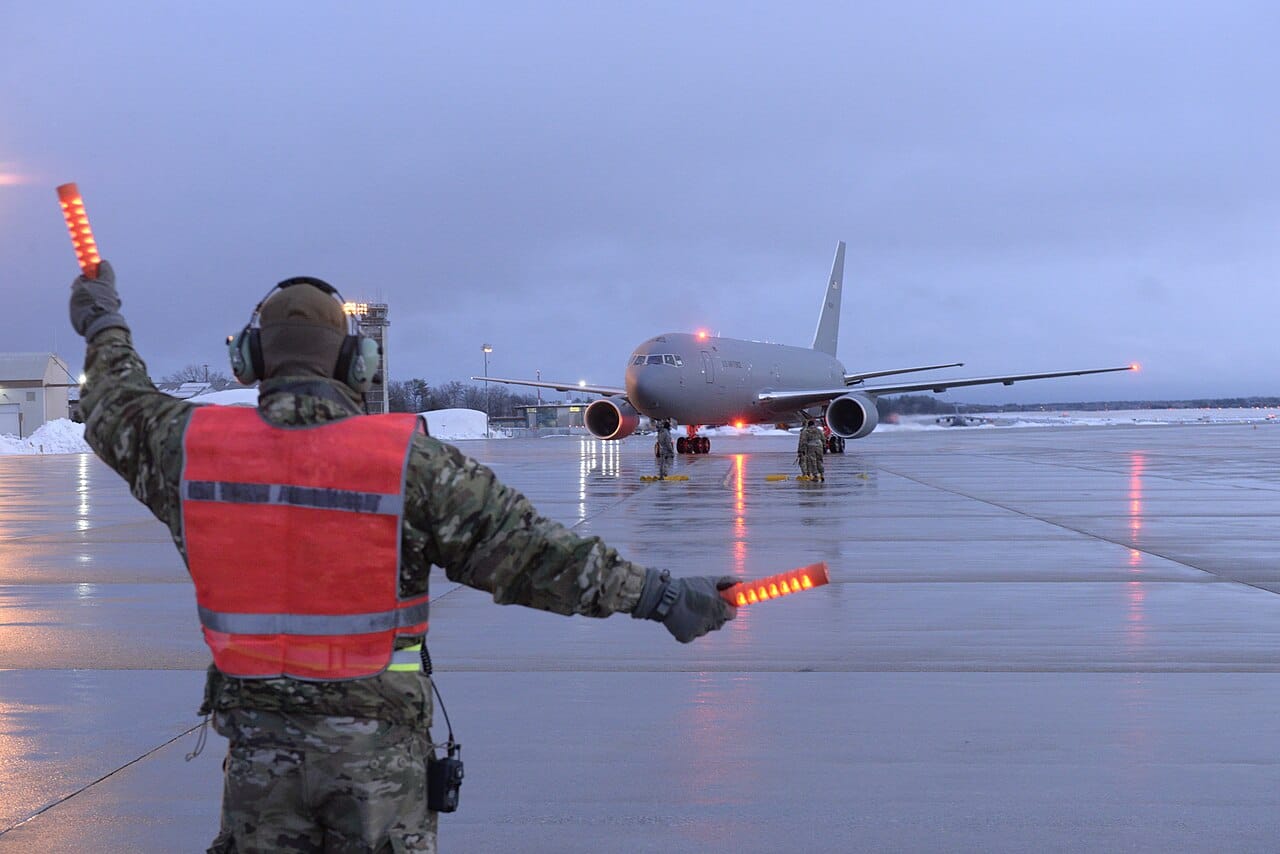
Qatar is about to stop borrowing other people’s gas stations. On Aug. 20, 2026, the US State Department signed off on a possible $4.5 billion sale of four Boeing KC-46A Pegasus tankers to the Qatar Emiri Air Force, a deal that would let the small, cash-rich Gulf state keep its fast-growing fighter fleet airborne without leaning on allied aircraft.
It is the kind of purchase that says a lot about ambition. Qatar already flies a fighter force that bigger air arms would envy: American F-15QA Eagles, French Rafales and European Typhoons. What it has never had is a way to top them off in mid-air on its own. Four Pegasus tankers would fix that.
Quick Facts: Qatar KC-46 Tanker Deal
- Genehmigt: US State Department notification, Aug. 20, 2026
- Flugzeug: Four Boeing KC-46A Pegasus
- Value: Up to $4.5 billion (maximum estimate)
- Motoren: Eight Pratt & Whitney PW4062 (four installed, four spare)
- Status: Cleared for Congressional review; no contract signed yet
- Would make Qatar: The fourth KC-46 operator, after the USA, Israel and Japan
What Washington actually approved
The package the State Department cleared is a maximum shopping list, not a signed cheque. Qatar requested up to four KC-46As and eight Pratt & Whitney PW4062 engines, four of them installed and four as spares. Bolted on top are 10 AN/ALR-69A radar warning receivers, Guardian laser transmitters for the Large Aircraft Infrared Countermeasure system, missile-warning sensors, secure communications, training gear and the usual mountain of spares and support.
The $4.5 billion is the ceiling. Qatar has not signed anything, the final figure could come in lower, and the deal still has to survive the US Congressional review process before Doha and Washington can even sit down to negotiate. Boeing, Pratt & Whitney, RTX and Northrop Grumman would share the work.
Why a tanker changes Qatar’s reach
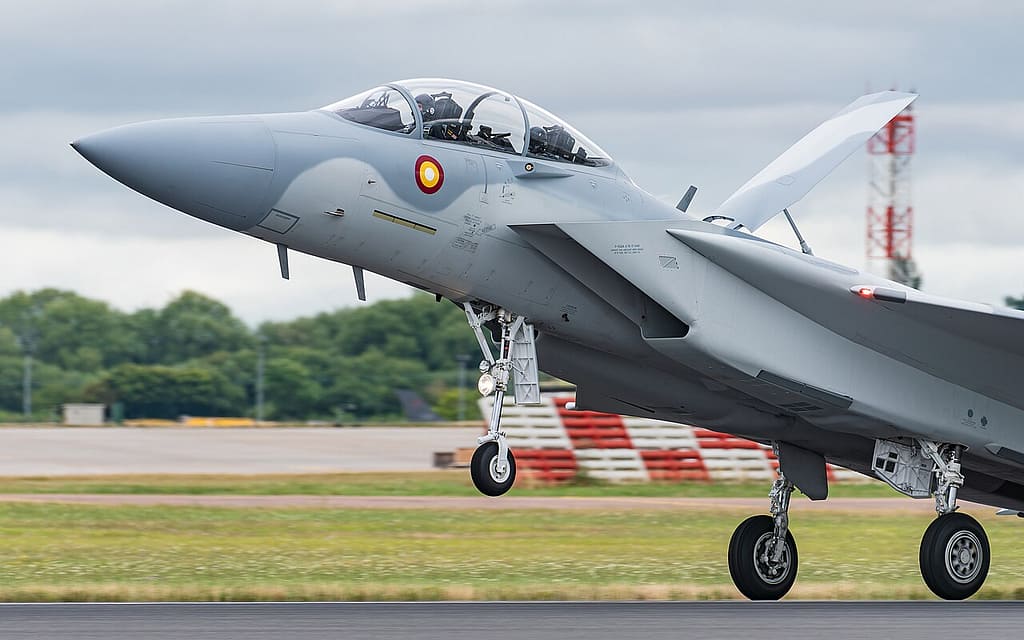
Boeing built the KC-46A from its 767 airliner, and its trump card is flexibility. The Pegasus can pass fuel through a fly-by-wire boom or through hose-and-drogue pods, which matters enormously for a mixed fleet. Qatar’s F-15QAs take fuel through a boom; its Rafales and Typhoons use probes for hose-and-drogue. One tanker type can feed all three.
It is not only about fighters, either. The KC-46 can also haul cargo, passengers and aeromedical patients, giving Qatar a long-range lift capability to sit alongside its Boeing C-17s and Lockheed Martin C-130Js. Doha had previously eyed the Airbus A330 tanker but never pulled the trigger; buying American Pegasus would put tanker support firmly under Qatari control instead of an ally’s.
Fourth in the world
If the deal goes through, Qatar would become only the fourth KC-46 operator on the planet, joining the US Air Force, Israel and Japan. That is rarefied company for a country smaller than Connecticut, and it fits a familiar pattern: Qatar keeps shopping like a superpower.
The State Department framed the sale as bolstering the security of a major non-NATO ally while insisting it would not alter the basic military balance of the region. The Pegasus has had a famously bumpy development, from its troubled remote vision system to its refueling boom. But for Qatar, a tanker of its own means its expensive fighters can finally stay up as long as the mission demands, no borrowing required.
Sources: US Department of State / DSCA notification, AeroTime, FlightGlobal, Bloomberg, Defense Daily.
0 Kommentare