
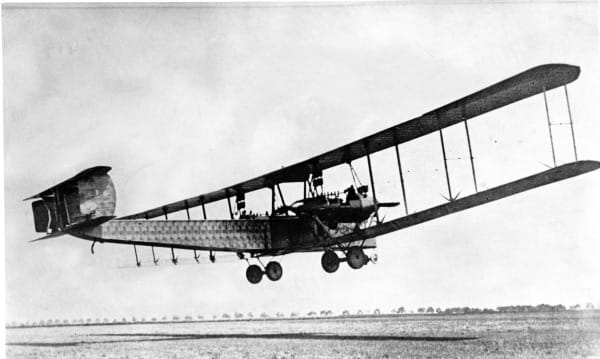
Before the Lancaster, before the B-17, before the very idea of a four-engined heavy bomber was settled doctrine, one already existed — and it was bombing London. The Zeppelin-Staaken R.VI, built from 1916, was a four-engined biplane with a wingspan of 42.2 metres (138 ft 5 in). That is within a metre or two of a Second World War Boeing B-29 Superfortress. A full generation early.
It was the flagship of Germany’s Riesenflugzeug — “giant aircraft” — programme, and the only R-plane built in any real numbers: eighteen in total. Constructed largely of wood and fabric, it needed an 18-wheel undercarriage to carry its own weight.
This is the story of the largest bomber ever to strike Britain — larger than anything the Luftwaffe would send over London in 1940 — and how a handful of them slipped across the Channel by moonlight and were never once shot down over England.
Kurzinfo
| Typ | Four-engined biplane heavy bomber (Riesenflugzeug) |
| Spannweite | 42.2 m (138 ft 5 in) — near-B-29 scale |
| Motoren | 4 × ~260 hp, in two tandem push-pull nacelles (tractor and pusher) |
| Crew | 7 (up to ~9), including in-flight mechanics in the nacelles |
| Max bomb load | 2,000 kg (4,409 lb); carried the 1,000 kg PuW bomb |
| Anzahl gebaut | 18 |
A giant built by an airship company
The name Zeppelin means airships. It is largely forgotten that the same firm built the largest and most sophisticated aeroplanes to reach production in the First World War. When a planned transatlantic aircraft was cancelled in 1914, the Zeppelin concern put its engineers to work on multi-engined bombers, and later built a factory at Staaken, near Berlin.
The engineering was deliberate. Where earlier R-planes buried their engines in the fuselage and drove the propellers through troublesome gearboxes, the R.VI dispensed with all of it. Four engines were mounted in two tandem nacelles between the wings — one driving a tractor propeller at the front, one a pusher at the rear. Four engines, four direct-drive propellers, no gearboxes. The specification demanded that engines be serviceable in flight, so a mechanic rode in an open niche in each nacelle, and could climb a ladder to a gun position on the upper wing.
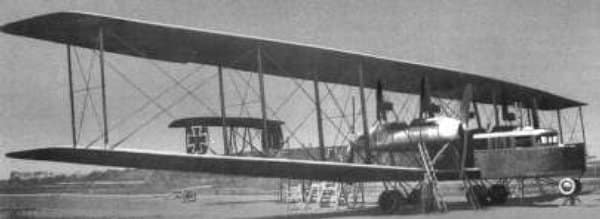
For 1917 this was extraordinary. The R.VI had an enclosed, glazed cabin for the pilots and radio operator, engine self-starters and a wireless transceiver. It was, alongside the Russian Sikorsky Ilya Muromets, among the very first closed-cockpit military aircraft — a heated cabin over the Channel while single-seat fighter pilots froze in the open.
London by moonlight
From September 1917 the R.VIs based near Ghent turned west. They joined the same strategic bombing campaign against Britain that had begun with the Gotha raids on Folkestone and London — but the Giants were a different order of machine. Many raids credited at the time to the smaller Gothas were in fact the work of these giants.
Navigation was a clumsy affair, but it worked. Flying singly on moonlit nights, a crew would take off, request a directional bearing by wireless, then follow the River Thames to the target. The round trip to London and back — some 550 km — took about seven hours. On the night of 16 February 1918 a Giant dropped the first 1,000 kg bomb ever to fall on Britain, destroying a wing of the Royal Hospital Chelsea. The next night a single Giant scored a direct hit on St Pancras station.
The strategic results were, by any sober accounting, slight against the enormous resources these aircraft consumed. But the psychological effect was disproportionate. The raids tied down large numbers of British aircraft, guns and men, and helped forge the doctrine — “the bomber will always get through” — that would haunt British planning into the next war.
Never shot down over England
Here is the R.VI’s most remarkable statistic, and it deserves precision. No Giant was ever brought down over Great Britain by a fighter or by anti-aircraft fire, even though some were intercepted.
The caveat matters, and I will state it plainly. The Giants were not invulnerable everywhere. Over the Continent it was another matter: four R.VIs were shot down in combat over the course of the war, one of them by a Sopwith Camel over France in September 1918. So “unbeatable over Britain” is exact; “unbeatable” is not.
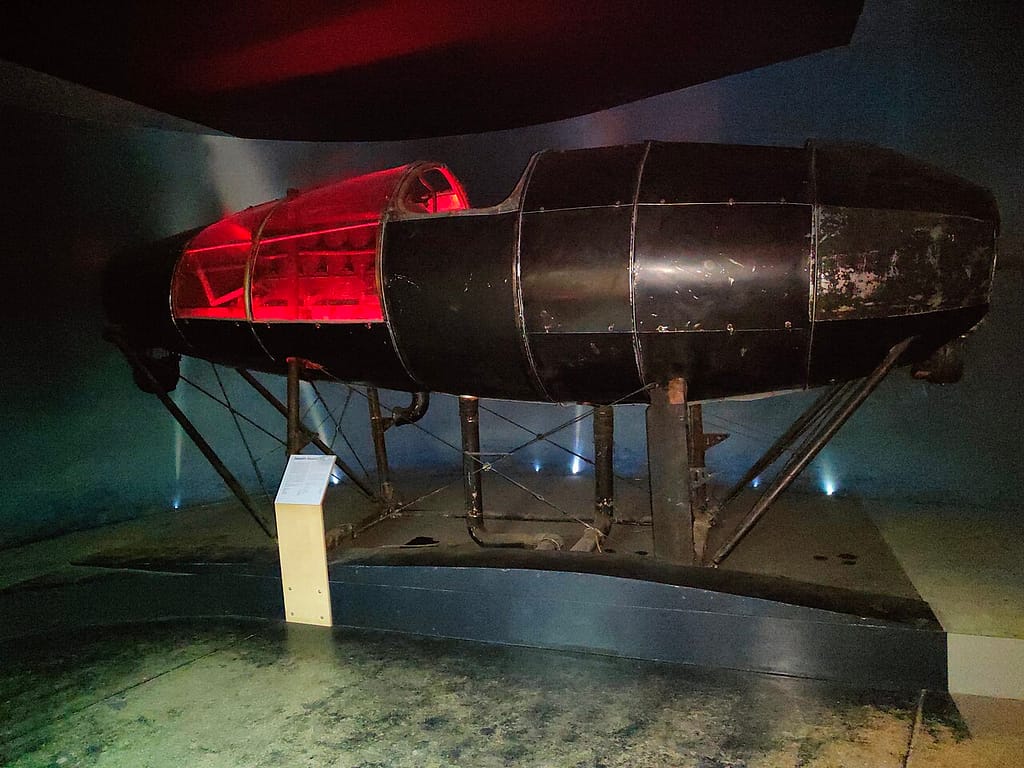
What killed the Giants was, overwhelmingly, the machines themselves and the dark. No fewer than eight of the eighteen built are known to have crashed for reasons other than enemy action — piloting an unassisted 25,000-lb aeroplane by night was brutally demanding work. Very little of any of them survives today; a few engine nacelles in a Kraków museum are among the largest surviving pieces of the biggest bomber to raid Britain.
Sources: Wikipedia (Zeppelin-Staaken R.VI; Riesenflugzeug); HistoryNet / Aviation History; firstworldwar.com; Haddow & Grosz, The German Giants (Putnam).

0 Kommentare