
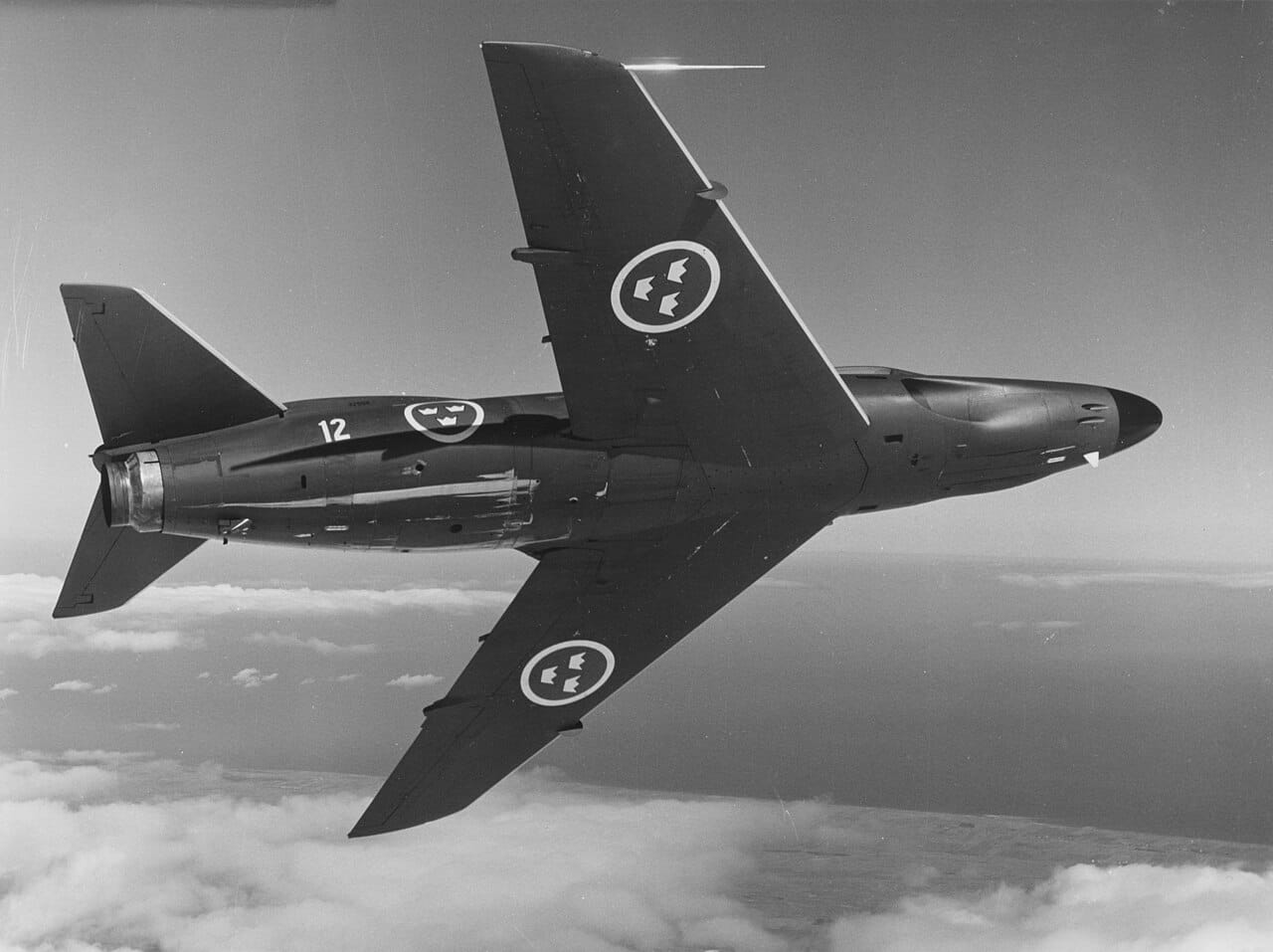
Sweden gave Saab a requirement in the late 1940s that reads like a dare: build an aircraft that can strike anywhere along two thousand kilometres of coastline within one hour of leaving a central base, in any weather, at night, and operate from a stretch of forest road after the real airfields have been bombed.
The answer was the Saab 32 Lansen. It broke the sound barrier in 1953, served for forty-two years, and almost nobody outside Sweden has heard of it.
Kurzinfo
| Typ | Two-seat transonic all-weather attack, fighter and reconnaissance aircraft |
| Hersteller | Saab AB, Linköping |
| Erster Flug | 3 November 1952, test pilot Bengt Olow |
| Introduced | 1956 |
| Im Ruhestand | 1997 (J 32E electronic warfare and target tug) |
| Anzahl gebaut | 450–455 (sources differ); delivered 1955–1960 |
| Crew | 2 (pilot and navigator) |
| Kraftwerk | 1 × Svenska Flygmotor RM6A afterburning turbojet, 65.3 kN — a licence-built Rolls-Royce Avon |
| Wing sweep | 35 degrees |
| Armament (J 32B) | 4 × 30 mm ADEN cannon; Rb 24 Sidewinder; Rb 04 anti-ship missile on the A 32A |
| Betreiber | Swedish Air Force only — never exported |
One Hour to the Coast
The requirement drove everything. Sweden is long, its coastline is enormous, and Swedish planners assumed an invasion would come from the sea with very little warning. An aircraft that could only fight in daylight and good weather was useless for a country where both are in short supply for much of the year.
So the Lansen became the Swedish Air Force’s first two-seat jet and its first aircraft with a built-in search radar — the two things that made genuine all-weather, night operation possible. A navigator working a radar in the back seat was not a luxury; it was the entire point.
On 25 October 1953, less than a year after its first flight, a Lansen exceeded Mach 1 in a shallow dive, reaching at least Mach 1.12 — the first Swedish aircraft to break the sound barrier.
Roads Instead of Runways
The other requirement shaping the aircraft was Bas 60, the Swedish doctrine of dispersed basing. Sweden assumed its main airbases would be cratered in the opening hours of a war and built a network of small wartime bases, including reinforced straight sections of public highway with taxiways running into the trees.

That is why the Lansen is built the way it is: rugged, simple to service, and designed to be turned round by conscript ground crews working outdoors with what they could carry. Elegance was not the objective.
What It Was Like to Fly
Two Lansens remain airworthy with the Swedish Air Force Historic Flight, and their display pilot has described the aircraft in unusual detail.
And on what happens when you push it past its comfort zone, which is the best description of a transonic 1950s airframe you will read anywhere.
The Cost, Which Should Not Be Softened
The Lansen served for four decades, and it killed a great many of the men who flew it.
Accidents destroyed roughly a third of all Lansens built over twenty-five years of service, killing about a hundred aircrew and seven civilians on the ground at Vikbo. The causes were technical faults, an aircraft that entered service before it was fully ready, and inadequate training for exactly the night and bad-weather flying it had been designed to make possible.

That is a brutal ledger, and it belongs in any honest account of the type. It also belongs in context: this was the era in which every air force in the world was learning to operate high-performance jets at night, and most of them were paying similarly.
Why You Have Never Heard of It
The A 32A attack variant retired in 1978, replaced by the Viggen. The J 32B fighters went in the early 1970s. The S 32C reconnaissance aircraft flew Baltic missions until 1978. The J 32E electronic warfare and target-tug aircraft soldiered on until 1997 — forty-two years after the first delivery.
And that is the whole answer to the obscurity question: the Lansen was never exported. The Tunnan went to Austria. The Draken went to Denmark, Finland and Austria. The Viggen and the Gripen became internationally famous. The Lansen served one air force, in one country, and when it retired it simply stopped existing outside a handful of museums.
A final note on attribution, because it is widely got wrong: the Lansen was not designed by Erik Bratt. Bratt led the Draken and the Viggen. The Lansen’s key figures were Saab project manager Frid Wänström and the German aerodynamicist Hermann Behrbohm. The confusion probably comes from a Saab 91 Safir that was fitted with scaled Lansen wings as a swept-wing testbed, and Bratt flew the Safir’s maiden flight.
Sources: Flygvapenmuseum; Saab AB 70th anniversary material; Vintage Aviation News interview with Maj. Alf Ingesson Thor; Gunston & Gilchrist. Production totals and some Bas 60 details differ between sources and are given as ranges.
0 Kommentare