
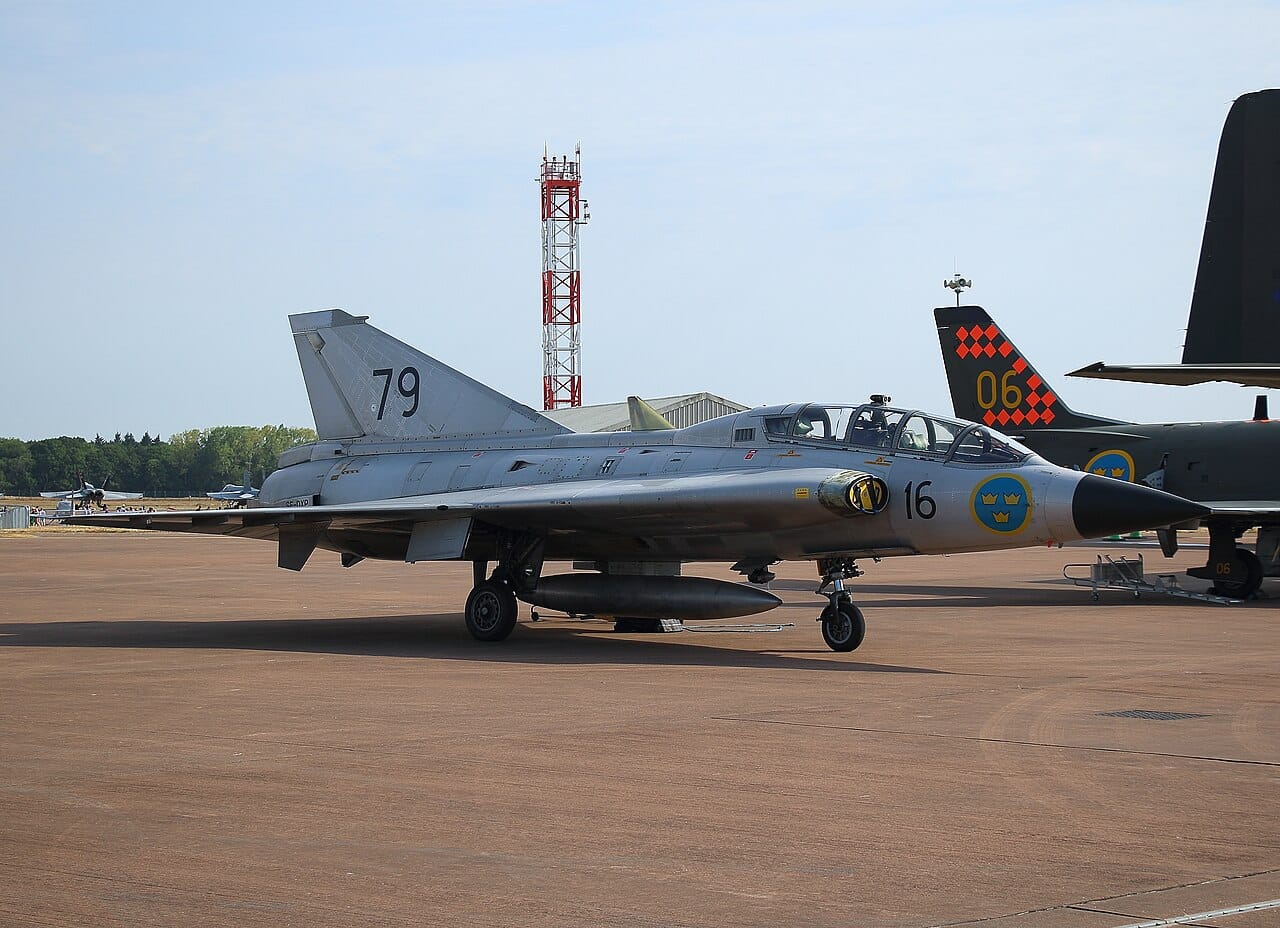
In the early 1950s, a neutral country of seven million people set out to build a supersonic interceptor that could hide in the forest, launch from a public road, and climb fast enough to catch a Soviet nuclear bomber over the Baltic. The result looked like nothing else in the sky.
The Saab 35 Draken — Swedish for “kite,” though everyone heard “dragon” — wore a wing shape no one had flown before: the double delta. It made the Draken one of the most distinctive fighters of the Cold War, and one of the most quietly brilliant.
QUICK FACTS
| Type | Single-seat supersonic interceptor |
| Origin | Sweden (Saab), chief designer Erik Bratt |
| First flight | 25 October 1955 (prototype) |
| Wing | Double delta — 80° inner, 60° outer |
| Top speed | Mach 2 (from 1960) |
| Trick | First aircraft known to fly the “Cobra” manoeuvre |
| Operators | Sweden, Finland, Denmark, Austria (last to retire, 2005) |
A wing nobody had flown
Sweden’s problem in the late 1940s was geography and arithmetic. It needed a jet that could intercept high-flying Soviet bombers, yet also scatter across the country and fly from ordinary roads if its airfields were bombed. Erik Bratt’s team gambled on a radical answer: two deltas in one. A steeply swept inner wing carried fuel, landing gear, intakes and guns; a shallower outer wing gave lift for short, slow field work — without spoiling supersonic speed.
It was untested, so Saab built a sub-scale flying model, the little Saab 210 “Lilldraken,” which first flew in 1952 and proved the shape worked. Three years later, on 25 October 1955, the full-size Draken took to the air. Within months it was supersonic in level flight; by 1960 it was doing Mach 2, the first Western-European-designed aircraft to get there.

The engineering behind the double-delta dragon.
Built for a war fought from roads
The Draken was designed around Sweden’s Bas dispersal doctrine: no fighter would sit on one big, targetable airbase. Instead, aircraft hid in the countryside and operated from reinforced stretches of highway, refuelled and rearmed in under ten minutes by teams of teenage conscripts. It was a whole air force built to survive a first strike and keep flying.
He had reason to be surprised. The Draken went through generation after generation of upgrades — interceptor, fighter, reconnaissance, two-seat trainer — and simply refused to become obsolete. Sweden flew its last examples until 1998; the final Swedish flight came in January 1999.

The superstall and the Cobra
That double delta had a dark side. At low speed the wing could drop into a stable, high-nose “superstall” that trapped unwary pilots — but a skilled one could use it deliberately, hauling the nose sky-high and bleeding off speed in a heartbeat. Decades before a Sukhoi did it at Paris, the Draken was flying what the world would later call the Cobra.
A short history of Sweden’s Cold War dragon.
A dragon that outlived the Cold War
The Draken flew far beyond Sweden. Finland assembled some under licence; Denmark and Austria bought them; and the little Austrian fleet kept flying until 2005 — half a century after the prototype first left the ground. A handful even served American test pilots in the Mojave into 2009.
For a country that refused to join either Cold War bloc, the Draken was proof that neutrality did not mean second-rate. Sweden had looked at the fastest, most expensive jets the superpowers could build — and answered with a home-grown dragon that could fly from a forest road and still catch anything in the sky.
The Draken in the air — the double delta at work.
Sources: Saab; Swedish Air Force histories; Hush-Kit pilot interviews; Vintage Aviation News.
0 Comments