
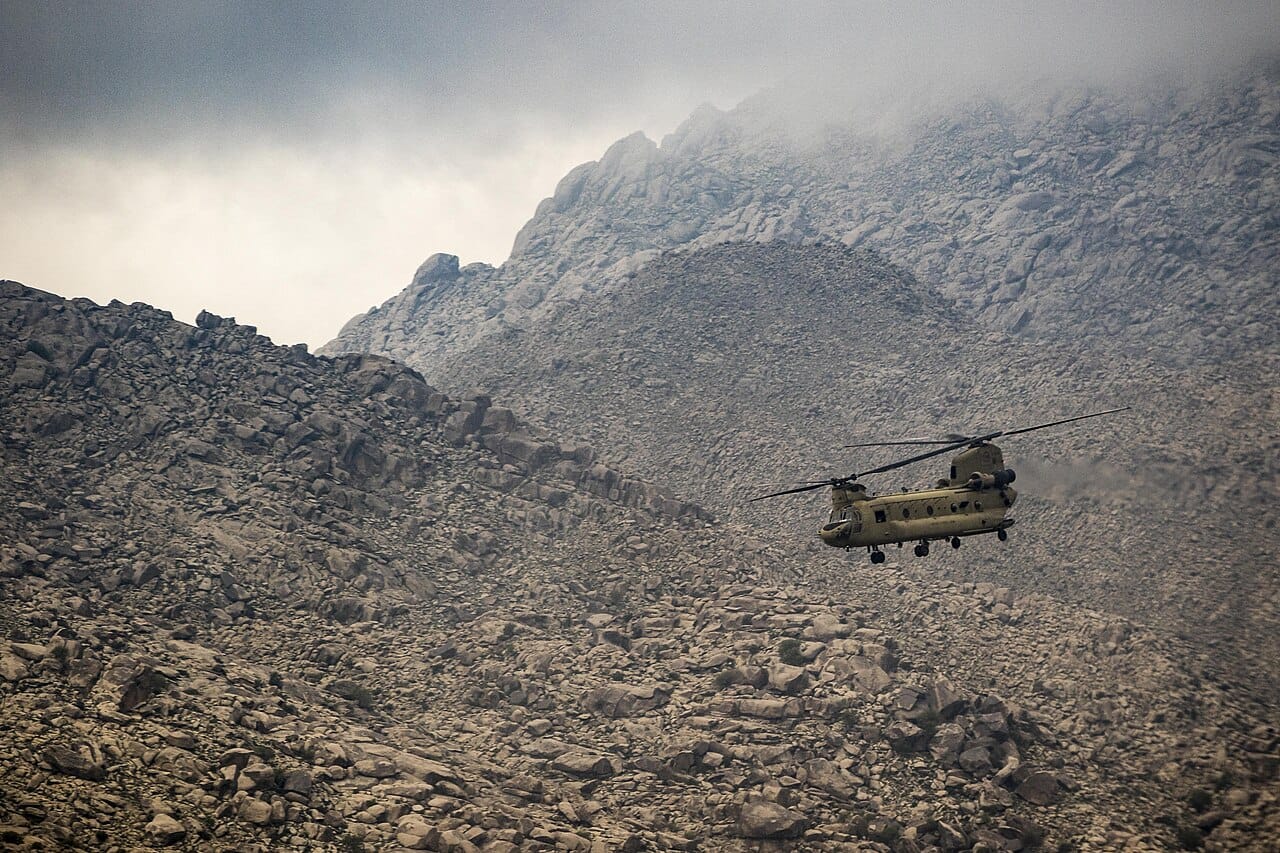
The Boeing CH-47 Chinook first flew on 21 September 1961. John F. Kennedy was president. The Berlin Wall was two months old.
It is still in production. It is still in front-line service with the US Army, the RAF and a dozen other air forces. Germany chose it in 2022 to replace its heavy-lift fleet. The US Army expects to fly it past 2060, which would be a century after first flight.
Nothing has replaced it because nothing has beaten the layout.
Kurzinfo
| Typ | Tandem-rotor heavy-lift transport helicopter |
| Hersteller | Boeing (originally Vertol, then Boeing Vertol) |
| Erster Flug | 21 September 1961 (YHC-1B) |
| Entered service | 1962 |
| Anzahl gebaut | Over 1,200 (Boeing, 2012); still in production |
| Crew / capacity | 3 crew; 33–55 troops, or 24 stretchers and 3 attendants |
| Powerplant (CH-47F) | 2 × Lycoming T55-GA-714A turboshafts, 4,733 shp each |
| Rotoren | 2 × 60 ft (18 m), counter-rotating, no tail rotor |
| Max speed | 170 kn (310 km/h) |
| Max gross weight | 54,000 lb (24,494 kg) |
| Nutzlast | 24,000 lb (10,886 kg) on triple external hooks |
Why Two Rotors, and Why It Still Wins
A conventional helicopter spends power on its tail rotor purely to stop itself spinning. That power produces no lift at all. A tandem-rotor machine uses two counter-rotating main rotors that cancel each other’s torque, so every horsepower goes into lifting.
It also has an enormous centre-of-gravity range, because the load sits between two lift points rather than under one. You can load a Chinook carelessly and it will still fly, which matters when the loading is being done in the dark under fire.
The Chinook came from a design the Army initially rejected. The Vertol Model 107 was judged too heavy for assault work and too light for transport; it went to the Marines as the CH-46 Sea Knight, and the Army took the enlarged Model 114 instead. The two aircraft look alike and are constantly confused. The Chinook is the bigger one.
Vietnam, and the Gunship Nobody Remembers
At its peak the US Army had twenty-one Chinook companies in Vietnam. Of nearly 750 aircraft in American and South Vietnamese hands, about 200 were lost.
Their most valuable work was not carrying troops. Under the codename Pipe Smoke, Chinooks recovered roughly 12,000 downed aircraft during the war, worth over $3.6 billion — slinging wrecked Hueys out of jungle clearings and flying them back to be rebuilt.
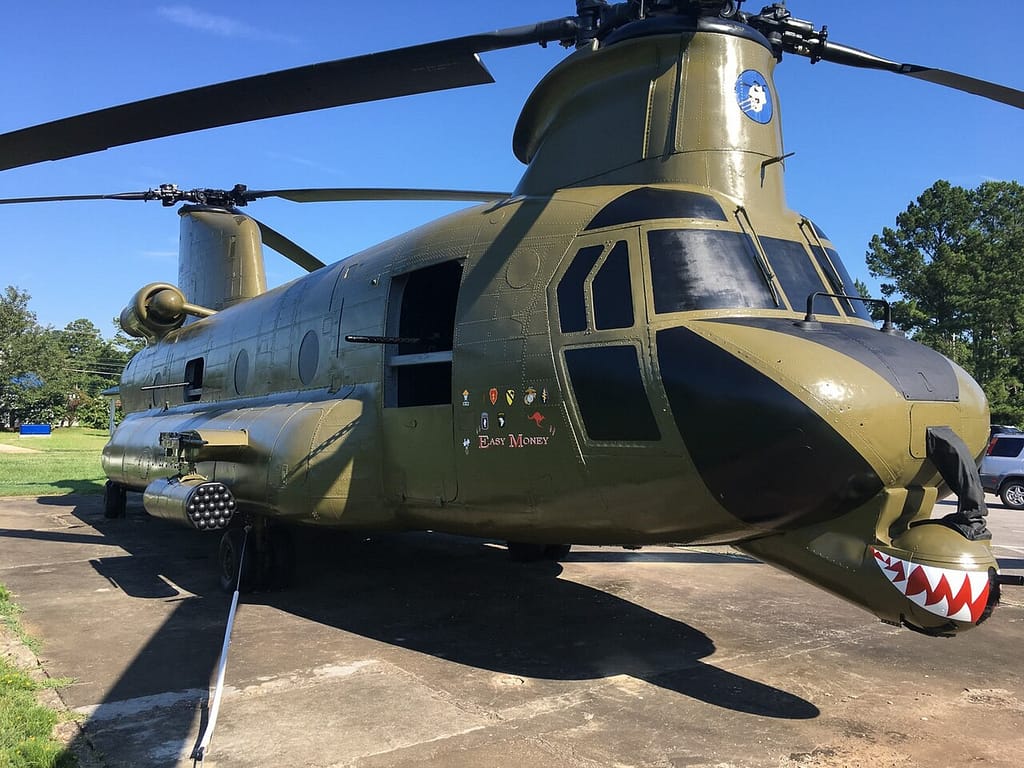
Then there was Guns A Go-Go. Four CH-47As were converted into gunships carrying two 20 mm cannon, a 40 mm grenade launcher in a nose turret, five machine guns and two rocket pods. Three deployed. One was lost in a taxiing collision; one was destroyed by mortars after being grounded by enemy fire; and one shot itself down when a retention pin worked loose and its own 20 mm cannon fired through the forward rotor.
Only “Easy Money” survives.
Bravo November
Five Chinooks sailed for the Falklands aboard the Atlantik-Förderband. One, ZA718, happened to be airborne on an air test when Exocets hit the ship on 25 May 1982. The other three burned with it.
ZA718 — Bravo November — spent the next eighteen days doing the work of four helicopters, flying every day but one, with no spares, no tools and no manuals, all of which had gone down with the ship. On one lift it carried 81 troops. Its normal capacity was 33.
Its Falklands career nearly ended before it began. On the Mount Kent operation the crew flew into a snowstorm at night with the radar altimeter reading zero, struck the surface of a creek, bounced off and kept flying. They had also jettisoned the cockpit door earlier, and flew the rest of the campaign without it.
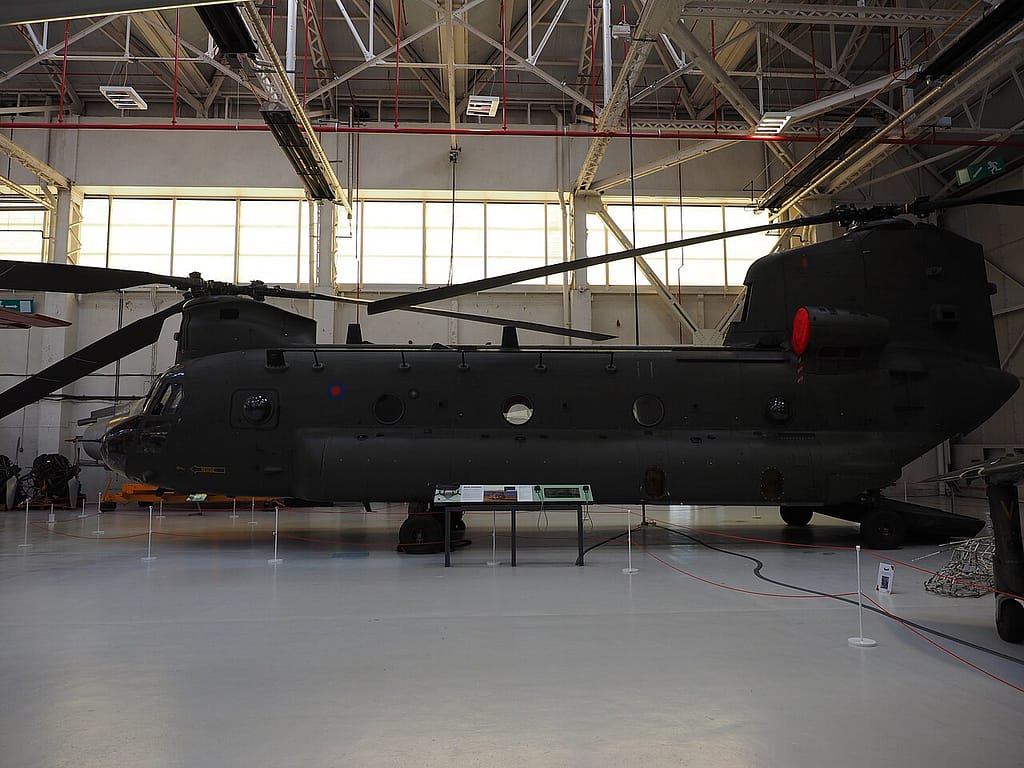
Bravo November went on to serve in Iraq and Afghanistan and became the most decorated airframe in the RAF. It is very widely reported that four different pilots won the Distinguished Flying Cross flying it. That is three, not four: Dick Langworthy in the Falklands, Steve Carr over the Al-Faw peninsula in 2003, and Ian Fortune in Helmand in January 2010. Research by the RAF Museum and the Air Historical Branch, with the pilot himself, established that the fourth award — to Craig Wilson in 2006 — was earned in a different Chinook. Both the museum and Wikipedia now say three.
Why Nothing Has Replaced It
Afghanistan proved the point in the hardest possible terms. At altitude and in heat, one Chinook could replace up to five UH-60 Black Hawks in the air assault role. Thin air punishes helicopters, and the machine with two big rotors and no power wasted on a tail rotor simply keeps working when others cannot.
The CH-47F Block II is pushing that further: 20 per cent more engine power, a 54,000 lb max weight, and hover performance targets at 6,000 feet and 95 degrees Fahrenheit so it can lift the Army’s new vehicles. Not everything worked — the Advanced Chinook Rotor Blades, inherited from the cancelled Comanche, were dropped by the Army over vibration and blade stall, a characterisation Boeing disputed.
Future Vertical Lift will start replacing Army rotorcraft in the mid-2030s, and it begins with medium lift. Heavy lift is not on the list. Sixty-five years after a tandem-rotor prototype first left the ground in Pennsylvania, nobody has come up with a better way to move ten tonnes to somewhere with no runway.
Sources: RAF Museum, “Bravo November”, Andrew Dennis, 21 May 2022; Boeing; U.S. Army aviation histories; National Archives imagery. Falklands lift totals differ slightly between the RAF Museum and other accounts.
0 Kommentare