
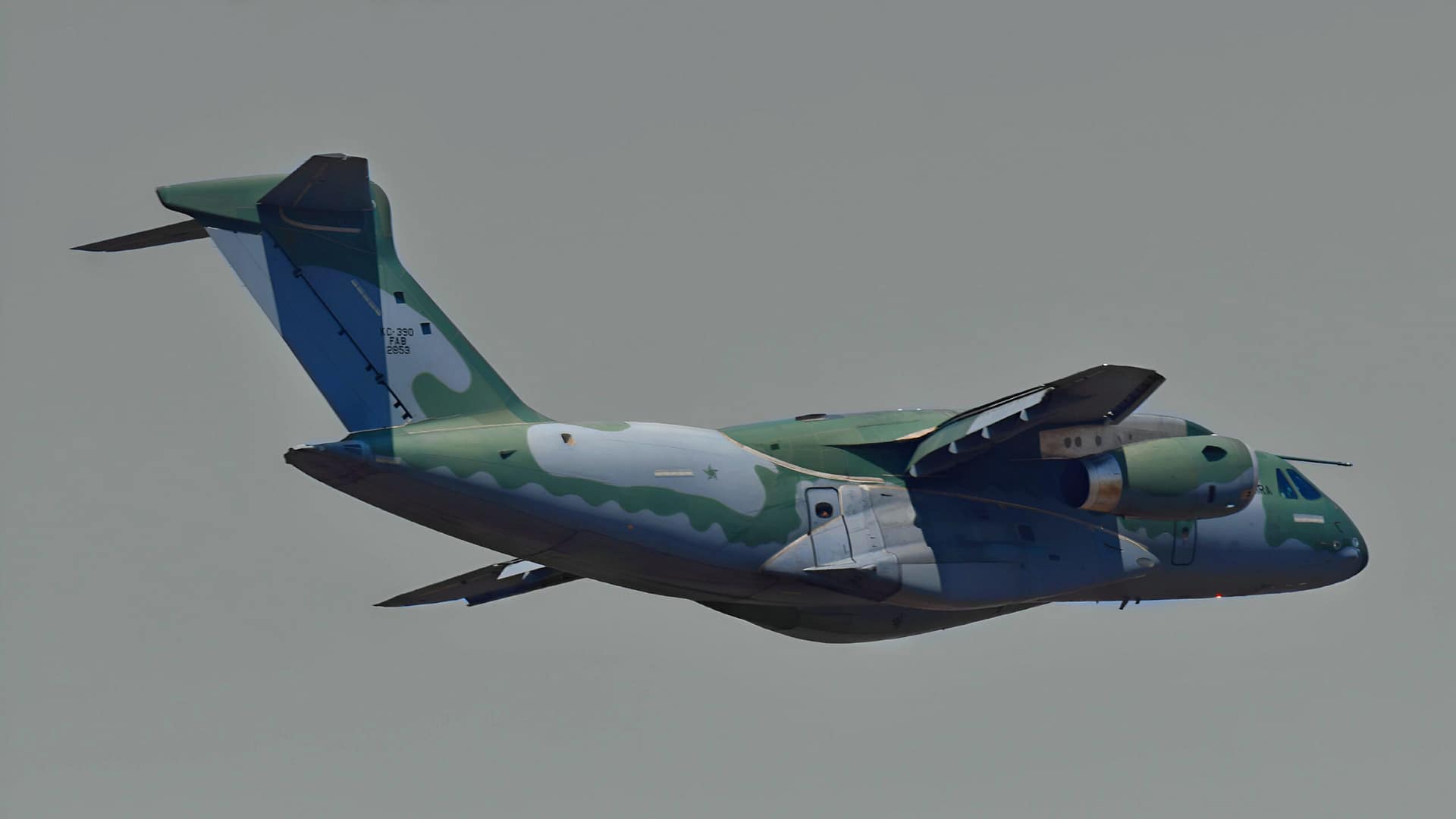
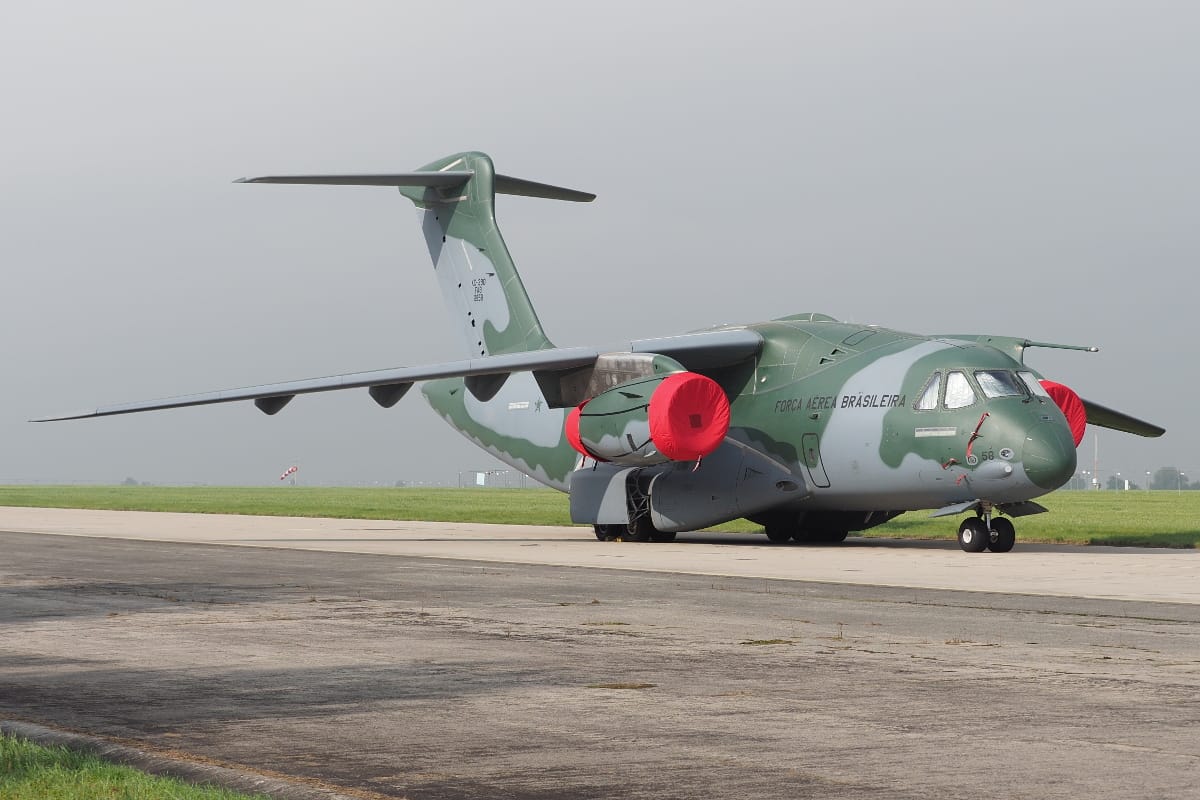
In February 2026, Embraer and Northrop Grumman signed a memorandum of understanding that formalised one of the most unlikely partnerships in modern defence aviation. The Brazilian airframer that built the KC-390 Millennium — a twin-jet tactical transport that has quietly become NATO's fastest-selling new airlifter — is teaming with one of America's largest defence contractors to pitch an upgraded version to the United States Air Force.
If it works, a Brazilian-designed aircraft will compete for what may be the most lucrative military transport contract of the next decade. And the partnership reveals something bigger: the global defence market is no longer a club where only American and European primes get to play.
What the KC-390 Actually Is
The C-390 Millennium is Embraer's first military jet transport. Powered by two International Aero Engines V2500 turbofans — the same engine family that powers the Airbus A320 — it cruises at 470 knots with a maximum payload of 26 tonnes. It can carry 80 troops, 64 paratroopers, or up to seven NATO-standard 463L cargo pallets. A UH-60 Black Hawk helicopter fits inside with the rotors folded.
The "K" in KC-390 denotes the tanker variant, which adds underwing refuelling pods capable of transferring 400 US gallons per minute. The aircraft is designed to operate from semi-prepared strips — gravel, packed earth, even grass — giving it the kind of austere-field capability that Western militaries are increasingly demanding for distributed operations in the Pacific and Eastern Europe.
In virtually every performance metric, the KC-390 outperforms the Lockheed Martin C-130J Super Hercules that it is designed to complement or replace. It flies faster, climbs higher, and carries more payload over longer distances. And because it uses commercial-derivative engines and modern fly-by-wire flight controls, its operating costs are substantially lower.
NATO's Fastest-Growing Order Book
Brazil's air force took delivery of the first C-390 in 2019. Since then, the order book has exploded. Portugal became the first European operator in 2023 and has since expanded its order to six aircraft with ten additional options available to allied nations. Hungary received its first KC-390 in September 2024. The Netherlands and Austria placed a joint order for nine aircraft with deliveries starting in 2027. The Czech Republic signed for two. Sweden confirmed four in April 2025. Lithuania announced three.
South Korea became the first Asia-Pacific customer, and at least one additional undisclosed nation has selected the platform. In total, more than ten countries have now ordered or committed to the KC-390 — a remarkable achievement for an aircraft that first flew only in 2015 and comes from a manufacturer with zero prior experience in military jet transports.
What is driving the orders is a combination of performance, cost, and timing. European air forces operating ageing C-130H fleets need replacements now, and the C-130J production line is oversubscribed. The Airbus A400M, while more capable in absolute terms, is far more expensive and has been plagued by delays and cost overruns. The KC-390 sits in a sweet spot: modern, affordable, available, and increasingly proven in service.
The Northrop Grumman Angle
Embraer builds excellent aircraft. What it does not have is a Washington lobbying operation, a US manufacturing base, or the political connections needed to sell military hardware to the Pentagon. That is where Northrop Grumman comes in.
Under the February 2026 memorandum of understanding, Northrop is developing an autonomous boom refuelling system for the KC-390, along with enhanced communications, survivability systems, and mission equipment. The upgraded aircraft would be pitched to the US Air Force as part of a "family of systems" approach to the service's Next-Generation Air Refuelling System programme — a large blended-wing tanker at the top end, the KC-390 as a tactical midsize tanker, and a small uncrewed tanker at the bottom.
Embraer has indicated it is prepared to invest over $500 million in a dedicated US production facility if the Air Force bites. That kind of commitment — jobs, supply chain, congressional-district spending — is the currency that wins Pentagon contracts.
Why It Matters
The KC-390's rise is significant for several reasons beyond the aircraft itself. It demonstrates that a manufacturer outside the traditional American-European defence duopoly can design, certify, and sell a frontline military platform to NATO nations — and win repeat orders on merit rather than political alignment.
It also reflects a shift in how air forces think about tactical airlift. The C-130 Hercules has been the unchallenged king of the medium-transport category for seven decades. Lockheed Martin has sold more than 2,600 of them. But the C-130's basic design dates to the 1950s, and even the latest J-model is an evolution of a platform conceived before the jet age transformed everything else in military aviation. The KC-390 is a clean-sheet jet designed for the twenty-first century, and air forces are noticing.
Whether Northrop and Embraer can crack the American market remains an open question. The US Air Force has not bought a foreign-designed combat aircraft since the Canberra bomber in the 1950s, and protectionist instincts run deep. But with the C-130J line stretched thin, the KC-46 tanker programme still struggling, and the service desperately seeking affordable options for distributed Pacific operations, the KC-390 may arrive at exactly the right moment.
Brazil built the aircraft. NATO is buying it. And now America's fifth-largest defence contractor is betting that the Pentagon should too.
0 Kommentare