
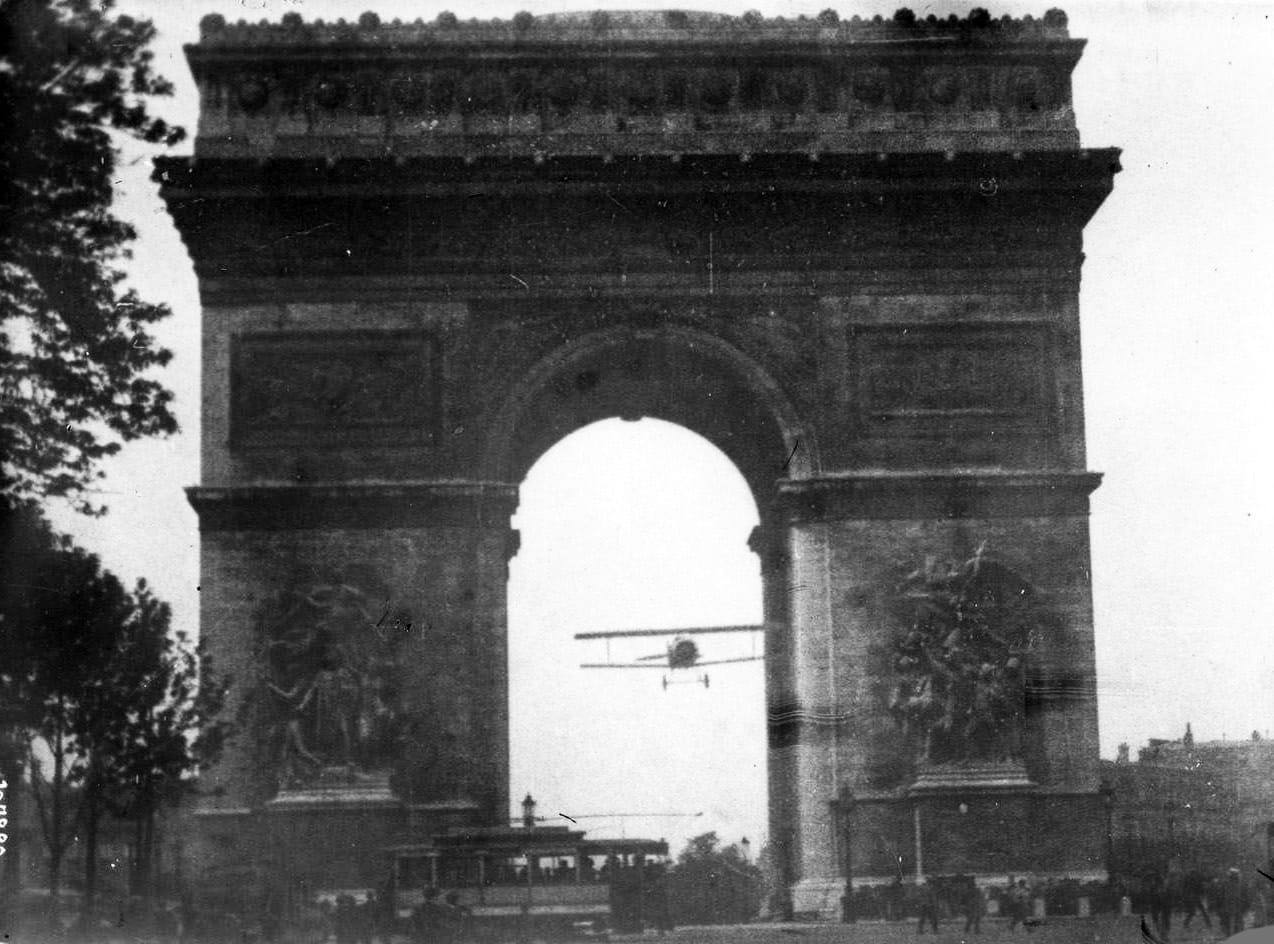
On the morning of 7 August 1919, Parisians near the Champs-Élysées heard an engine where there should have been none. They looked up to see a Nieuport fighter dropping toward the great arch at the head of the avenue — and then, impossibly, threading straight through the opening of the Arc de Triomphe, wings just clearing the stone. At the controls sat Charles Godefroy, and he had just flown one of the most audacious stunts in the history of the air.
It was not a joke, and it was not for money. It was a protest — made at a hundred miles an hour, through a gap barely wider than the aeroplane itself.
Kurzinfo
| Stunt | Flying a fighter under the Arc de Triomphe |
| Pilot | Charles Godefroy |
| Datum | 7 August 1919 |
| Flugzeug | Nieuport fighter biplane |
| The gap | Arch opening roughly 14 m wide, 29 m high |
| Warum | Protest — aviators were told to march, not fly, in the victory parade |
An insult to the airmen
The First World War had made aviators into heroes. So when France planned its great victory parade in 1919, its pilots expected to fly over the celebrations. Instead, the story goes, they were told to Marsch — on foot, like infantry. To men who had fought and died in the skies over the Western Front, it stung.
The airmen decided to answer in their own language. One of their number would fly under the Arc de Triomphe itself. The first volunteer, the ace Jean Navarre, was killed while practising just weeks before. Charles Godefroy took his place.
A gap the width of an aeroplane
The numbers are what make it terrifying. The arch’s central opening is roughly 14 metres wide and 29 metres high. A Nieuport’s wings span a large fraction of that width, leaving almost no margin for error on either side, and none at all for a wobble in the gusty air funnelling between the buildings. Godefroy had to line up perfectly, hold the aircraft dead level, and commit — because once inside the arch, there is no going around.
He made it. The aircraft flashed through the opening and out the other side over the Champs-Élysées, and a cameraman on the ground caught the whole thing on film — which is why, more than a century later, we can still watch it happen.
The stunt that became legend
Because it was seen as an act of pride on behalf of France’s wartime aviators, Godefroy largely escaped punishment, and the flight passed into legend. It has inspired imitators and no small number of would-be daredevils ever since — though in an age of controlled airspace and instant interception, no one will ever repeat it.
Godefroy’s flight belongs to a brief, reckless golden age when a skilled and stubborn pilot could make a point simply by pointing his aeroplane at the impossible — and flying through it.
Sources: Contemporary French newsreel footage (Gaumont/Pathé archives); Musée de l’Air et de l’Espace.
Verwandte Fragen
Who flew under the Arc de Triomphe?
French pilot Charles Godefroy flew a Nieuport fighter biplane under the Arc de Triomphe in Paris on 7 August 1919. The daring stunt was filmed and remains one of the most famous acts of daredevil flying in history.
Why did Godefroy fly under the Arc de Triomphe?
It was a protest. After World War I, French airmen were reportedly told to march on foot in the 1919 victory parade rather than fly overhead — an insult to aviators who felt they had earned the skies. Flying under the Arc was a defiant answer on their behalf.
How dangerous was the stunt?
Extremely. The arch’s opening is only about 14 metres wide and 29 metres high — a tiny target for a biplane with a wide wingspan. A momentary misjudgement would have meant hitting one of France’s most sacred monuments at speed. Another pilot, Jean Navarre, had died while practising for a similar feat weeks earlier.
Was Godefroy punished?
Accounts vary, but because the flight was seen as an act of pride on behalf of France’s wartime aviators — and because it thrilled the public — Godefroy largely escaped serious consequences. The filmed stunt turned him into a folk hero of early aviation.
Can you fly under the Arc de Triomphe today?
Absolutely not. It would be illegal, wildly dangerous and impossible to attempt without immediate interception. Godefroy’s flight belongs to a brief, lawless golden age of aviation that modern rules and airspace control have firmly closed.
0 Kommentare