
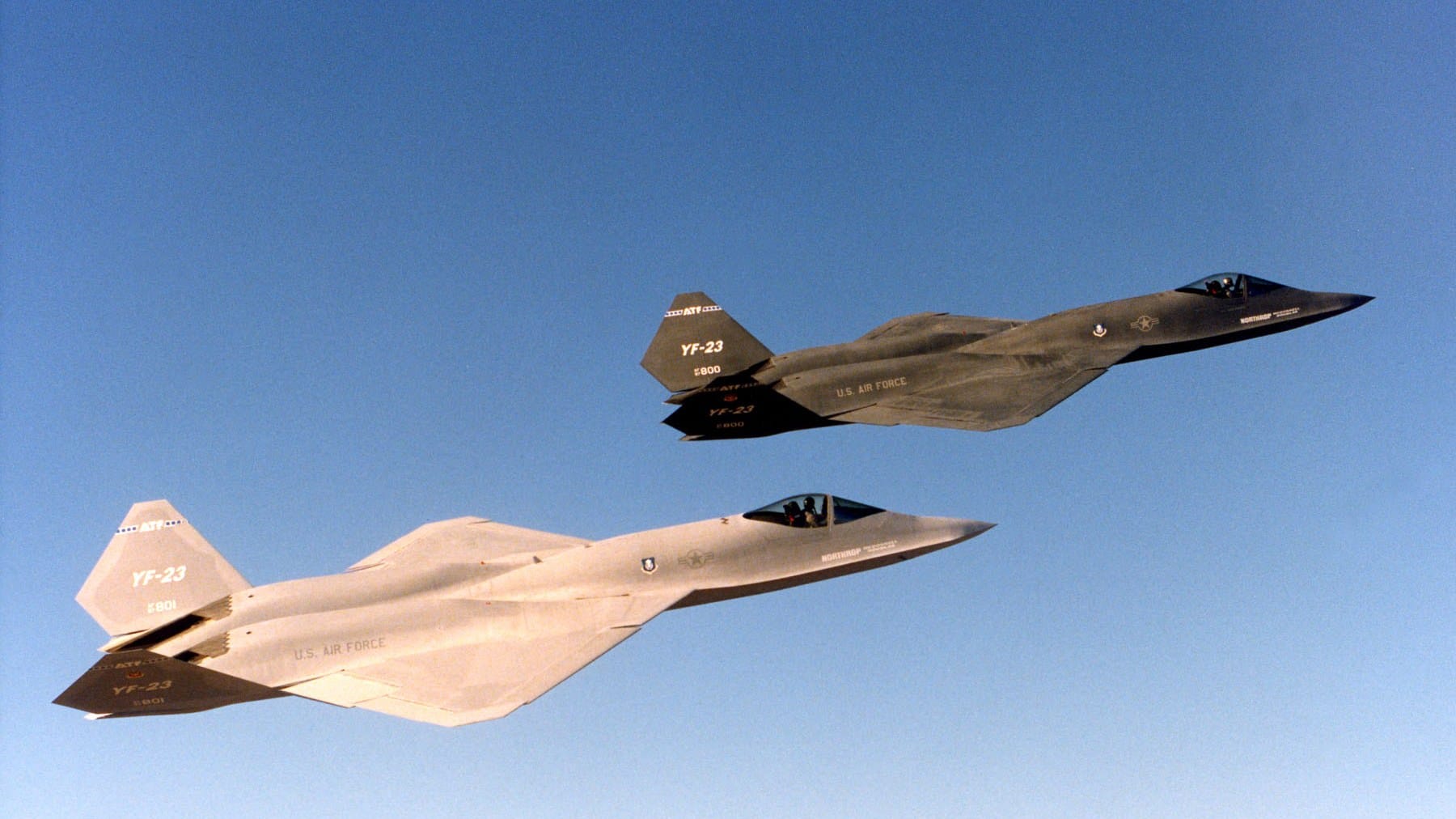
The desert air was still cool at Edwards Air Force Base on the morning of 27 August 1990 when Northrop chief test pilot Paul Metz taxied out in a machine that looked like nothing else on Earth. Charcoal grey, diamond-winged, its two tails canted outward like the fins of a dart, the jet seemed to have arrived from a decade that had not happened yet. Metz lifted it off the runway and flew it for 50 minutes.
The aircraft was YF-23 Prototype Air Vehicle 1, and it existed for exactly one purpose: to beat the Lockheed YF-22 in the Advanced Tactical Fighter competition. Two teams, four prototypes, one contract — and the winner would define American air superiority deep into the 21st century.
Eight months later, Lockheed won. Pilots, engineers and armchair analysts have been arguing about it ever since. The YF-23 “Black Widow II” may be the best fighter that never was.
Quick Facts: YF-23 vs YF-22
| Competition | Advanced Tactical Fighter (ATF) demonstration/validation, 1986–1991 |
| Contenders | Northrop/McDonnell Douglas YF-23 vs Lockheed/Boeing/General Dynamics YF-22 |
| YF-23 first flight | 27 August 1990 — Paul Metz, Edwards AFB |
| YF-22 first flight | 29 September 1990 — Dave Ferguson, Edwards AFB |
| YF-23 edge | Stealth, supercruise speed, range |
| YF-22 edge | Agility, thrust vectoring, live missile firings |
| Decision | 23 April 1991 — Air Force Secretary Donald Rice picks the F-22 and P&W F119 |
| The prototypes today | PAV-1: National Museum of the USAF, Dayton · PAV-2: Western Museum of Flight, Torrance |
Built to Beat the Flankers
The ATF was conceived in the early 1980s as the answer to a new generation of Soviet fighters, the Su-27 and MiG-29. The US Air Force wanted an aircraft that combined the invisibility of the F-117 with the speed and agility of an F-15 — and it wanted the ability to cruise supersonically without afterburner, a trick called supercruise that no operational fighter could sustain.
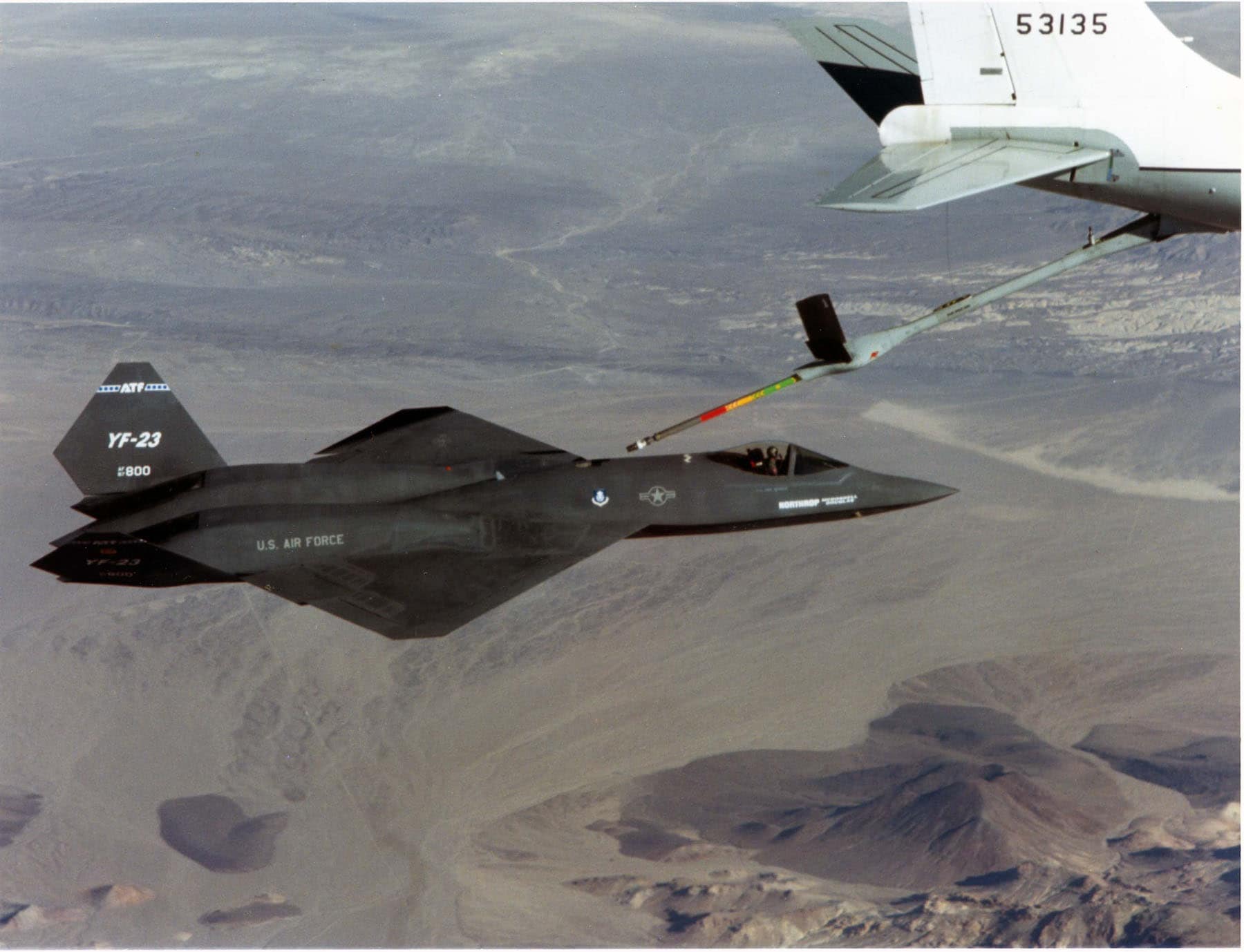
On 31 October 1986 the Air Force selected two teams for the demonstration and validation phase: Lockheed leading Boeing and General Dynamics, and Northrop paired with McDonnell Douglas. Each team would build two flying prototypes, one for each of the competing engines — the Pratt & Whitney YF119 and the General Electric YF120.
The stakes were enormous. The Air Force originally planned to buy 750 ATFs; Defense Secretary Dick Cheney’s 1990 Major Aircraft Review trimmed the figure to 650 before a single decision had been made. For the losing team, there might be no fighter work at all for a generation.
Two Ways to Build a Ghost
Northrop’s answer was radical. The YF-23 had no vertical tails in the conventional sense, only two big all-moving surfaces canted at 50 degrees, and its engines exhaled through heat-shielded trenches on top of the fuselage to hide their infrared glow. It made no compromises for airshow agility: no thrust vectoring, just clean shape, raw speed and stealth. The P&W-powered PAV-1 demonstrated supercruise at Mach 1.43, and the GE-powered second aircraft was reportedly faster still.
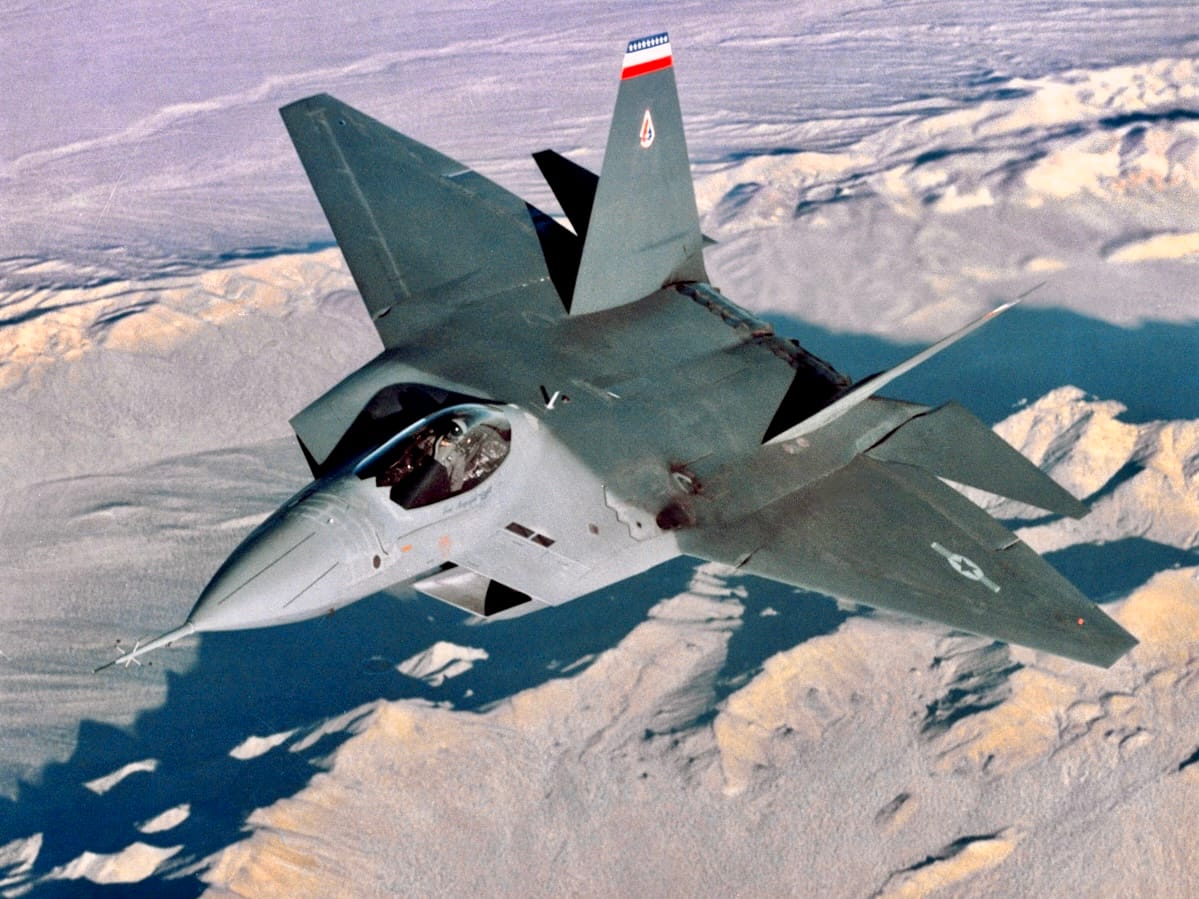
Lockheed’s YF-22 was the extrovert. Its two-dimensional thrust-vectoring nozzles let it pitch its nose to extreme angles of attack, and during the fly-off Lockheed made sure everyone saw it: high-alpha passes, a live AIM-9 Sidewinder shot in November 1990 and an AIM-120 AMRAAM firing in December. Northrop fired no missiles — the requirement was to show the capability could exist, not to demonstrate it live.
Both teams wrapped up flying by the end of December 1990. Both aircraft, the Air Force later confirmed, met the requirements. Then the waiting began.
Metz and fellow YF-23 pilot Jim Sandberg have also argued that the jet’s enormous tailerons were so powerful that they largely cancelled out the YF-22’s celebrated thrust-vectoring advantage. It is a point the record never got to settle.
The Announcement
On 23 April 1991, Air Force Secretary Donald Rice stepped in front of the press at the Pentagon and ended the suspense: the Lockheed team’s F-22, powered by Pratt & Whitney’s F119, would be America’s next air superiority fighter. Rice said the decision rested on confidence that the Lockheed team and Pratt & Whitney could deliver the aircraft and engine at their projected costs — and he pointedly declined to crown either prototype the better performer, denying that one had been significantly more manoeuvrable or stealthy than the other.
On 2 August 1991 the Air Force followed up with a 9.55-billion-dollar engineering and manufacturing development contract. Lockheed was in the fighter business for the next half century. Northrop, for all practical purposes, was out of it.
Lockheed’s program manager, Sherm Mullin, had fought for that outcome with brutal candour. In 1985, still a part-time contributor to the proposal, he told the president of Lockheed California the team was going to lose “because this program is contaminated with part-timers, including me and you.” The next day, Mullin was program manager.
Why Lockheed Really Won
The official reason was management confidence and cost realism. The unofficial reasons have filled books. Northrop’s reputation in Washington was bruised by cost overruns and legal trouble surrounding the B-2 program, and the Navy’s A-12 stealth bomber — cancelled that January in one of the great procurement disasters — had burned confidence in paper promises across the industry. Betting 650 fighters on the team perceived as the steadier manager was, in 1991, an easy argument to make.
Metz himself, who is not given to bitterness, points to something softer: salesmanship. Northrop’s brilliant engineers spoke in engineering. Lockheed understood that source selections are decided by people, and it packed its flight demonstrations with vivid, lasting impressions — vectored-thrust pirouettes and live missile shots that told a story anyone could grasp.
And hovering over it all was the Navy. Its Naval ATF requirement was still nominally alive in April 1991, and Lockheed had pitched a carrier-capable variant of its design. Historians still argue over how much weight that carried; the NATF quietly died within months anyway.
The Cult of the Black Widow
Losing made the YF-23 immortal. Freed from the compromises of production, it remains the fastest-looking aircraft never to enter service, and every few years its ghost resurfaces — most famously in the mid-2000s, when Northrop reportedly dusted off the design as the basis for an FB-23 regional bomber pitch.
The two prototypes survive. PAV-1, the “Gray Ghost,” hangs its diamond wing in the research and development gallery of the National Museum of the US Air Force in Dayton, Ohio. PAV-2 sits with the Western Museum of Flight at Zamperini Field in Torrance, California, where Metz and Sandberg have returned to tell its story.
As for Metz, he switched badges. On 7 September 1997 he made the first flight of the production F-22 Raptor — making him the only pilot to take both of the ATF’s bloodlines into the air for the first time. The Air Force got its Raptor. The Black Widow got immortality.
Sources: Wikipedia (Northrop YF-23, Lockheed YF-22), The War Zone (Paul Metz & Jim Sandberg lecture, 2019), Aerospace America / AIAA (Sherm Mullin interview, 2023), Air Force Historical Foundation, GlobalSecurity.org, National Museum of the USAF, Western Museum of Flight
0 Kommentare