
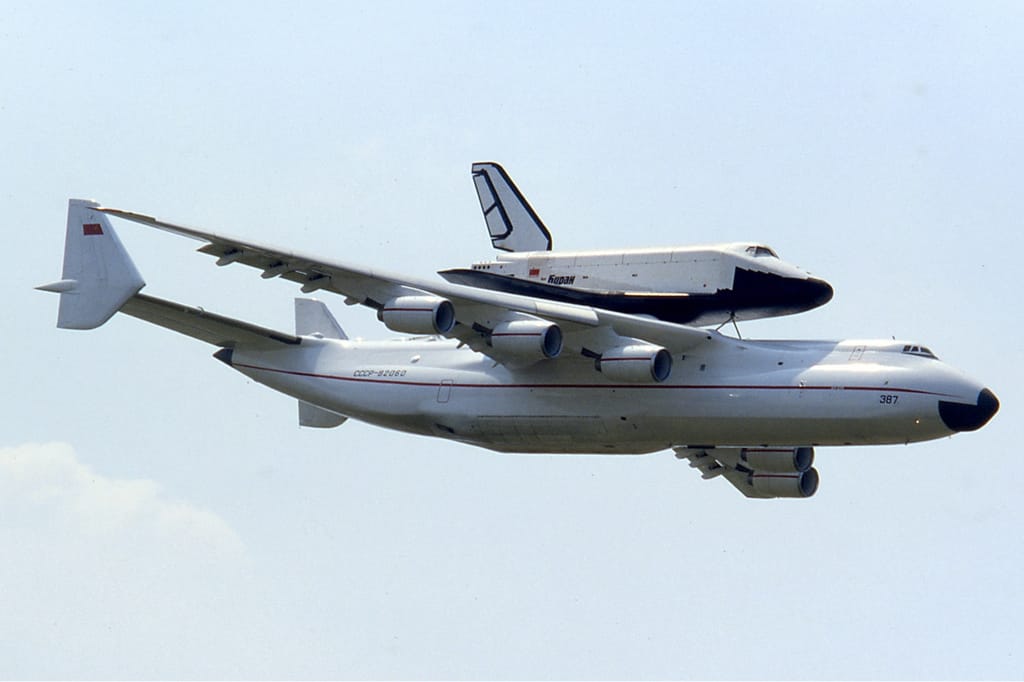
On 15 November 1988, a spacecraft that looked almost exactly like the American Space Shuttle rose from the Baikonur Cosmodrome on a pillar of flame, circled the Earth twice, and landed itself on a runway in a 60 km/h crosswind — with no one aboard and no one flying it. It was called Buran, Russian for “snowstorm.” It performed flawlessly. And it never flew again.
The story of the Soviet shuttle is one of the strangest in spaceflight: a machine of genuine brilliance, built for reasons of fear rather than need, flown once to prove a point, and then left to rot in a hangar until the roof fell on it. To look at Buran is to see a road not taken — and a cautionary tale about what happens when an empire builds something magnificent it cannot afford to use.
| Vehicle | Buran orbiter 1.01 (“snowstorm”) |
| Nation | Soviet Union |
| First & only flight | 15 November 1988 |
| Flug | Uncrewed, 2 orbits, ~3 hours, autoland |
| Launcher | Energia super-heavy rocket |
| Schicksal | Crushed in 2002 hangar collapse |
A twin, but not a copy
The USSR did not want a shuttle. Soviet engineers argued, correctly, that their expendable rockets were cheaper and simpler. But the American Shuttle looked, to Moscow’s strategists, like it might drop weapons from orbit or snatch Soviet satellites — and so, in 1976, the Politburo ordered a counterpart. More than a thousand enterprises were pulled into the effort.
From the outside, Buran and the American orbiter are near-identical — the same delta wing, the same black-and-white heat shield. Underneath, they diverge sharply. The US orbiter carried three main engines and lit them at launch. Buran carried none. All the muscle came from the Energia rocket beneath it, a super-heavy booster powerful enough to loft a hundred tonnes on its own. That made Buran a true payload, and Energia a launcher that could serve other missions.
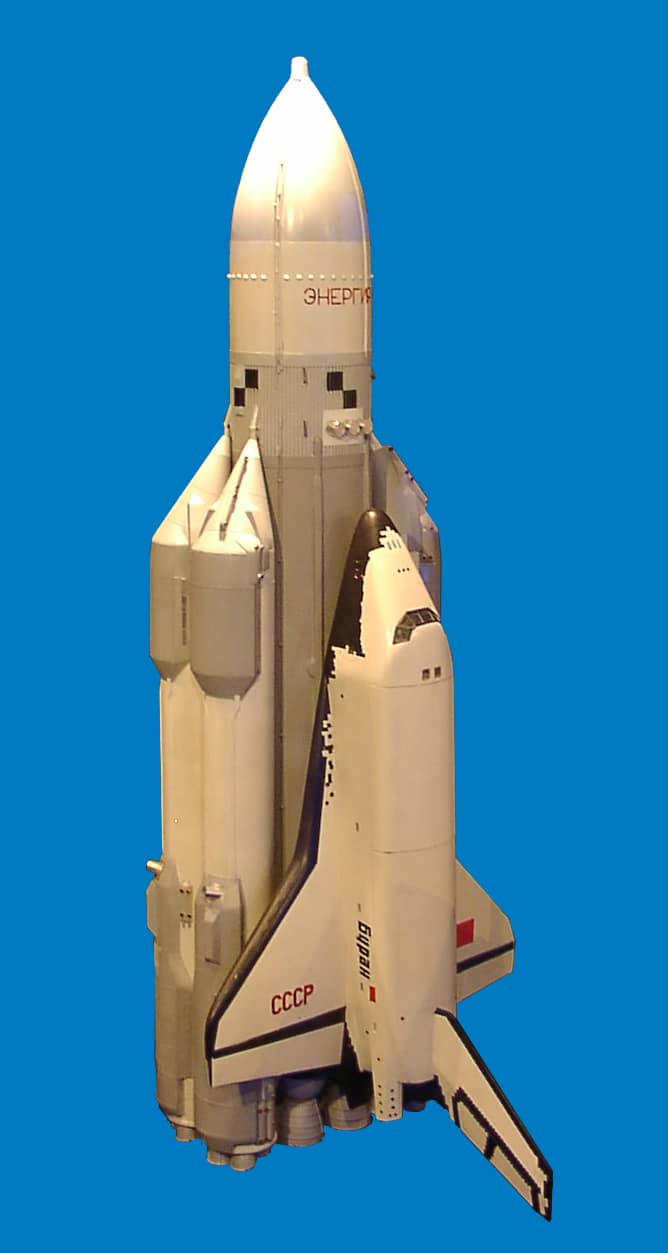
The other difference was the one that mattered most on 15 November 1988. The American Shuttle always landed by hand; a commander flew it down. Buran flew its entire mission — ascent to touchdown — on its own computers. As it approached the runway it made an unplanned, low-probability manoeuvre to bleed off energy, briefly convincing controllers it had gone wrong. It hadn’t. It swept round and greased the landing.
One perfect flight
The numbers were extraordinary for 1988: a fully automated orbital flight and a hands-off landing in a crosswind, a feat the Americans never attempted. Buran shed only a handful of its tens of thousands of heat-shield tiles. The engineers who built the runway were so meticulous, one story goes, that the chief designer drove a car along it with a glass of water on the hood to check for bumps. Not a drop spilled.
And then history intervened. The Soviet Union was months from crisis and years from collapse. A second orbiter, Ptichka, was nearly finished; more were on the jigs. But the money evaporated. The programme was formally cancelled in 1993, having flown exactly once.
The roof falls in
The flown orbiter, 1.01, was rolled into an assembly building at Baikonur and largely forgotten. On 12 May 2002, the roof of that hangar — poorly maintained, its structure neglected — collapsed during repair work. It destroyed the only Buran ever to reach space and killed eight workers on the roof. The machine that had flown a flawless mission was crushed under falling concrete, never having flown a second time.
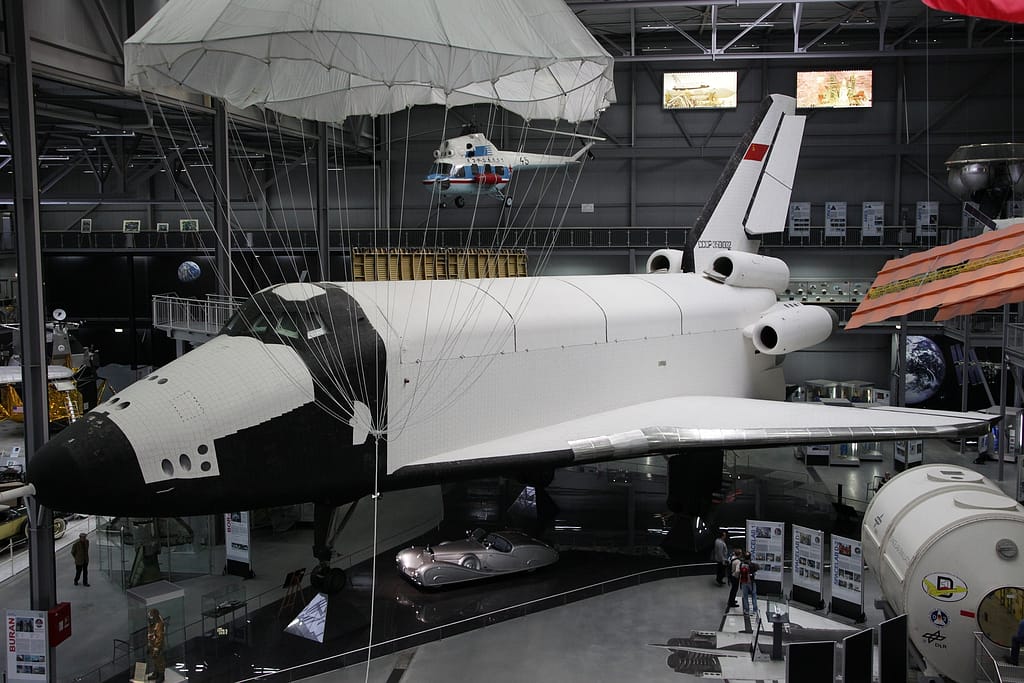
Survivors remain: an atmospheric test article now sits in a German museum at Speyer; the near-complete Ptichka still waits at Baikonur. They are monuments to a paradox — one of the most sophisticated flying machines ever built, flown once, and then abandoned by the country that made it.
Sources: RussianSpaceWeb; TASS/Roscosmos; Smithsonian; space.com; Spaceflight Now (2002).
0 Kommentare