
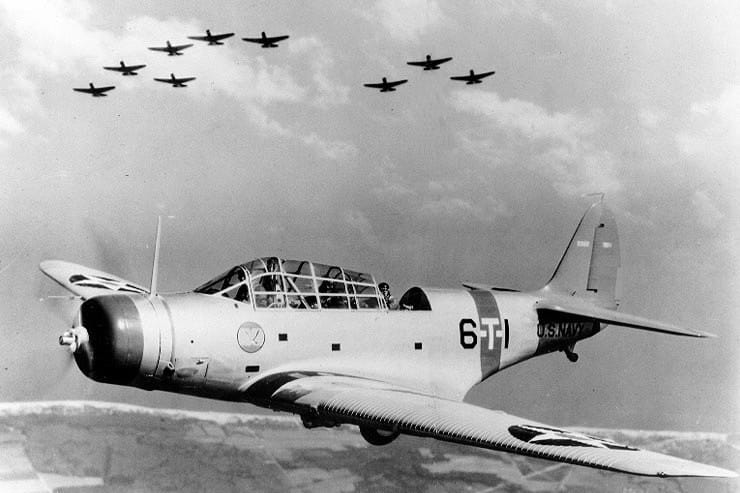
On the morning of 4 June 1942, forty-one obsolete torpedo bombers lumbered off three American carriers toward the Japanese fleet. Their aircraft were too slow, their torpedoes barely worked, and most of them had no fighter escort. Within an hour, all but a handful had been shot into the sea, and not one of their torpedoes had found a target.
It was one of the most one-sided slaughters in the history of air combat. It was also, in a way nobody could have foreseen, the moment that won the Battle of Midway. This is the story of the Douglas TBD Devastator, and the men who flew it to its death.
Kurzinfo
- Flugzeug: Douglas TBD Devastator, U.S. Navy torpedo bomber; first flew 1935
- Firsts: the Navy’s first all-metal monoplane, first fully enclosed cockpit, first with hydraulic folding wings
- Crew: three — pilot, bombardier, radioman/gunner
- Das Problem: by 1942 it was desperately slow, and its Mark 13 torpedo was riddled with defects
- Midway: 41 launched, zero torpedo hits, only 6 returned
- Torpedo Squadron 8: all 15 aircraft lost; one man, Ensign George Gay, survived
Yesterday’s Wonder Weapon
When it first flew in 1935, the Devastator was a marvel. It was the most advanced aircraft in the U.S. Navy: the first all-metal monoplane to fly from its carriers, the first with a fully enclosed cockpit, the first with wings that folded at the touch of a hydraulic control. For its day, it was the future.
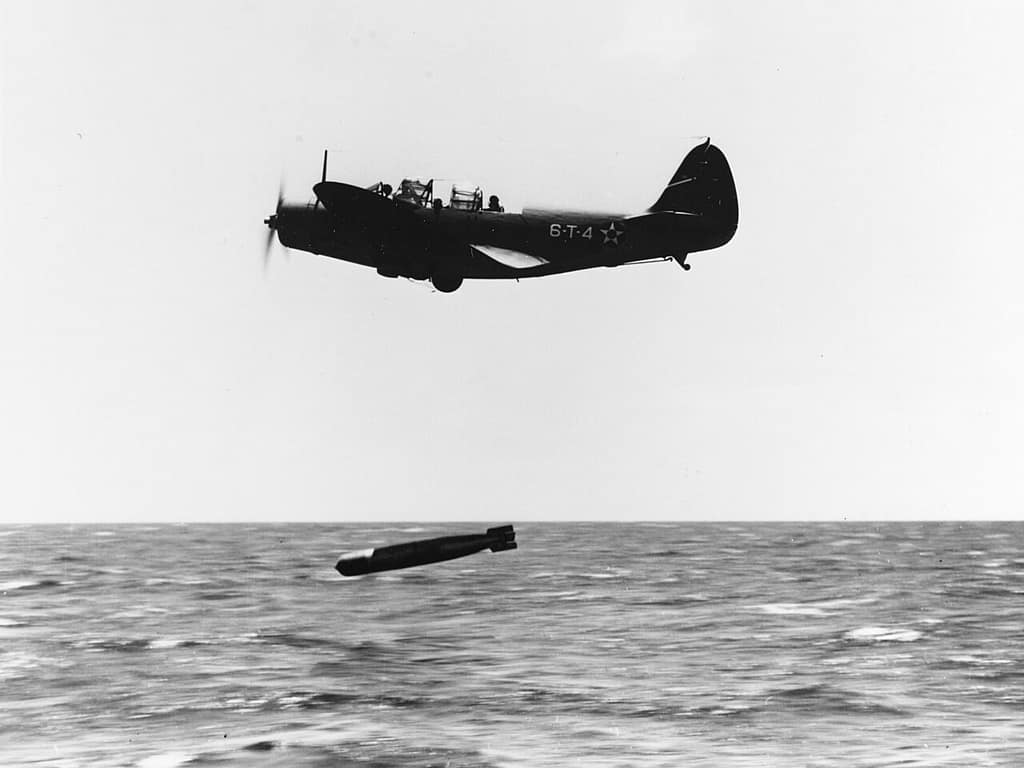
But aviation moved fast in the late 1930s, and by the time war came the Devastator was a relic. Its top speed was barely 200 mph, and to launch a torpedo it had to slow to under 115 mph and fly dead straight and level toward the enemy. Against modern anti-aircraft guns and the nimble Mitsubishi Zero, that was very nearly a suicide profile.
The Charge of Torpedo Eight
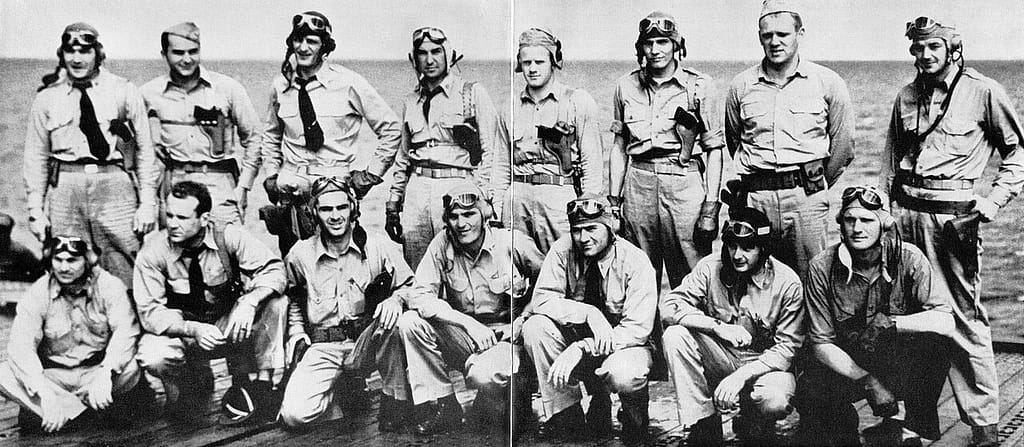
At Midway, the American torpedo squadrons went in anyway. The attacks were poorly coordinated; some squadrons lost their fighter escort and pressed on alone. Lieutenant Commander John Waldron, leading Torpedo Squadron 8 off the USS Hornet, knew what he was asking of his men. The night before, he had told them plainly what the mission might cost.
Waldron led all fifteen of his Devastators straight at the Japanese carriers. Every one was shot down. Of the thirty men who took off, only one lived: Ensign George Gay, who ditched his burning aircraft, hid beneath a floating seat cushion, and watched the rest of the battle unfold around him from the water.
The Sacrifice That Turned the War
The torpedo bombers scored nothing. But their doomed charge did something no one had planned. To slaughter the low, slow Devastators, the Japanese fighter cover dove down to sea level, and the carriers spent precious minutes twisting away from torpedo runs, their decks in chaos. The sky above was left wide open.
Into that opening, minutes later, fell the American dive bombers — the Dauntless squadrons that had found the enemy at last. Almost unopposed, they planted their bombs on three Japanese carriers in the space of a few devastating minutes. A fourth followed that afternoon. The heart of Japan’s carrier fleet was gone, and the Pacific war had turned — on the backs of the men who never scored a hit.
George Gay floated for some thirty hours before a flying boat found him. He lived to become the most famous enlisted-turned-officer survivor of the battle, and he never stopped honoring the men who did not come back.
The Devastator was quietly withdrawn within weeks, replaced by the far superior Grumman Avenger. Not one survives on dry land today. But its memory endures, because at Midway it proved a hard truth of war: sometimes the aircraft that fails, and the men who die in it, buy the victory for everyone who comes after.
Sources: Wikipedia; U.S. Naval History and Heritage Command (oral history of George Gay); Parshall & Tully, Shattered Sword; U.S. Naval Institute.
0 Kommentare