
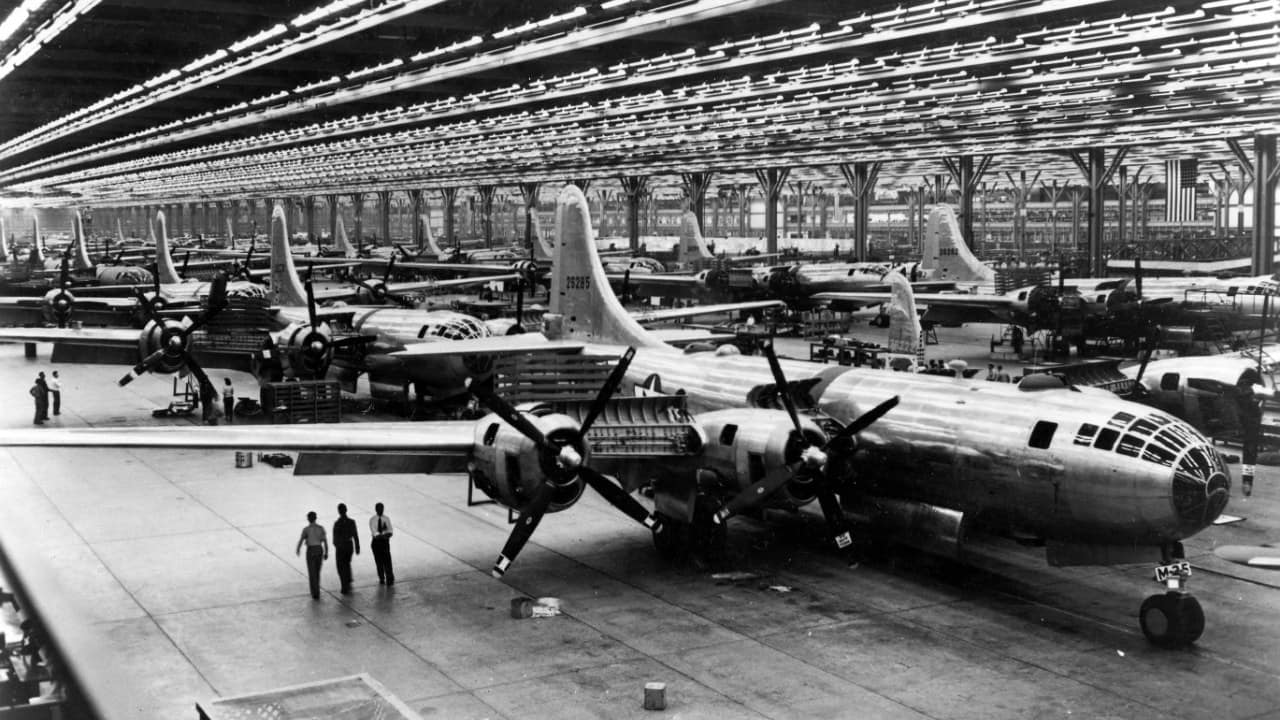
Part 7 of The Race for the Bomb, an Afterburner focus series. The Manhattan Project cost 1.9 billion dollars. The aircraft built to deliver its product cost three billion. This is the engineering story of the B-29 Superfortress — bought off the drawing board, nearly strangled by its own engines, and finished outdoors in a Kansas winter.
Seattle, 18 February 1943, 12:09 p.m. The second prototype of Boeing’s new superbomber lifts off from Boeing Field for a routine test flight. In the left seat is Edmund T. Allen — Eddie Allen — the most respected engineering test pilot in America, the man who first flew the Stratoliner and, five weeks earlier, the Lockheed Constellation. Eight minutes in, an engine catches fire. The extinguishers seem to work; Allen turns for home.
At 12:24 the Boeing Field tower hears the radio operator, Harry Ralston: Allen, better get this thing down in a hurry. The wing spar is burning badly. Then, a minute later: have fire equipment ready. Am coming in with a wing on fire. Three miles short of the runway, the burning wing structure lets go. The aircraft falls onto the Frye meat-packing plant. All eleven aboard die, with some twenty workers on the ground and a firefighter — and with them dies, for a while, the confidence of the entire program.
The aircraft that killed Eddie Allen would become the most complex machine mass-produced to that point in human history, and the most expensive weapons program of the Second World War — costlier than the atomic bomb it was destined to carry. It is worth understanding exactly where those three billion dollars went, because the answer explains most of what happened over Japan in 1945.
Quick Facts: B-29 Superfortress
- Program cost: roughly $3 billion — against about $1.9 billion for the Manhattan Project
- Gebaut: 3,970 including prototypes, at four plants, 1942–1946
- Spannweite: 43.05 m (141 ft 3 in); maximum takeoff weight 60.5 tonnes (133,500 lb)
- Motoren: four Wright R-3350 Duplex-Cyclones, 2,200 hp each — whose magnesium fires burned at roughly 3,000°C
- Ordered before first flight: 1,664 aircraft
- Crew tunnel: 87 cm wide and roughly 10 m long, over the unpressurised bomb bays
- China logistics: about 12 supply flights over the Himalayas for every single combat sortie
Bought Off the Drawing Board
The requirement, issued in January 1940 before a single German bomb had fallen on London, read like science fiction: a bomber with a pressurised crew compartment, a speed near 400 miles per hour, and the range to carry a serious bomb load 5,000 miles. Boeing’s answer, the Model 345, won the competition on paper — and the U.S. Army Air Forces then did something unprecedented in aviation procurement: by the time the prototype XB-29 first flew, on 21 September 1942, 1,664 production aircraft were already on order. The verdict on that first 75-minute flight came from Eddie Allen himself, a man not given to speeches. She flew, he said, and that was the entire report.
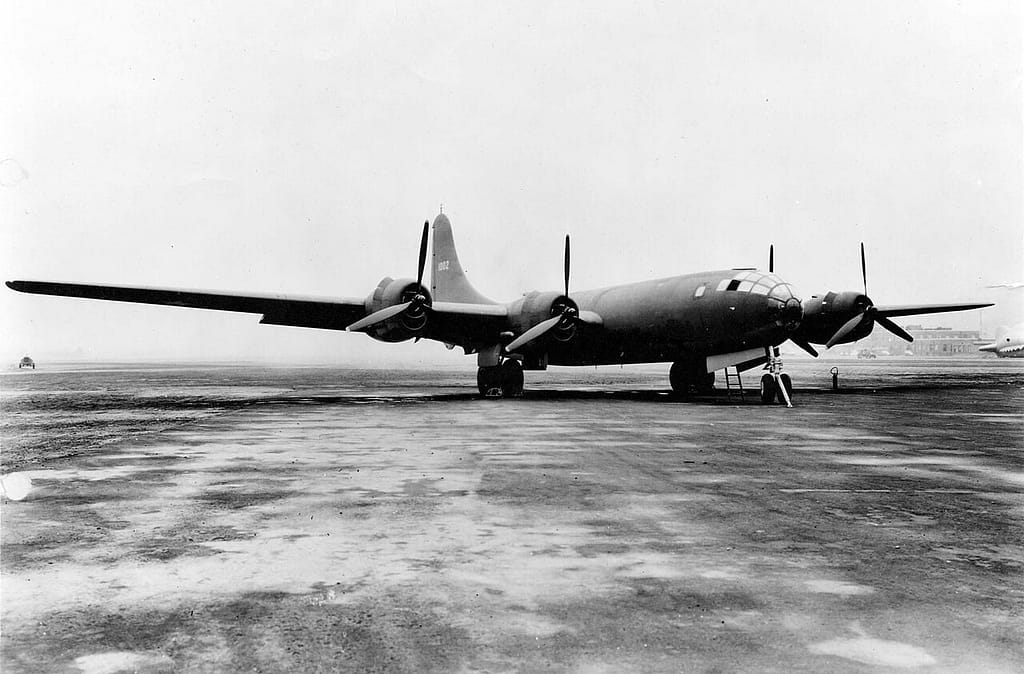
What the Army had bought, sight unseen, was a generation’s leap in four simultaneous directions. The B-29 was the first mass-produced bomber with a pressurised fuselage, holding a comfortable 2,400-metre cabin altitude at 9,000 metres — a direct inheritance from Boeing’s 307 Stratoliner. Because the bomb bays had to open to the stratosphere, they stayed unpressurised, so crewmen commuting between the forward and rear compartments crawled through a padded tunnel 87 centimetres wide and roughly ten metres long, on hands and knees above the bombs.
Its guns, too, belonged to a new era. Instead of men hunched in draughty turrets, the Superfortress carried a General Electric central fire-control system: five sighting stations feeding five analog computers, each continuously correcting for range, lead, bullet drop, airspeed, altitude and temperature, driving remote turrets that any gunner could hand to any other. A single top-side gunner acted as fire-control quarterback, distributing turrets around the formation’s threats. In 1944 this was not an aircraft; it was a flying network with dozens of electric motors and an electronic brain.
The Wrong Engine
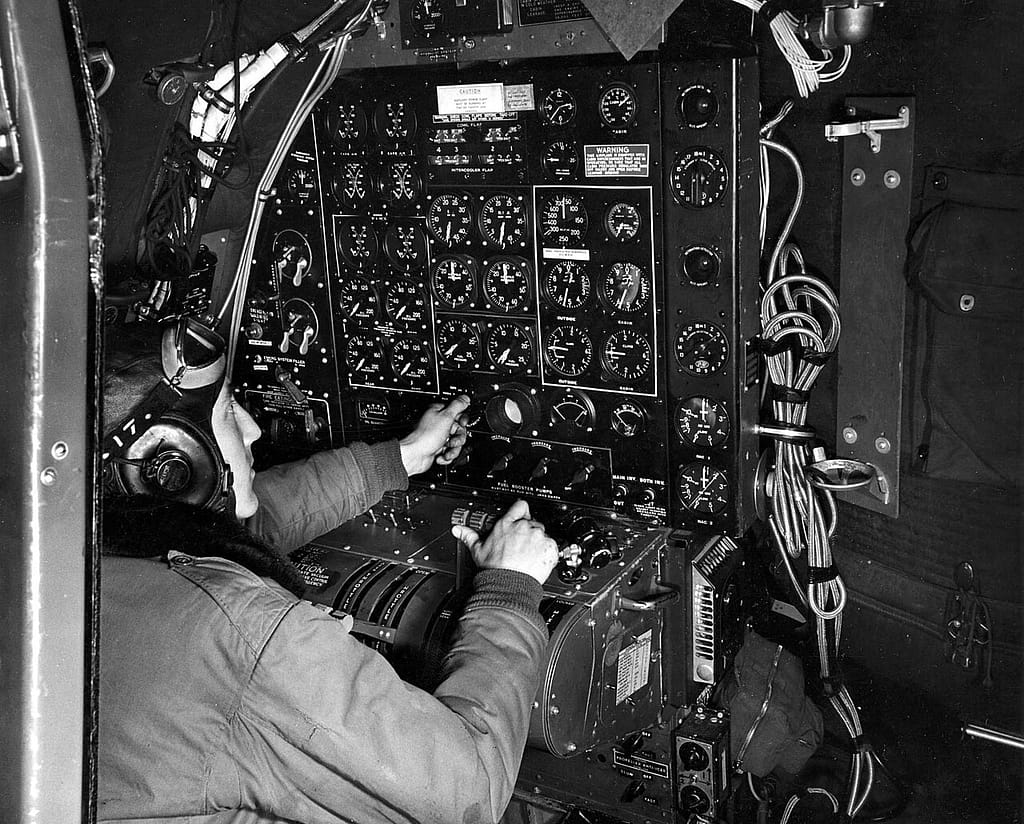
Every leap has a price, and the B-29’s price was bolted to its wings four times over. The Wright R-3350 Duplex-Cyclone — eighteen cylinders, 54.9 litres, 2,200 horsepower — was rushed into mass production years ahead of maturity. Its rear cylinder row ran chronically hot behind tight cowlings; overheated exhaust valves failed and were, in the mechanics’ grim phrase, swallowed whole into the cylinders; and the crankcase was cast from magnesium, a metal which, once alight, burns at temperatures no extinguisher touches and can eat through a wing’s main spar in seconds. That is the failure chain that killed Eddie Allen, and in the early months of operations it destroyed more B-29s than the Japanese did.
The fixes — revised baffles, cowl-flap discipline, oil-flow modifications, and eventually fuel injection — arrived not from serene engineering iteration but from the program’s second great crisis, fought in the open air of a Kansas winter.
The Battle of Kansas
On 11 January 1944, General Hap Arnold — commander of the entire Army Air Forces, and the man who had promised Roosevelt B-29s over Japan by spring — toured the Wichita plant, stopped beside the 175th fuselage on the line, and chalked his claim on it: this was the aircraft he wanted, and he wanted it before the first of March. The production statistics behind the visit were dire: of 97 B-29s built by mid-January, 16 could fly. None was combat-ready. When Arnold returned on 9 March and found that number unchanged, the explosion was heard through the entire procurement system.
What followed — the Battle of Kansas — has no parallel in aviation history. Roughly 1,200 technicians and 600 workers pulled off the assembly lines were thrown at the parked fleet on frozen Kansas airfields, working outdoors through snowstorms at temperatures down to minus 19 degrees Celsius, in shifts capped at twenty minutes because hands froze to the metal. The modification lists ran to hundreds of items per aircraft; 586,000 electrical connections had to be resoldered across the fleet. The last modified bomber left on 15 April 1944, and by early May, 130 Superfortresses had staged toward India. The deadline was met by brute force, outdoors, in winter — a sentence that describes a remarkable amount of the Second World War.
Birth of the B-29: the official 1945 film of the Wichita production lines — the machine the Battle of Kansas was fought over.
Logistics as Farce: The China Missions
The first operational scheme, Operation Matterhorn, looked bold on a map and absurd on a fuel ledger. B-29s would strike Japan from forward fields at Chengtu, China — but every litre of fuel, every bomb and every spare part had to be flown over the Himalayas, because no road reached China. The arithmetic, as LeMay described it, meant a B-29 flying roughly seven tanker round-trips over the Hump to accumulate the fuel for one mission against Japan; counting all supply aircraft, about twelve supply flights per combat sortie. The bomber force became its own tanker fleet. Results matched the logistics: the first raid on the Japanese home islands since Doolittle, against the Yawata steel works on 15 June 1944, put 47 aircraft over the target for exactly one direct hit. In 49 missions from China, the command lost more aircraft to its engines and its geography than to enemy fighters, and official historians’ verdict is blunt: Matterhorn was not worth its cost. In January 1945 the China basing was abandoned.
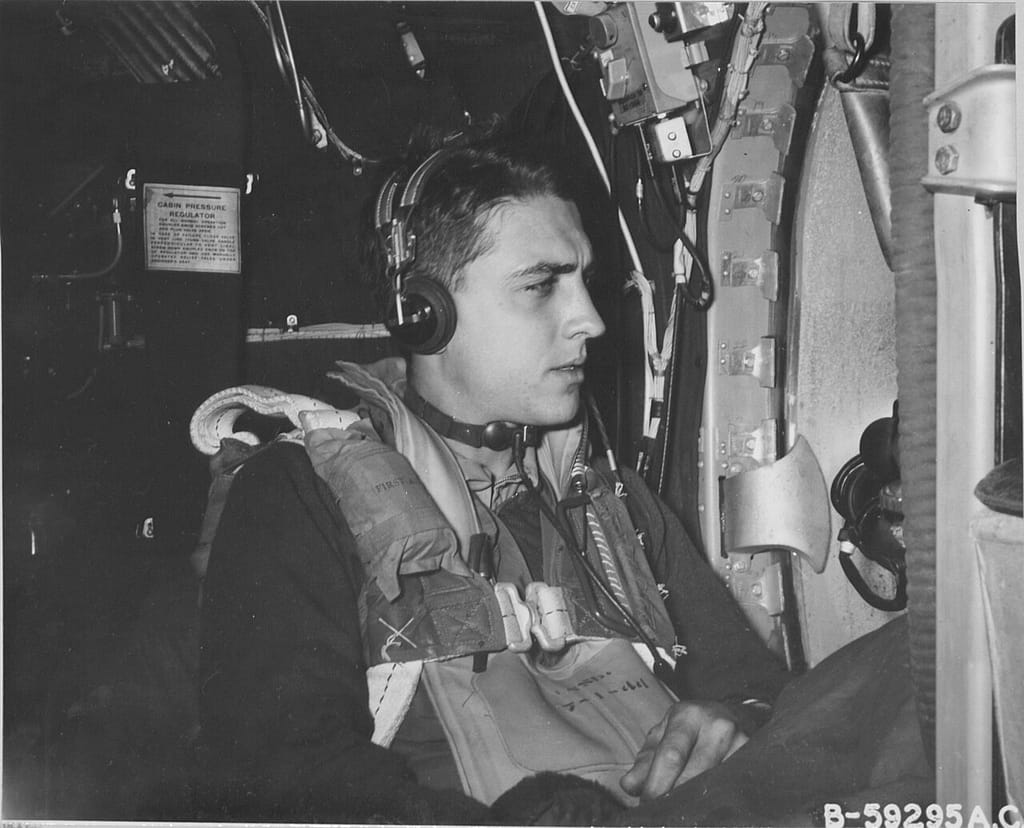
The real campaign awaited real bases: the Marianas — Saipan, Tinian, Guam — captured in mid-1944 at a cost of thousands of lives largely so that B-29s could reach Tokyo. From there, on 24 November 1944, 111 Superfortresses led by Dauntless Dotty flew the first Tokyo raid of the new era — straight into a 200-kilometre-per-hour river of wind at altitude that scattered their bombs across the landscape. That collision with the jet stream, and how it broke high-altitude precision bombing over Japan, is a story Afterburner told in detail in The Wind That Beat the B-29 Over Tokyo; here it needs only its consequence. By January 1945 the three-billion-dollar bomber was failing at its designed mission — and a new commander named Curtis LeMay was about to invert every assumption in its operating manual. That reckoning is Part 8.
Flying the B-29: the restored 1944 training film — cockpit, flight engineer’s panel and all.
Silverplate
One more variant belongs in this part, though its missions belong to Part 9. From late 1943, under the codename Silverplate, a small line of B-29s was quietly rebuilt for a cargo that officially did not exist: bomb bays reconfigured around a single five-ton weapon, using suspension gear adapted from the British Lancaster; every turret and every kilogram of armour deleted except the tail guns; fuel-injected engines and reversible-pitch propellers. Forty-six such aircraft were built during the war — the fastest, lightest, emptiest B-29s ever made, stripped to carry precisely one thing. Fifteen of them stood on Tinian in August 1945.
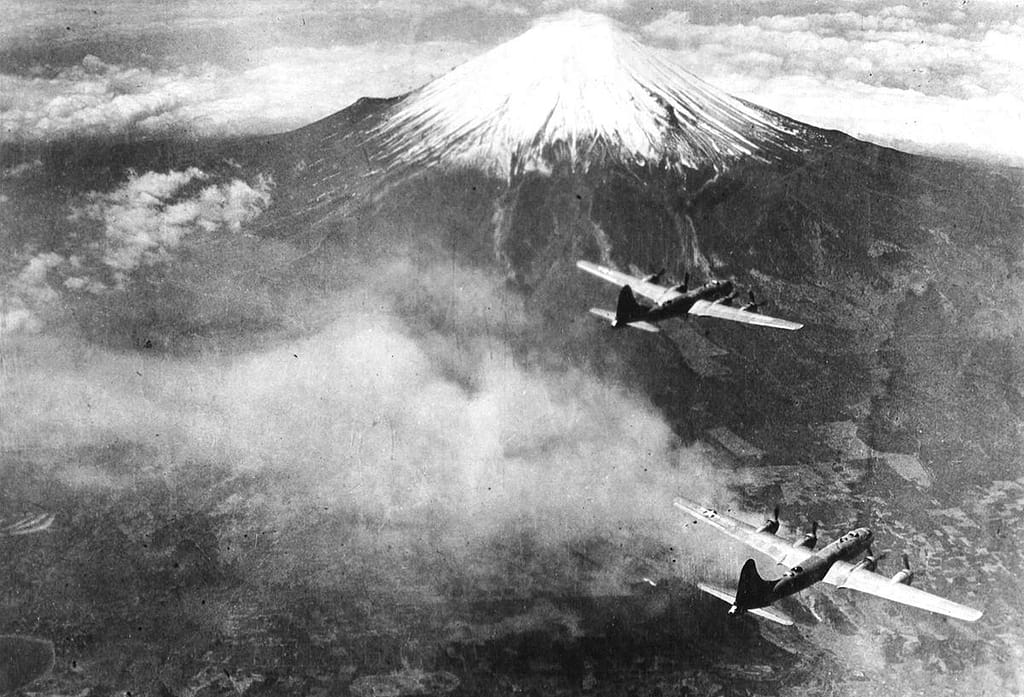
Tally the ledger, as this series keeps doing. Three billion dollars; 3,970 aircraft; an engine that killed its own crews until Kansas winters and engineering attrition tamed it; the world’s first pressurised, computer-gunned bomber — delivered into a jet stream nobody had forecast. The B-29 was simultaneously the greatest aeronautical achievement of the war and a machine still arguing with its own ambitions. What happened when it stopped arguing and was pointed, at low altitude and by night, at cities built of wood — that is the next, darkest chapter of this series.
Megaprojects on the Superfortress: how the most expensive weapons program of the war nearly failed, and why it mattered.
Sources: HistoryLink (Essays 2874, 3828), This Day in Aviation, Air & Space Forces Magazine, National WWII Museum, PBS American Experience, Smithsonian NASM, Brookings Institution, Wikipedia.
The Race for the Bomb — an Afterburner Focus Series
Series overview: all ten parts
Previous — Part 6: Firestorm: Hamburg, Dresden, and the Whirlwind
Next — Part 8: History’s Deadliest Air Raid Wasn’t Nuclear
0 Kommentare