
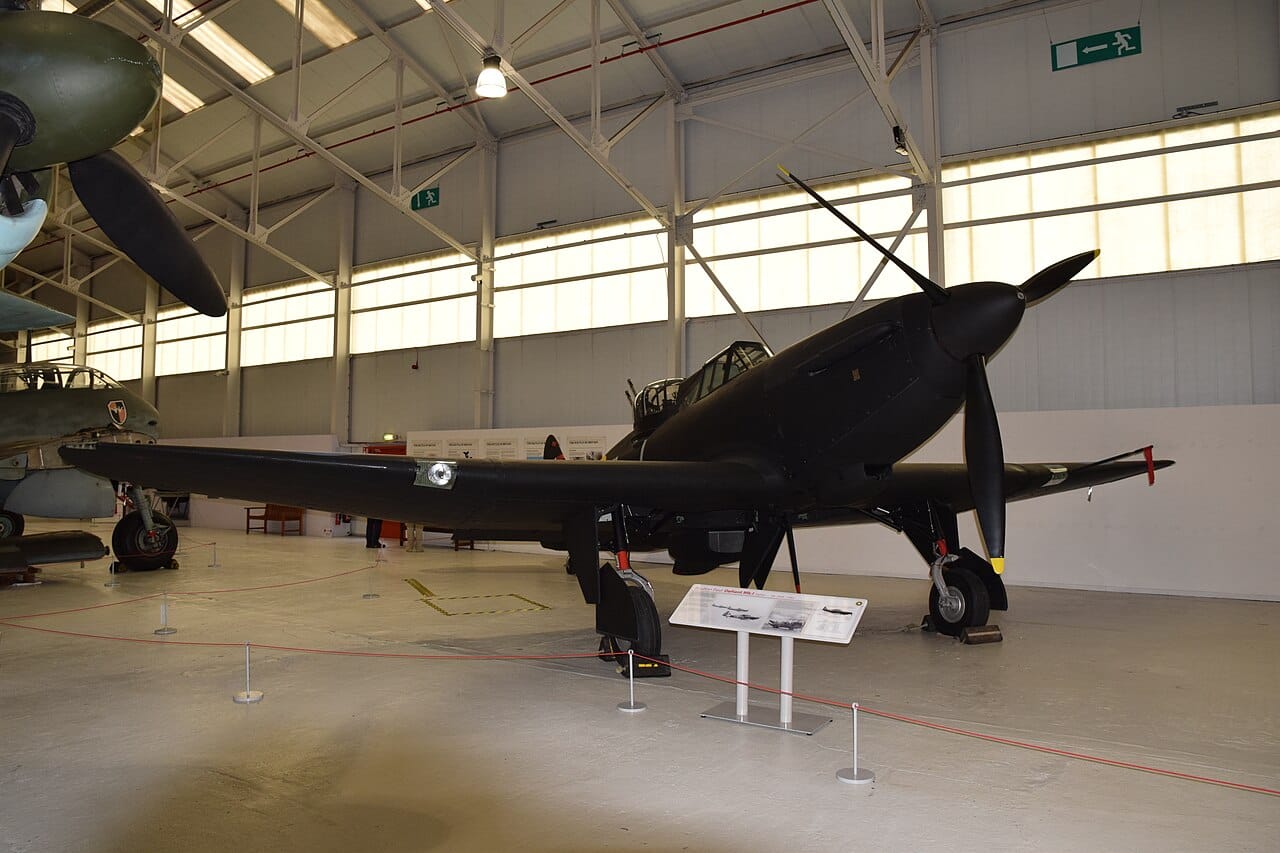
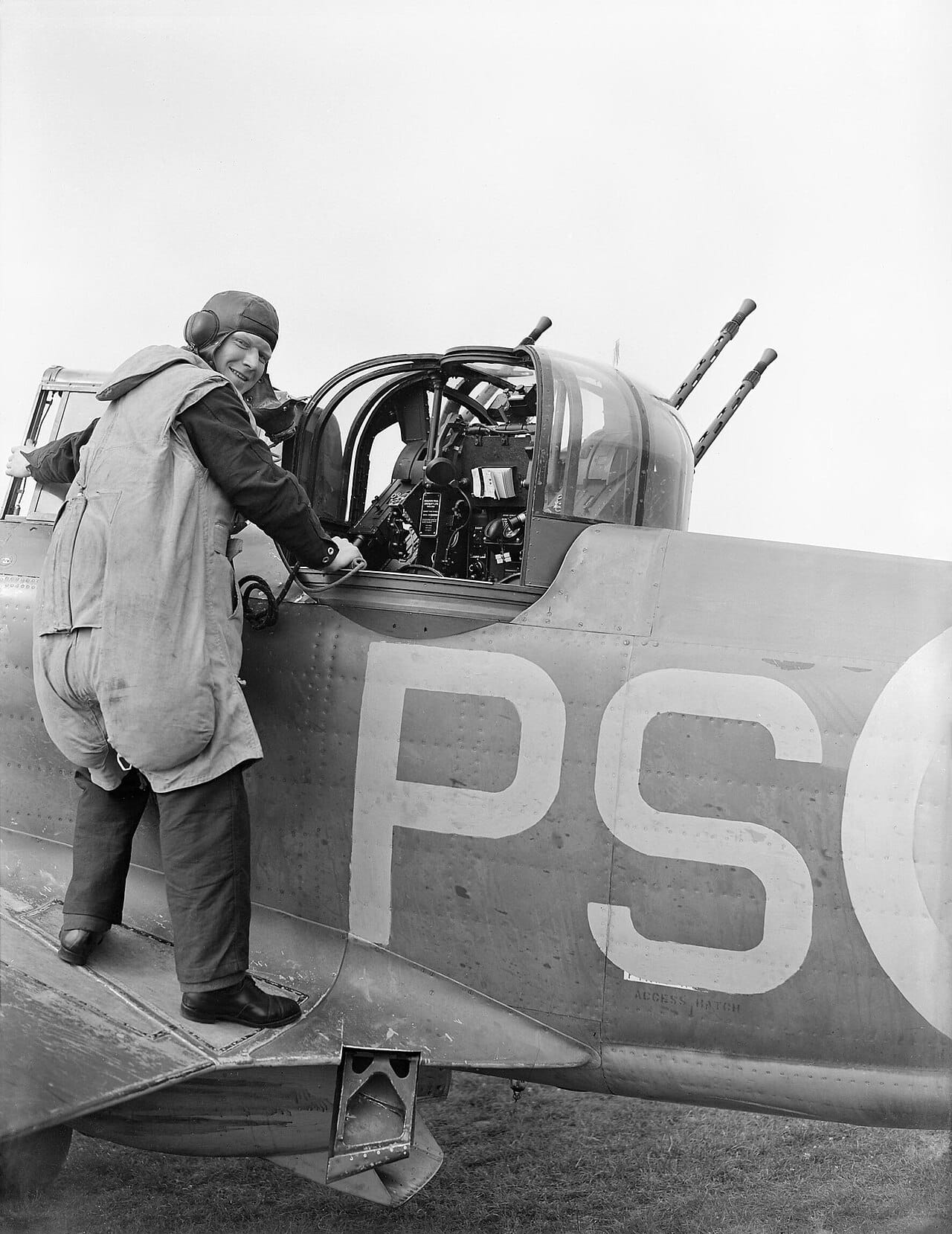
Picture a fighter that cannot shoot straight ahead. No guns in the nose, none in the wings — nothing the pilot can aim simply by pointing the aircraft. Instead, all four machine guns sit in a powered turret behind the cockpit, worked by a second crewman. This was the Boulton Paul Defiant, and for a few startling weeks in 1940 it was one of the deadliest aircraft in the sky. Then it became one of the most dangerous places a young British airman could sit.
The Defiant is one of aviation’s great cautionary tales: a clever idea taken just slightly too far.
Kurzinfo
| Typ | British WWII “turret fighter” (RAF), built by Boulton Paul |
| Rüstung | Four .303 machine guns in a powered dorsal turret — no forward-firing guns |
| Erster Flug | 1937 |
| Early success | Over Dunkirk, May 1940, when Bf 109s mistook it for a Hurricane |
| Katastrophe | 19 July 1940 — seven of nine No. 141 Squadron Defiants shot down off Folkestone |
| Second life | A successful night fighter during the Blitz, some fitted with airborne radar |
The turret-fighter idea
In the 1930s, RAF planners expected the next war to be fought against massed formations of bombers. A fighter with a movable gun turret, the thinking went, could pull alongside a bomber stream and rake it without the pilot having to aim the whole aircraft — and it removed the need for every pilot to be a crack deflection shot. The Defiant was built around that doctrine: no fixed guns at all, just a power-operated turret with four Brownings and a dedicated gunner to swing them.
The Dunkirk surprise
Over Dunkirk in late May 1940, the idea worked spectacularly — largely by accident. From most angles the Defiant’s silhouette closely resembled the Hawker Hurricane, so Luftwaffe Bf 109 pilots bounced it from behind, the classic killing position — and flew straight into four guns they did not know were there. No. 264 Squadron put in extravagant claims over those few days. The numbers were almost certainly inflated, but the shock was real, and for a brief moment the Defiant looked like a war-winner.
Then the Germans worked it out
The advantage lasted exactly as long as the surprise. Once Luftwaffe pilots understood what they were facing, they simply attacked from head-on or from below — the turret’s blind spots, and the directions in which the Defiant had no defence whatsoever. A pilot who got an enemy squarely in front of him could do nothing but watch. On 19 July 1940, seven of nine Defiants from No. 141 Squadron were shot down in minutes off Folkestone. The type was quickly pulled out of daylight combat.
But the story does not end in disaster. In the night skies of the Blitz, the Defiant found real purpose. Its steady handling and a turret that could fire upward into the soft underside of a bomber suited night interception well, and fitted with early airborne radar it became a quietly effective killer in the dark.
The lesson it taught was blunt: in a dogfight, the ability to point your aircraft and shoot is almost everything. The turret fighter was an elegant answer to the wrong question — and the men in those turrets paid the price for finding that out. Give it the cover of night, though, and the same flawed machine did its quiet, deadly work.
Sources: Wikipedia; HistoryNet; Battle of Britain Historical Timeline.
Verwandte Fragen
What was the Boulton Paul Defiant?
The Boulton Paul Defiant was a British two-seat fighter of World War II built as a \u201cturret fighter.\u201d Its only armament was four .303 machine guns in a powered turret behind the pilot, with no forward-firing guns.
Why did the Defiant have no forward guns?
It was designed around a 1930s doctrine that fighters would attack bomber formations from alongside, using a movable turret rather than fixed guns. This removed the need for the pilot to aim the whole aircraft, but left the Defiant unable to fire straight ahead.
Why was the Defiant successful at first?
Over Dunkirk in May 1940, German Bf 109 pilots mistook the Defiant for a Hawker Hurricane and attacked from behind \u2014 directly into the field of fire of its rear turret. The element of surprise produced sharp early successes.
Why did the Defiant fail as a day fighter?
Once Luftwaffe pilots learned to attack from head-on or below \u2014 the turret\u2019s blind spots \u2014 the Defiant was almost defenceless. On 19 July 1940, seven of nine Defiants of No. 141 Squadron were shot down, and the type was withdrawn from daylight combat.
What happened to the Defiant after the Battle of Britain?
The Defiant found a successful second career as a night fighter during the Blitz. Its stable handling and upward-firing turret suited night interception, and some aircraft carried early airborne interception radar.
When did the Boulton Paul Defiant first fly?
The Defiant first flew in 1937 and entered RAF service shortly before the Second World War.
Ähnliche Beiträge
0 Kommentare