
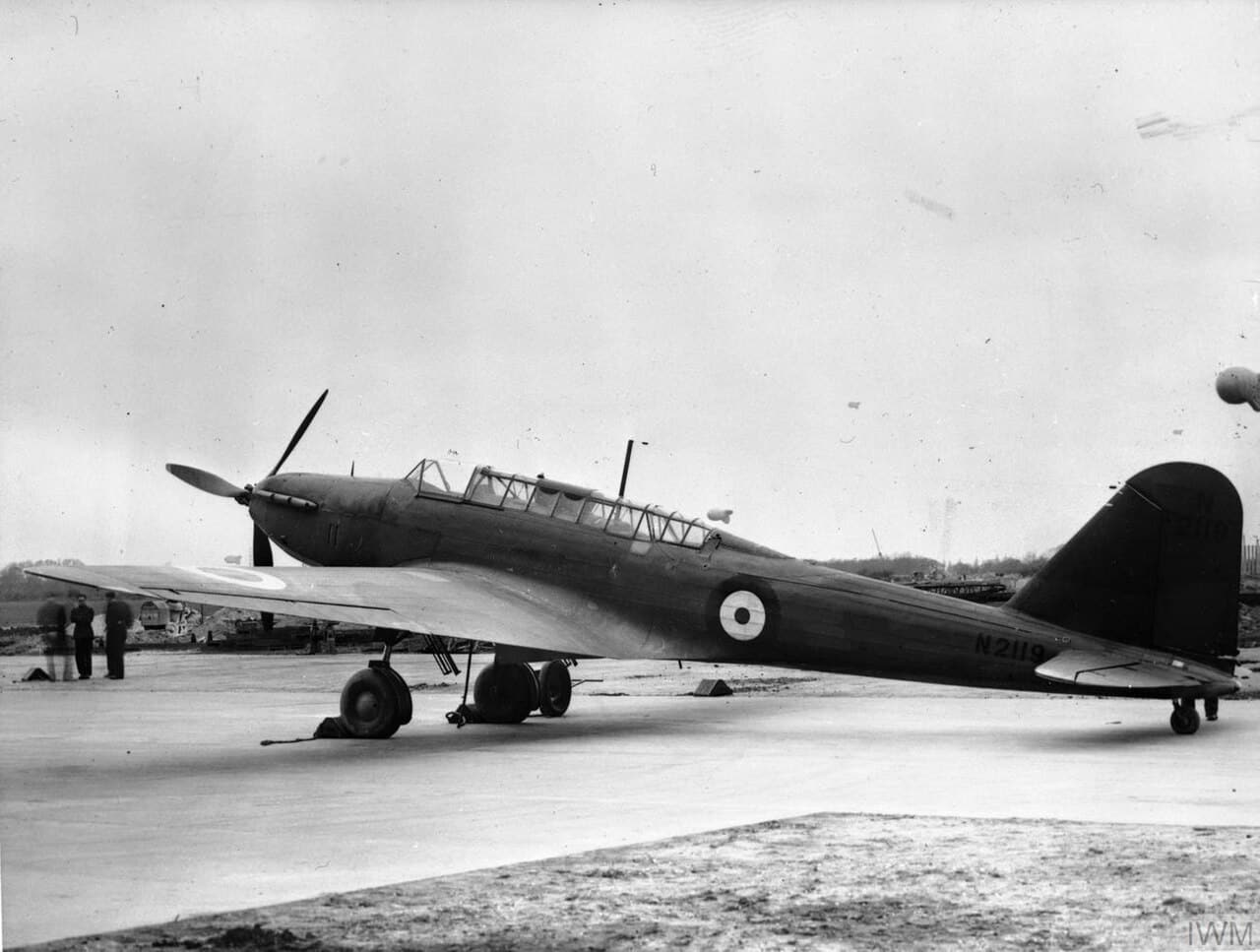
On the morning of 12 May 1940, No. 12 Squadron was asked for volunteers. The target was a pair of bridges over the Albert Canal near Maastricht, across which the German Army was walking into Belgium. Everyone in the squadron volunteered.
Five Fairey Battles went. One came back.
Two of the men who did not return became the first members of the Royal Air Force to be awarded the Victoria Cross in the Second World War. The third man in their aircraft died with them and received nothing at all.
Kurzinfo
| Flugzeug | Fairey Battle, single-engine three-seat light bomber, in RAF service from 1937 |
| Motor | One Rolls-Royce Merlin, roughly 1,030 hp — the same family of engine as the Spitfire and Hurricane |
| Crew | Three: pilot, observer, wireless operator/air gunner |
| Defensive armament | One fixed forward .303 Browning in the starboard wing; one Vickers K gun in the rear cockpit |
| Bomb load | Four 250 lb bombs internally, plus around 500 lb externally |
| Deployed | Ten squadrons sent to France on 2 September 1939 as the Advanced Air Striking Force |
| Losses, 10–14 May 1940 | Around 118 sorties flown, roughly 60 aircraft destroyed — a loss rate near 50 per cent |
| Six-week total | Approximately 200 Battles lost, including about 99 between 10 and 16 May |
A Good Aeroplane, Five Years Too Late
The Battle was not a bad design. That is what makes the story so grim.
When it entered service in 1937 it replaced the Hawker Hart and Hind — open-cockpit biplanes. Against those it was transformative: an all-metal monoplane with a retractable undercarriage, an enclosed canopy, a Merlin up front and roughly twice the bomb load over twice the range. On paper in 1936, it was a serious modern bomber.
The problem was arithmetic. Fairey hung a three-man crew, a bomb bay and a long fuselage on a single engine of about 1,030 horsepower — the same engine that, in a Spitfire, had only one man and no bombs to carry. The Battle cruised at a bit over 200 mph. A Bf 109E did more than 350.

Its defensive armament was one rifle-calibre machine gun pointing forward and one pointing backward. There was no armour worth the name and no self-sealing tanks in the early aircraft. It was, in the phrase that has followed it ever since, Messerschmitt fodder.
Everyone knew. The Battle was already being described as obsolescent when the squadrons formed. It was sent to France anyway, because it was what Britain had.
The Battle’s design, deployment and the catastrophic weeks of May 1940.
The First Week
Ten Battle squadrons crossed to France on 2 September 1939 as the Advanced Air Striking Force. For eight months they sat through the Phoney War flying leaflet drops and reconnaissance. On 10 May 1940 the German offensive began, and the Battles were sent against advancing columns and the bridges over the Meuse and the Albert Canal.
The loss rates from that first week do not read like combat statistics. They read like a casualty list.
On 10 May, around 40 per cent of the aircraft despatched did not return. On 11 May, a formation of eight was sent out and none came back — a 100 per cent loss. On 12 May, 62 per cent. Across 10 to 14 May the Battles flew roughly 118 sorties and lost about 60 aircraft. No air force in history has sustained that and continued.
Veldwezelt
The bridges at Veldwezelt and Vroenhoven had to go. The Belgians had failed to demolish them; German armour was crossing.
The Advanced Air Striking Force issued Task 109 at 13:15, ordering No. 12 Squadron to destroy the bridges — in the language of the order itself — at all costs. Every air crew on the squadron volunteered, so the five places were settled by drawing lots. Five Battles took off. Flying Officer Donald Garland led in P2204, with Sergeant Thomas Gray as his observer and Leading Aircraftman Lawrence Reynolds in the back as wireless operator and gunner.
They went in low, into massed machine-gun and anti-aircraft fire, with German fighters standing patrol overhead. Garland’s formation attacked Veldwezelt in a dive from the lowest practicable altitude. British fighters watching from nearby reported the target obscured by bomb bursts.
Only one Battle came back, badly damaged. The bridge was hit — and lightly enough that within hours German engineers had thrown temporary crossings over the canal anyway.
The citation, published in the London Gazette on 11 June 1940, is written in the flat administrative prose the service reserves for its worst days.
Garland and Gray received the first RAF Victoria Crosses of the war. Both were posthumous.
The Third Man
Leading Aircraftman Lawrence Reynolds was in the same aircraft, on the same sortie, and died in the same crash. He was not decorated.
The reasoning at the time was that the gunner had no influence over whether the attack pressed home — he could neither navigate to the target nor aim the bombs. It has never sat well. Reynolds volunteered like everyone else, flew into the same flak, and is the only one of the three whose name most people have never heard. If you take one thing from this article, make it his name.

Sedan
Two days later came the day the Battle squadrons never recovered from.
German engineers had thrown pontoon bridges across the Meuse at Sedan, and the bridgehead there was the hinge of the whole invasion. Everything the Advanced Air Striking Force had left was thrown at it on 14 May, in daylight, without adequate fighter escort, against concentrated mobile flak and standing patrols of Bf 109s.
Sources differ on the exact figures — contemporary records were chaotic and squadron diaries incomplete. The most commonly cited accounts put the despatch at somewhere around seventy aircraft and the losses at between thirty-five and forty Battles, drawn from Nos. 12, 103, 105, 150 and 218 Squadrons, with Blenheims lost alongside them. Whichever figure is right, it remains among the highest loss rates the RAF has ever suffered in a single operation.
The bridgehead held. The Germans crossed. Six weeks later France had fallen.
From disaster in France to a second life training aircrew across the Commonwealth.
Period footage and the full design history of the type.
What It Was Actually For
The survivors were pulled out of France and the Battle disappeared from front-line service by the end of 1940. And then it did something genuinely useful for the rest of the war.
Stripped of the requirement to survive contact with a fighter, the Battle turned out to be exactly what a training organisation needed: a docile, forgiving, Merlin-engined aeroplane with room for an instructor. Hundreds went to Canada and Australia under the Empire Air Training Scheme as target tugs, gunnery trainers and bomber-crew trainers. A generation of Commonwealth aircrew learned their trade in the type that had been slaughtered over Belgium.
The uncomfortable conclusion is that the Battle was never really the villain. It did what it was designed to do in 1936. The failure was doctrinal: sending unescorted, lightly armed day bombers against defended targets in clear weather, and continuing to send them after the first day’s losses had already given the answer.
The RAF learned. Within two years Bomber Command had moved to night operations, heavy four-engined aircraft and powered gun turrets, and Fighter Command never again let a bomber force go out alone in daylight if it could help it.
That lesson was bought at Veldwezelt and Sedan, by crews who knew perfectly well what was going to happen when they lifted off, and who volunteered to a man.
Sources: RAF Museum; London Gazette, 11 June 1940; Imperial War Museum collections; historyofwar.org; Advanced Air Striking Force squadron records.
0 Kommentare