
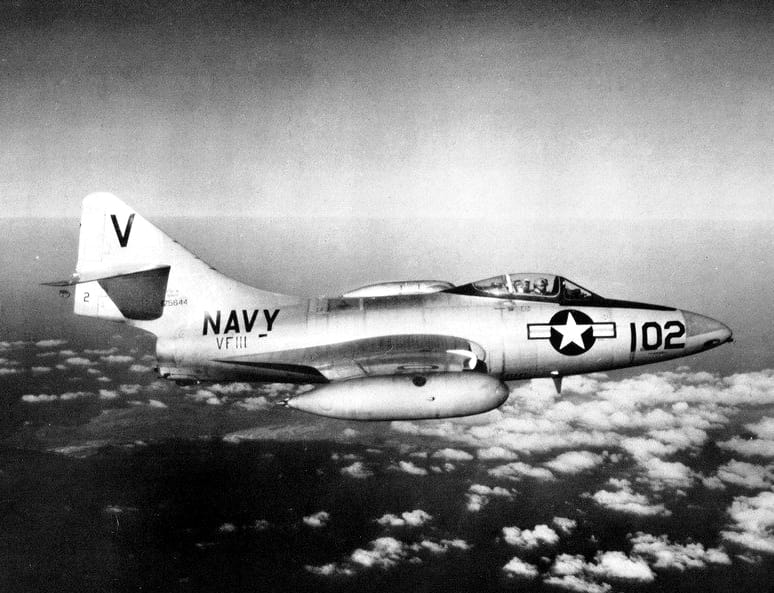
On 3 July 1950, barely a week into the Korean War, Lieutenant JG Leonard Plog rolled his straight-winged jet onto the tail of a propeller-driven Yak-9 and squeezed the trigger. It was the first air-to-air kill ever scored by a US Navy jet, and it belonged to a stubby, tip-tanked fighter called the Panther.
Grumman had started the design in the last months of World War II, mating a single imported Rolls-Royce Nene engine to a rugged carrier airframe. The permanent tanks on the wingtips gave the Panther its unmistakable silhouette, and after its 1947 maiden flight it was cleared for carrier operations in September 1949.
Kurzinfo
| Typ | Single-seat, single-engine carrier jet |
| Erster Flug | 21 November 1947 |
| Kraftwerk | 1 x Pratt & Whitney J48 turbojet (F9F-5) |
| Höchstgeschwindigkeit | 579 mph (932 km/h) |
| Anzahl gebaut | 1,382 |
| Notable pilots | John Glenn, Ted Williams, Neil Armstrong |
| Schicksal | Frontline to 1956; Argentina to 1969 |
The Navy's Korean Workhorse
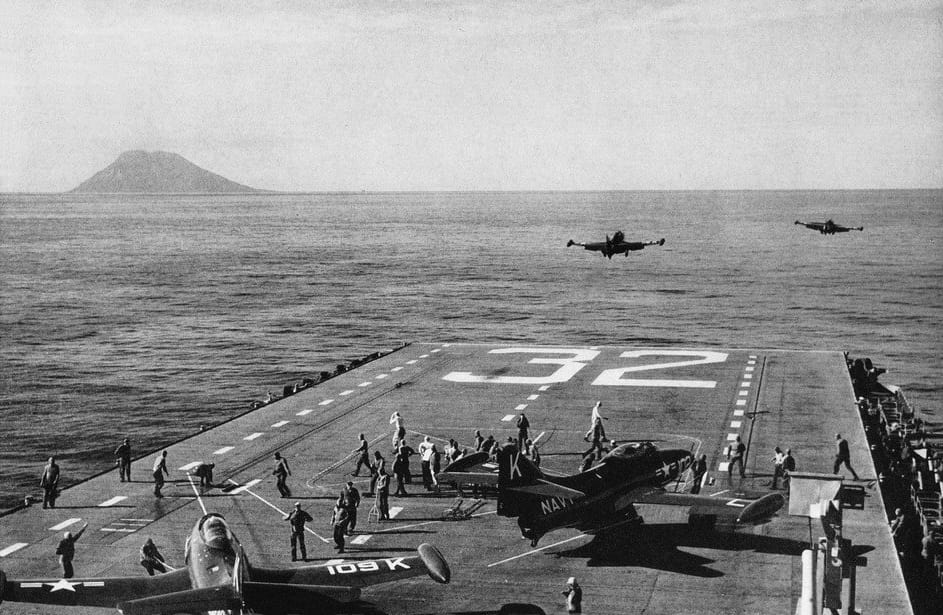
Over Korea the Panther became the US Navy and Marine Corps' primary jet, flying some 78,000 sorties. It was outclassed in a straight fight by the swept-wing MiG-15, yet Panther pilots still claimed seven of them for the loss of two of their own, and spent most of the war hammering bridges, flak sites and supply lines as a tough, dependable attack aircraft.
The cockpit roster reads like a hall of fame. Future astronaut John Glenn flew Panthers as a Marine, alongside baseball legend Ted Williams, who left the Boston Red Sox to serve. Fellow moonwalker-to-be Neil Armstrong flew them too, and ejected after his jet clipped a cable strung across a Korean valley.
One Panther Against Seven MiGs
The most astonishing Panther story stayed secret for forty years. On 18 November 1952, Lieutenant Royce Williams found himself alone against a swarm of Soviet MiG-15s over the Sea of Japan. In a running half-hour battle he shot down four, nursed his shattered jet back to the carrier riddled with 263 hits, and was ordered never to speak of it to avoid igniting open war with Moscow.
The Panther also became the first jet of the Navy's Blue Angels, thrilling airshow crowds from 1949. Withdrawn from frontline service in 1956, a handful soldiered on with Argentina until 1969.
It was never the fastest cat in the sky, but the Panther put the US Navy into the jet fight and carried some of the twentieth century's most famous aviators there in one piece.
A short history of Grumman’s jet cat and the war that made it famous:
Sources: Wikipedia; Task & Purpose; National Naval Aviation Museum; U.S. Navy.
0 Kommentare