
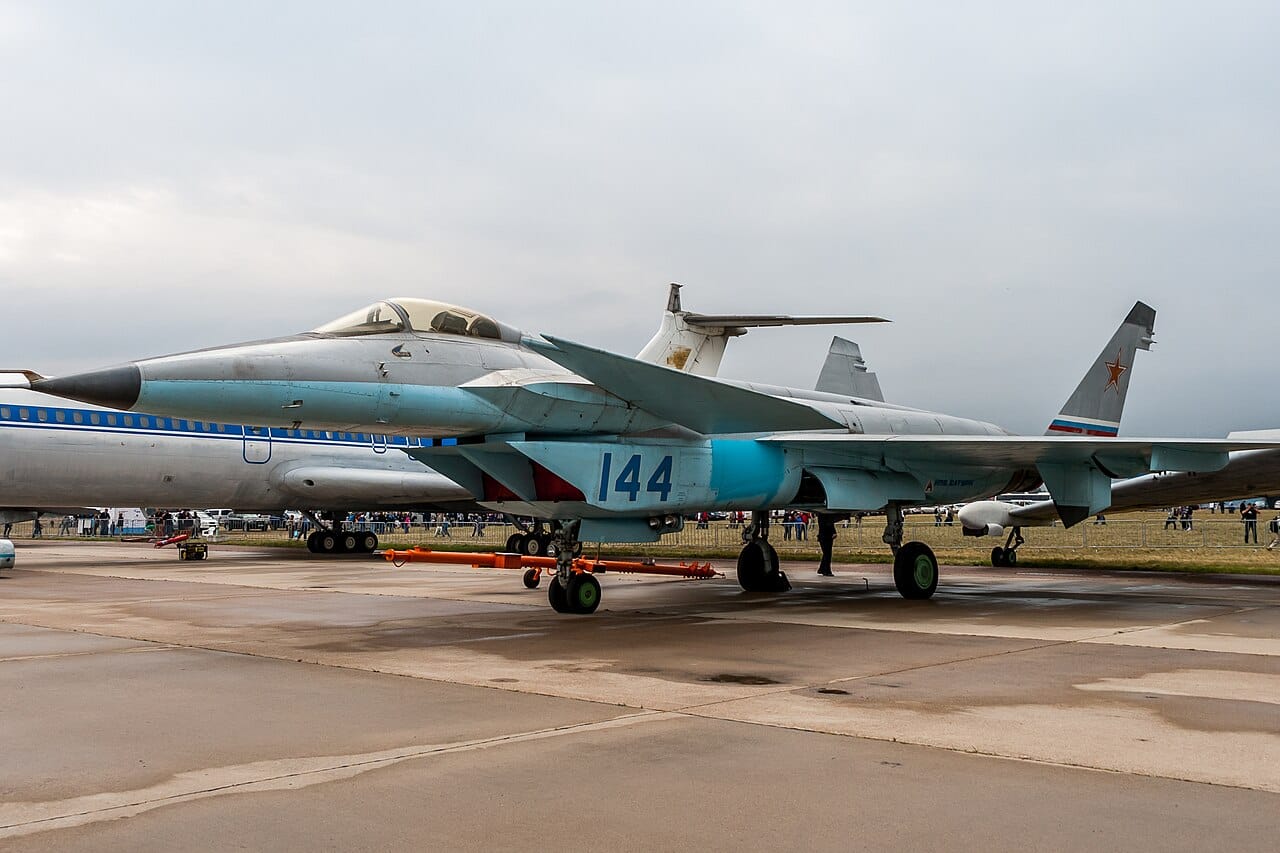
In 1997, the Russian government formally cancelled the fighter that was supposed to answer the American F-22. Three years later, in front of an invited crowd at Zhukovsky, that cancelled fighter took off anyway.
The Mikoyan 1.44 is one of aviation's strangest footnotes: a fifth-generation technology demonstrator that flew a grand total of twice, years after the programme it belonged to had already been declared dead. It is a story of Soviet ambition, post-Soviet poverty, and an aircraft that arrived just in time to be obsolete.
Kurzinfo
- Typ: Mikoyan 1.44 — technology demonstrator for the 1.42 fighter
- Programm: MFI (Multifunctional Frontline Fighter), rooted in the 1983 I-90 requirement
- Layout: Canard-delta, twin afterburning turbofans (~130 kN class)
- Erster Flug: 29 February 2000, test pilot Vladimir Gorbunov (18 minutes)
- Second flight: 27 April 2000 (22 minutes) — then nothing
- Abgesagt: Programme discontinued 1997; superseded by PAK FA / Su-57
- Sole prototype: Gromov Flight Research Institute, Zhukovsky
A child of the 1980s
The lineage begins in 1983, when the Soviet Union approved the I-90 requirement — the “fighter of the 1990s” — as its counter to the American Advanced Tactical Fighter that would become the F-22 Raptor. Mikoyan's answer was the Multifunctional Frontline Fighter, or MFI. Two designations attached to it: 1.42 for the intended production aircraft, and 1.44 for the demonstrator that would prove the concept in the air.
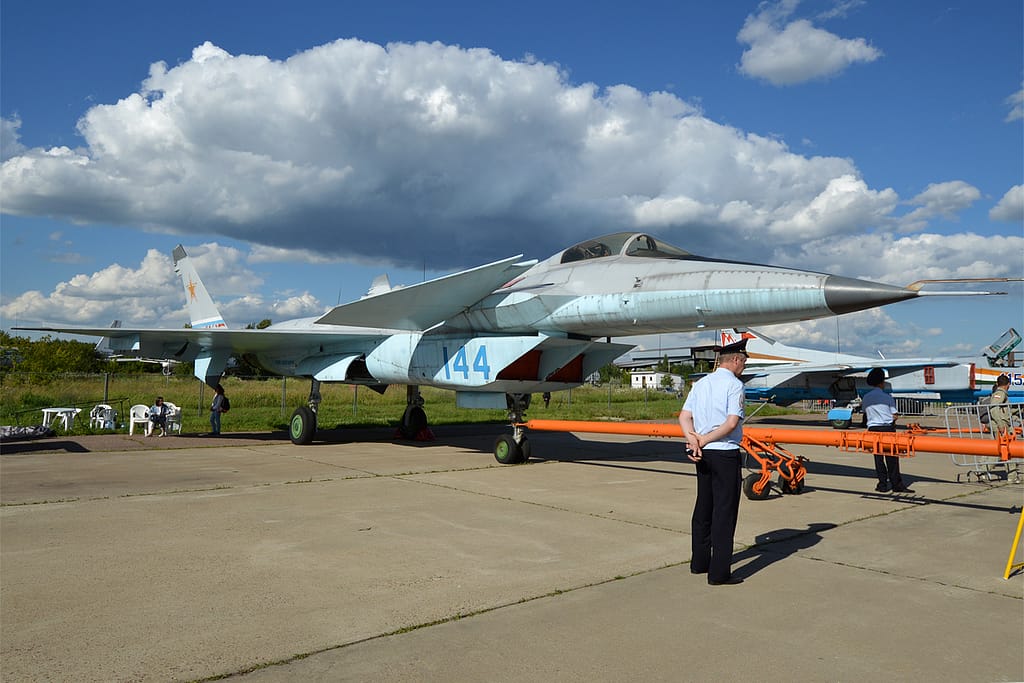
The design was aggressive. A large canard-delta planform promised supermaneuverability; the airframe was meant to cruise beyond Mach 2 and to fold in the era's new ideas about radar signature. On paper, it was a genuine fifth-generation contender, conceived to replace the Su-27 in frontline service.
Killed by economics, not engineering
Then history intervened. The collapse of the Soviet Union in 1991 gutted the defence budget, and the MFI became a casualty of the chaos. Development slipped year after year for lack of money. In 1997, the government formally pulled the plug — and yet the single completed demonstrator still sat at Zhukovsky, essentially finished. Mikoyan revealed it to the public in January 1999, an aircraft with no programme left to serve.
On 29 February 2000, test pilot Vladimir Gorbunov finally took the 1.44 into the air — roughly nine years late. The flight lasted 18 minutes and stayed gentle: a maximum altitude of about 1,000 metres and a speed of some 600 km/h. A second sortie followed on 27 April, lasting 22 minutes. After that, the aircraft never flew again.

The legacy that outlived the jet
The 1.44's engineering did not vanish with the programme. Russia's fifth-generation effort restarted under the PAK FA banner, a leaner and more affordable design that Sukhoi — not Mikoyan — would carry to service as the Su-57. The 1.44 became the road not taken: the ambitious, canard-heavy answer that the country simply could not afford in the 1990s.
Today the sole prototype rests at the Gromov Flight Research Institute. It is a strangely poignant machine — not a failure of design so much as a victim of timing, a Cold War fighter that outlived the Cold War by just long enough to prove it could fly, and no longer.
Sources: Wikipedia (Mikoyan Project 1.44); Vintage Aviation News; The National Interest; military-factory.com.

0 Kommentare