
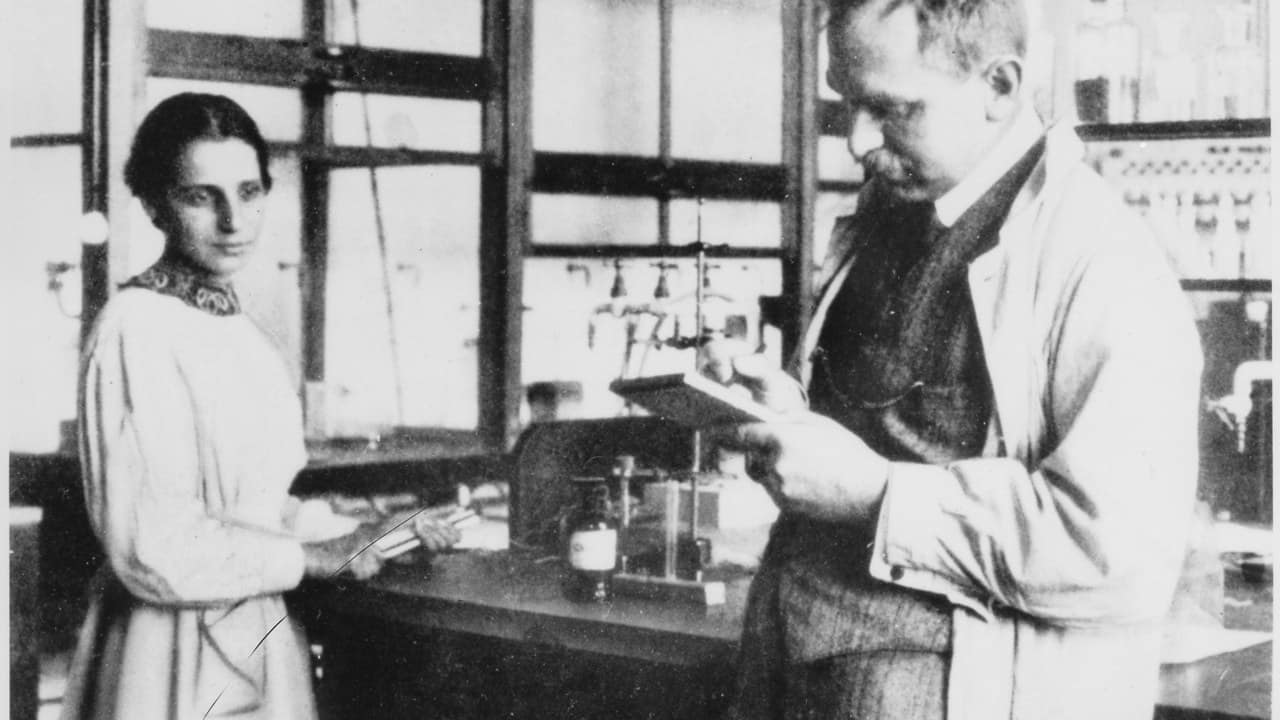
Part 3 of The Race for the Bomb, an Afterburner focus series. Part 2 followed the exodus of Europe’s Jewish scientists. Now, in a Berlin laboratory those laws had just emptied, the uranium atom comes apart.
Kungälv, on the Swedish west coast, the third day of Christmas 1938. Snow on the ground, and two figures moving slowly through the woods: a 60-year-old exile on foot and her nephew on skis. Lise Meitner had insisted she could keep up perfectly well without skis, and she did.
In her pocket was a letter from Berlin that could not be true. Otto Hahn — her research partner of thirty years, writing to the colleague the race laws had chased out of Germany five months earlier — reported that when he and Fritz Strassmann bombarded uranium with neutrons, out came something that behaved, chemically, in every test, exactly like barium. Barium sits near the middle of the periodic table. It was as if you had fired a pea at a cannonball and the cannonball had come apart into two cannonballs of half the size. Perhaps, Hahn pleaded, you can come up with some fantastic explanation.
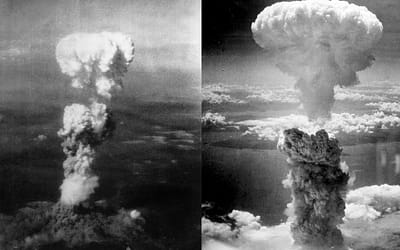
Aunt and nephew stopped, sat down on a fallen tree trunk, and began doing physics on scraps of paper. What they worked out in that snowy wood — before returning, very quietly, to Christmas dinner — was that no one on Earth yet knew but them: the uranium nucleus can split. Within seven years the calculation on those scraps would flatten two cities. This is the story of the discovery, and of the letter, the memorandum and the safe that carried it from a Swedish forest to the White House.
Quick Facts: The Discovery of Fission
- 10 marks — all the money Meitner carried out of Germany in July 1938, plus a borrowed diamond ring
- 200 MeV — the energy per split uranium nucleus, calculated on a tree trunk at Christmas 1938
- ~3.5 neutrons per fission — the Paris measurement of April 1939 that confirmed a chain reaction (modern value ~2.5)
- $6,000 — the first US government funding for uranium research, October 1939
- About a pound — the Frisch-Peierls critical-mass shock estimate, where everyone expected tons
- 25 lb ≈ 1,800 tons of TNT — the MAUD Report’s bomb, July 1941
- 46 Nobel nominations, zero prizes — Lise Meitner’s ledger
The Letter from Berlin
Rewind five months. Meitner had spent three decades building, with Hahn, one of the great scientific partnerships of the century at the Kaiser Wilhelm Institute in Berlin — she the physicist, he the radiochemist. Austrian citizenship shielded her from the Nazi purges until March 1938, when the Anschluss dissolved Austria and her protection with it. On the night of 12 July she packed for ninety minutes. Hahn pressed his mother’s diamond ring into her hand — bribe money in crystal form, in case the border guards needed persuading. On 13 July, escorted by the Dutch physicist Dirk Coster, she crossed into Holland with two small suitcases of summer clothes and ten marks. The guards never searched her.
Hahn and Strassmann kept working. On 16 and 17 December they ran the decisive experiment, and the impossible result would not go away: their neutron-bombarded uranium kept producing what chemistry insisted was barium. Hahn mailed the paper to Die Naturwissenschaften on 22 December — before Meitner had even replied to his letter — but he knew what he had and had not shown. As chemists, he and Strassmann wrote, they should call the substance barium; as nuclear chemists, they could not yet bring themselves to take a step so contradictory to all previous experience in physics.

It fell to the exile and her nephew, Otto Frisch — himself a refugee physicist, working at Bohr’s institute in Copenhagen — to supply the physics on their Christmas walk. Treat the nucleus as a liquid drop, they reasoned, and the electrical repulsion of 92 protons very nearly cancels the surface tension holding it together. A single slow neutron could set the drop wobbling until it pinched into two. The two fragments would fly apart with about 200 million electron volts of energy, and the missing mass — about one-fifth of a proton — supplied exactly that sum through Einstein’s E=mc². Frisch borrowed a word from a biologist for the way cells divide, and named the process fission.
“What Idiots We Have All Been!”
Back in Copenhagen in the first days of January, Frisch caught Niels Bohr just as he was leaving for America. He had barely begun explaining when, as Frisch later recalled it, Bohr struck his own forehead and exclaimed: oh, what idiots we have all been! We could have foreseen it all — this is just as it must be. Bohr sailed on 7 January carrying the secret; a colleague, not realising it was confidential, spilled it at a Princeton seminar the evening they landed, and by the time the Washington Conference on Theoretical Physics convened on 26 January the news was loose in America. Physicists walked out of the session mid-lecture to go split uranium in their own basements. Frisch, meanwhile, had already confirmed fission directly on 13 January, catching the monstrous ionisation pulses of the recoiling fragments; the Meitner-Frisch interpretation, composed by long-distance telephone between Stockholm and Copenhagen, appeared in Nature on 11 February 1939.
One question remained, and it was Szilard’s question from Part 1: does a splitting uranium nucleus emit fresh neutrons? In March 1939 at Columbia, Szilard and Walter Zinn ran the experiment — on a gram of radium rented with 2,000 borrowed dollars — and watched the flashes on their screen that meant yes. That night, Szilard wrote later, there was very little doubt in my mind that the world was headed for grief. In Paris, Frédéric Joliot’s team published the same discovery in Nature on 18 March, and in April measured roughly three and a half neutrons per fission. Szilard begged the Paris group to keep the numbers secret. Joliot refused; the era of open publication had one last, fatal spasm, and every physicist from Moscow to Tokyo could now do the arithmetic.
A Porch on Long Island
You know from Part 2 how the warning reached Roosevelt: Wigner and then Teller chauffeuring the non-driving Szilard to Einstein’s summer cottage near Peconic; Einstein’s astonished admission that he had not thought of a chain reaction at all; the letter signed on 2 August 1939.
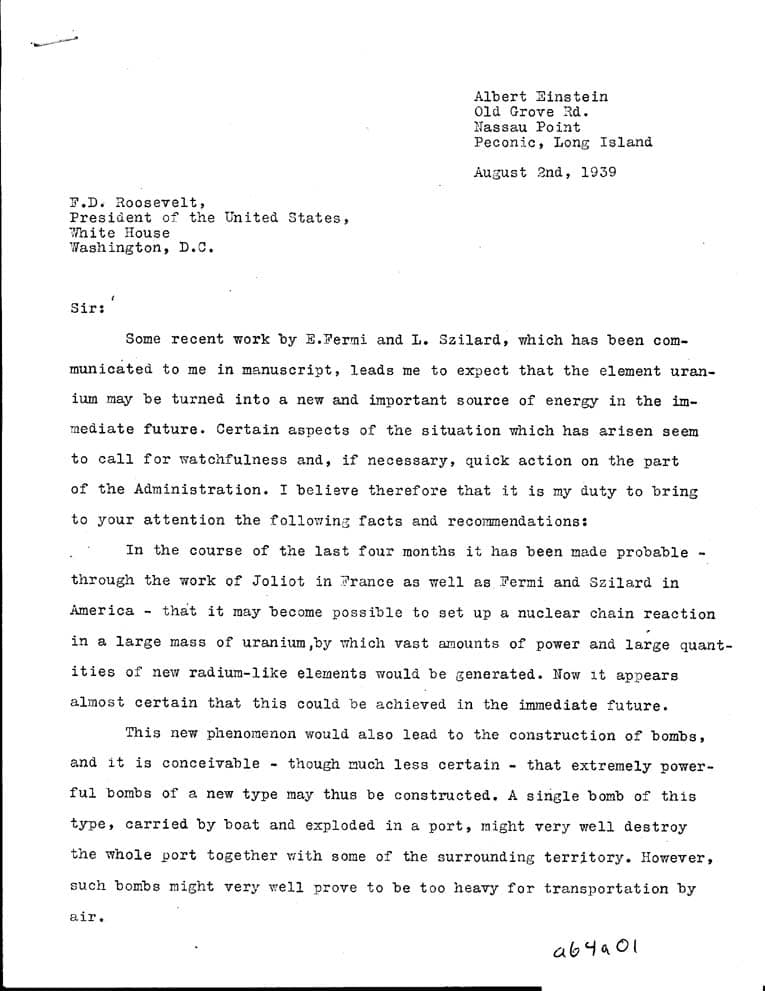
The economist Alexander Sachs finally put the letter in Roosevelt’s hands on 11 October. Alex, the president summarised, what you are after is to see that the Nazis don’t blow us up — and told his aide the matter required action. What action produced was one of the great anticlimaxes of the war: an Advisory Committee on Uranium under Lyman Briggs, a cautious 65-year-old government scientist, which met on 21 October 1939, granted exactly 6,000 dollars for graphite and uranium, reported that a bomb was possible, and watched its report disappear into a White House file. For nearly two years, the country that would build the bomb did almost nothing about it.
Two Enemy Aliens and One Page of Arithmetic
The logjam broke in Britain, and the men who broke it were officially too suspect to be told secrets. In Birmingham in March 1940, Otto Frisch — the same Frisch, now in England — and Rudolf Peierls were classed as enemy aliens and barred from the radar work going on down the corridor. Left alone with the one problem nobody guarded, they asked: never mind natural uranium — how much pure uranium-235 would a bomb actually need? The consensus said tons, comfortably unbuildable. Peierls’s formula and Frisch’s cross-section estimate returned an answer of about a pound. They checked it, stared at it, and wrote the two-part Frisch-Peierls memorandum — the founding document of the atomic age as a practical weapon.
Their memo — its true critical-mass figure was an underestimate, but the order of magnitude changed everything — went up the chain and created the MAUD Committee, which owes its name to a misunderstanding worthy of a spy farce: a garbled telegram from Bohr ending “tell Cockcroft and Maud Ray Kent.” British intelligence hunted for the code; Maud Ray of Kent turned out to be the former governess of Bohr’s sons.
The OpenMind explainer on Lise Meitner and the discovery of nuclear fission — the Kungälv walk, the liquid drop and the stolen Nobel, in eight minutes.
The Report in the Safe
The MAUD Report of July 1941 is the hinge of this entire series. It concluded that an effective uranium bomb containing some 25 pounds of active material was feasible, equivalent to about 1,800 tons of TNT, and possibly ready in two years. Churchill minuted his assent with characteristic economy: although personally quite content with the existing explosives, he felt Britain must not stand in the path of improvement. The British programme took the deliberately boring name Tube Alloys.
And America? The MAUD papers had been sent to Lyman Briggs months earlier. When the Australian physicist Mark Oliphant flew the Atlantic in an unheated bomber in August 1941 to find out why the Americans had gone silent, he discovered the answer: Briggs, too security-minded to share and too cautious to act, had put the reports in his safe and shown them to no one — not even his own committee. Oliphant, appalled, toured America repeating the British conclusions to anyone with authority, finishing with Ernest Lawrence at Berkeley. The chain reaction of meetings that followed ran through Vannevar Bush to Roosevelt, who approved an all-out feasibility push on 9 October 1941. A National Academy report confirmed MAUD in November. Then came Pearl Harbor, and within ten days the program that would become the Manhattan Project had money, structure and a war to justify both.
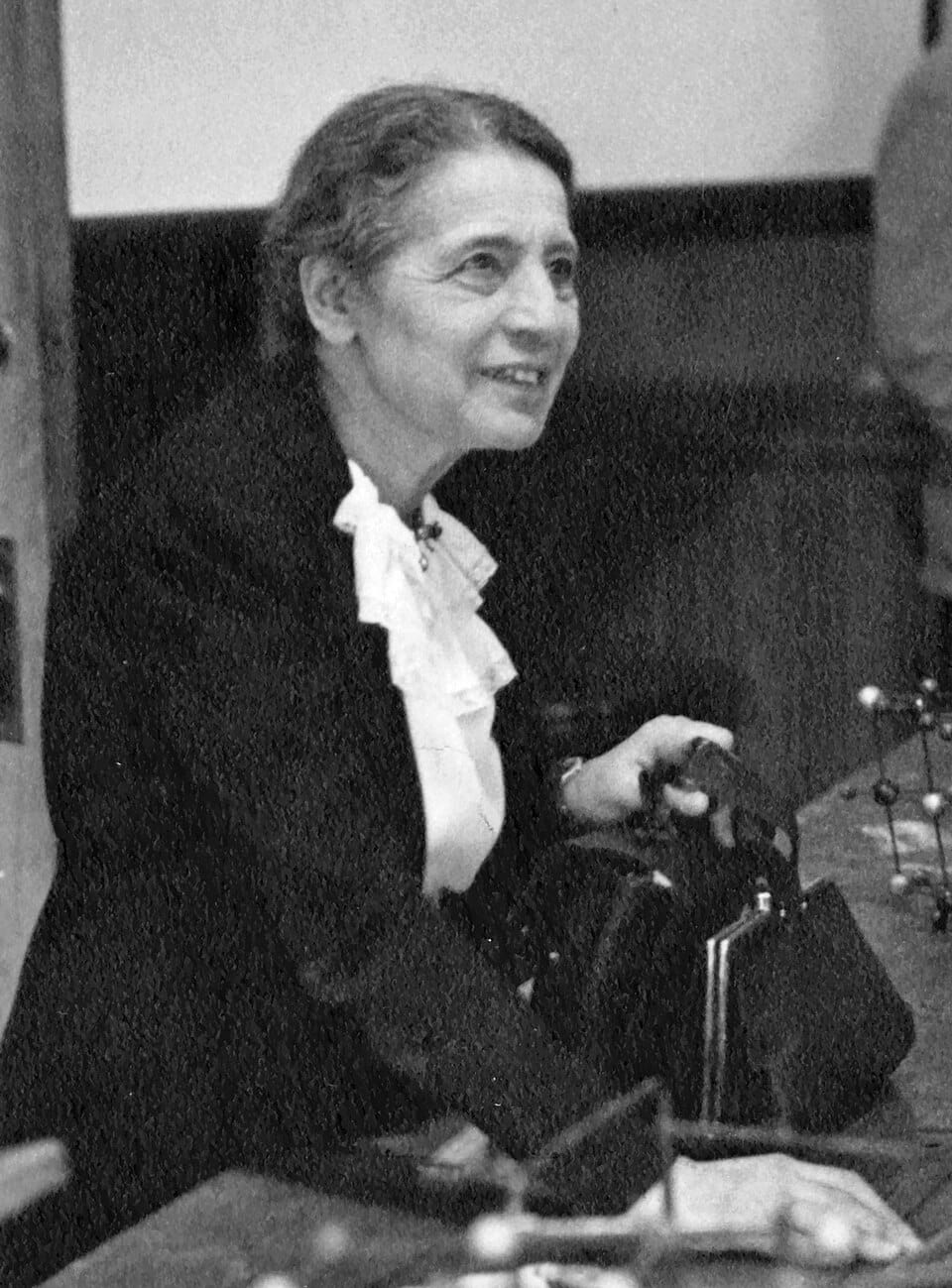
As for the two people on the tree trunk: Meitner was invited to join the bomb project and answered in one line — I will have nothing to do with a bomb. The 1944 Nobel Prize in Chemistry went to Otto Hahn alone; Meitner, nominated 46 times without success, eventually got an element instead: meitnerium, number 109. Frisch went to Los Alamos, where he measured critical masses by hand. And in Berlin, the regime that had exiled half its geniuses began organising its own uranium club — with the same physics, the same head start, and one catastrophic measurement error waiting for it. That is Part 4.
Sources: Nature (143, 1939), Die Naturwissenschaften facsimiles via German History Intersections, Atomic Heritage Foundation, PBS American Experience, Library of Congress, fissilematerials.org (MAUD Report full text), Wikipedia, Richard Rhodes: The Making of the Atomic Bomb.
The Race for the Bomb — an Afterburner Focus Series
Series overview: all ten parts
Previous — Part 2: The Martians Who Fled to America
Next — Part 4: Hitler’s Bomb Died on a Frozen Plateau
0 Kommentare