

The cargo compartment of a C-5A Galaxy is the size of a small warehouse. On the afternoon of 4 April 1975, the crew at Tan Son Nhut filled the lower deck of one with cardboard boxes, and into the boxes they put babies — two and three to a box, strapped down with cargo webbing, because the aircraft had no seats for infants and there were far too many infants for the seats it had.
Upstairs, in the troop compartment, older children sat belted in beside American women who had volunteered as escorts: nurses, embassy staff, teachers, secretaries from the Defense Attaché Office. Three hundred and fourteen people in total.
Twelve minutes after take-off, at 23,000 feet over the South China Sea, the back of the aeroplane blew off.
Kurzinfo
| Datum | 4 April 1975 (some contemporary accounts give 3 or 5 April) |
| Flugzeug | Lockheed C-5A Galaxy, serial 68-0218, 60th Military Airlift Wing |
| Mission | First flight of Operation Babylift, Tan Son Nhut to Clark Air Base |
| An Bord | 314 people |
| Lost | 138, including 78 children, 35 Defense Attaché Office staff and 11 USAF personnel |
| Survived | 176 |
| Ursache | Rear cargo door lock failure leading to explosive decompression and loss of tail flight controls |
| Crew | Capt Dennis “Bud” Traynor, Capt Tilford Harp, MSgt Allen Engles — Traynor and Harp both awarded the Air Force Cross |
Why the Children Were on That Aeroplane
By the first week of April 1975, North Vietnamese forces held most of South Vietnam and were closing on Saigon. The Ford administration wanted Americans out, but a visible evacuation risked panic in a city already fraying. Ambassador Graham Martin approved a set of quieter departures instead. One of them was Operation Babylift: American adults would fly out accompanying South Vietnamese orphans, many of them already matched with adoptive families in the United States and Europe.
The first aircraft was to fly to Clark Air Base in the Philippines. From there the children would transfer to charter flights, and President Ford would meet them personally when they landed in San Diego.
CBS News coverage from 4 April 1975 — period reporting on the crash as the story broke.
Twelve Minutes
At 4:15 p.m. the Galaxy was thirteen nautical miles off Vũng Tàu, on a heading of 136 degrees, climbing through 23,000 feet. The locks on the rear loading ramp let go and the cargo door departed the aircraft.
The decompression was instantaneous. Air, fog, insulation and loose equipment went out through the hole. Traynor, thirty years old and in the left seat, later described the moment plainly.
The departing door took the flight control cables with it. Traynor has described the rear of the aircraft afterwards as a gaping hole with the control cables hanging out of the back like spaghetti. Two of the four hydraulic systems failed, taking with them the rudder and the elevator — the controls that point the aircraft up, down and around.
What was left was one aileron, the spoilers, and the throttles. To descend or climb, the crew had to work the engines: more power to rise, less to sink, riding the long slow porpoise the aeroplane now wanted to fly. That oscillation has a name, the phugoid, and it is the thing that has killed most crews who ever lost their hydraulics. Traynor, Harp and Engles held it, turned 180 degrees, and pointed the Galaxy back at Saigon.
They got it down to 4,000 feet and lined up on Tan Son Nhut’s runway 25L, descending at 250 to 260 knots. Turning onto final, the sink rate suddenly ran away from them. They pushed the throttles up. It was not enough.
The Rice Paddy
At 4:45 p.m. the aircraft touched down in a paddy field short of the runway. It slid a quarter of a mile, lifted off again for another half mile, crossed the Saigon River, struck a dike and broke into four pieces. Fuel ignited in some of the wreckage.
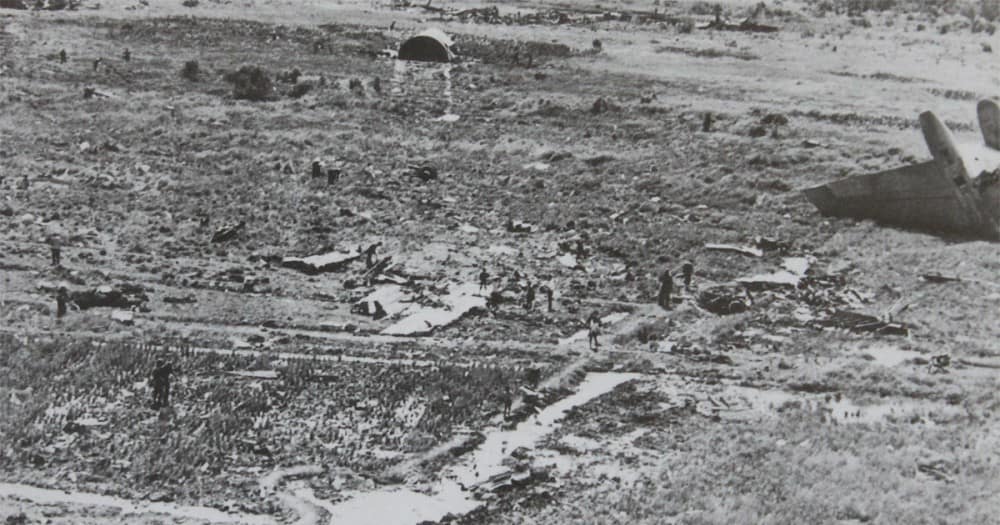
The upper deck, where the older children and most of the escorts were, stayed largely intact. The lower deck did not. Almost everyone who died was below.
Then came the part that no rescue plan had allowed for. The wreck lay in deep mud a mile from the nearest road. Fire engines could not get to it. Helicopters had to land some distance away and the survivors had to be carried out on foot, through the paddy, to reach them. About a hundred South Vietnamese soldiers formed a cordon — the site was close to ground where there had been a firefight with the Viet Cong the night before.
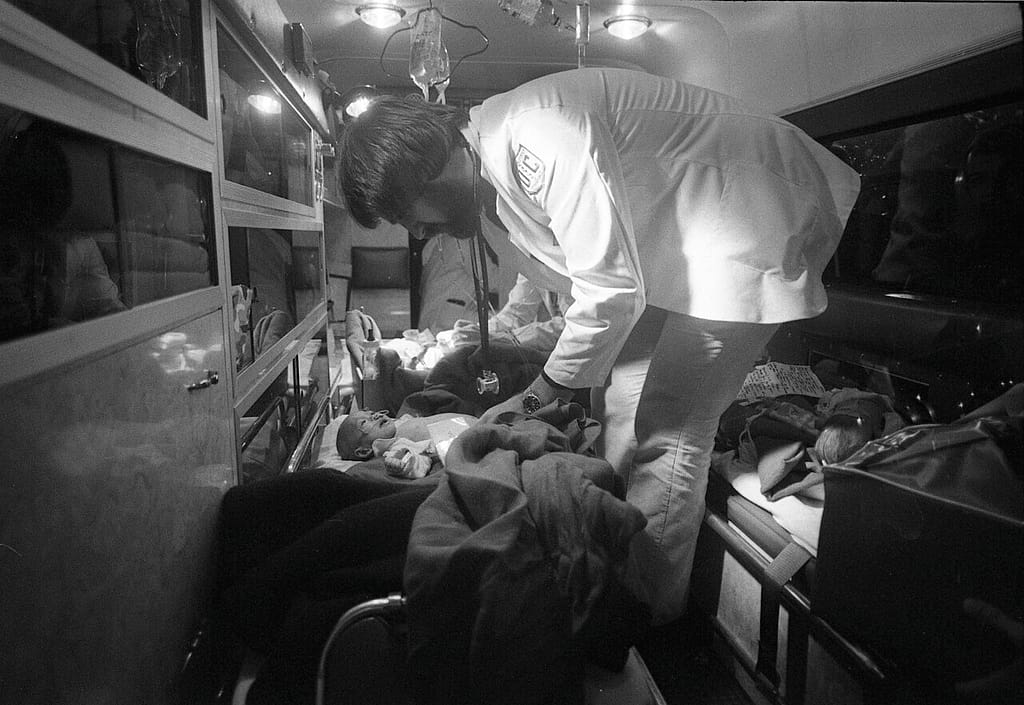
Among the survivors was 1st Lieutenant Regina Aune, a USAF flight nurse. She climbed out of the troop compartment and began passing children to the helicopters. She went back into the mud and did it again, and again, and carried roughly eighty children out before her body stopped cooperating. Only afterwards was it established that she had been doing this with a broken foot, a broken leg and a fractured vertebra.
When she could no longer stand, she found the ranking officer and asked, in the formal language of the service, to be released from her duty.
Then she collapsed. She received the Cheney Award for 1975. Thirty-seven medals in total went to the crew and their next of kin.
A survivor who was seven months old on the flight returns to walk through a C-5 Galaxy decades later.
Seven Locks
Because the door had failed so violently, sabotage was the first assumption. Saigon in April 1975 was not short of people with reason to attack an American aircraft.
The US Navy went looking for the evidence. USS Abnaki and USS Deliver recovered the rear hatch and the flight recorder from the South China Sea. On land, the investigation was hampered by looting of the wreck; the Air Force ended up paying a bounty to buy components back from local people.
The answer, when it came, had nothing to do with the enemy. Several of the door locks had never properly engaged. Locks had been cannibalised from other C-5s to keep aircraft flying and refitted badly, degrading how they seated. An initial inspection found five of the seven locks inoperative. Under pressure to get the flight away, a second, off-shift maintenance team was brought in — and missed it. The aircraft was signed out as airworthy.
The flight crew had struggled with the doors before departure, cycling them open and closed several times to get an indication that they were locked. As the aircraft climbed and the pressure differential across the door grew, the handful of locks doing the work of seven gave way.
A full documentary reconstruction of the flight, the door failure and the investigation that followed.
Afterwards
It remains the third-deadliest accident involving a United States military aircraft. It was the first fatal loss in the C-5 fleet’s history. Members of Congress called for the type to be grounded; instead the fleet flew under heavy restrictions for months while the cause was pinned down. Five Defense Intelligence Agency employees died in the crash, and it stood as the single largest loss of life in that agency’s history until September 2001.
The Air Force accident board concluded that anybody survived at all because of how Traynor handled the aircraft — his unorthodox flying on power alone, and his decision to put it on the ground while he still had some control rather than gamble on reaching the runway.
Operation Babylift did not stop. Over the following weeks it carried more than two thousand children out of Vietnam, and it remains genuinely contested: some of those children were not orphans, some families were separated in the chaos, and a number of the adults who organised it have spent fifty years arguing about whether it was rescue or removal. Those are fair questions and they deserve their own telling.
The surviving children were flown on to the United States. The children who died were cremated and buried at the cemetery of St Nikolaus Catholic Church in Pattaya, Thailand. In 2025, fifty years on, survivors of the flight gathered to meet each other again.
Every one of them owes it to three men working a broken aeroplane with the throttles, and a nurse with a fractured spine who kept going back into the mud.
Sources: USAF Accident Investigation Board findings; “Last Flight From Saigon”, USAF Southeast Asia Monograph Series IV; CINCPAC Command History Appendix III: Babylift; Aviation Safety Network; Air & Space Forces Magazine; US Air Force heritage archives; Defense Intelligence Agency historical division.

0 Kommentare