
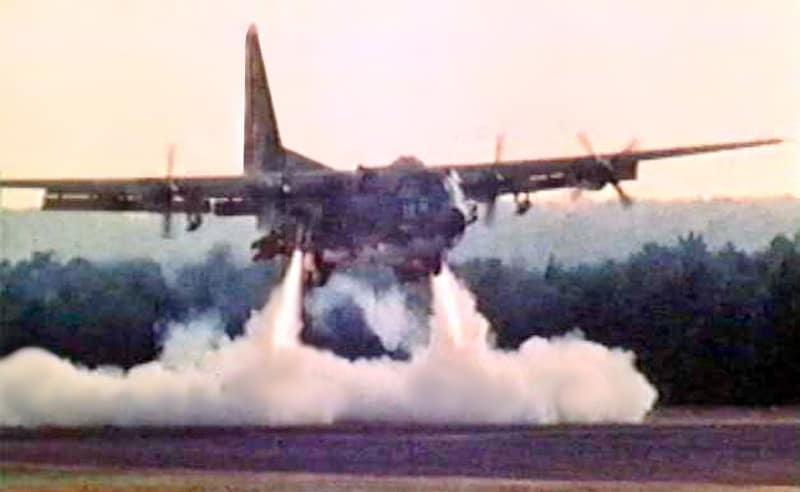
In the autumn of 1980, American engineers strapped thirty rockets to a C-130 Hercules. The plan was insane and deadly serious: fly the four-engine transport into a soccer stadium in the middle of Tehran, stop it inside the length of the pitch, load fifty-two American hostages, and blast it back into the sky almost vertically before the walls arrived.
The programme was called Credible Sport. It produced one of the most extraordinary aircraft ever built — and one of the most spectacular test crashes ever filmed.
Kurzinfo
| Programm | Operation Credible Sport (1980) |
| Flugzeug | Lockheed C-130H modified to XFC-130H "Super STOL" |
| Rockets fitted | 30, in five sets (braking, descent and lift) |
| Ziel | Land and take off inside a Tehran stadium |
| Crash | 29 October 1980, Wagner Field, Eglin AFB — no fatalities |
| Ergebnis | Cancelled after a hostage-release deal; hostages freed Jan 1981 |
Born from a disaster
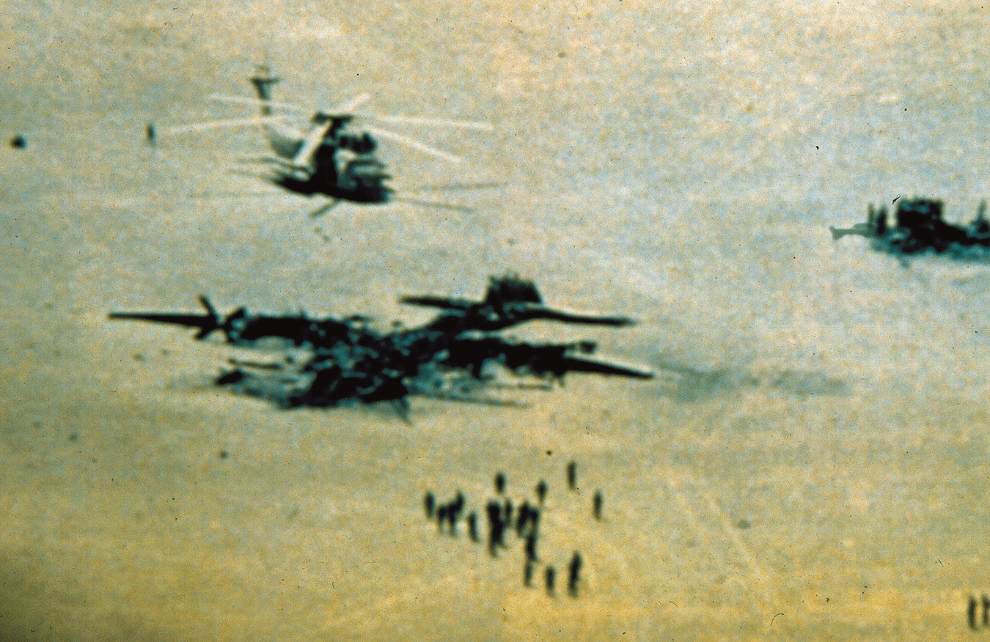
Credible Sport existed because the first rescue attempt had ended in catastrophe. On 24 April 1980, Operation Eagle Claw collapsed at a desert refuelling point code-named Desert One, where a helicopter collided with an EC-130 and eight servicemen died. The mission was aborted; the hostages stayed in Tehran.
A second attempt would need to land right in the heart of the city — and there was no runway. So planners turned to the only flat, open space near the embassy: the Amjadieh soccer stadium. The problem was getting a Hercules in and out of a space barely 600 feet long, ringed by 90-foot obstacles.
Thirty rockets and a very short field
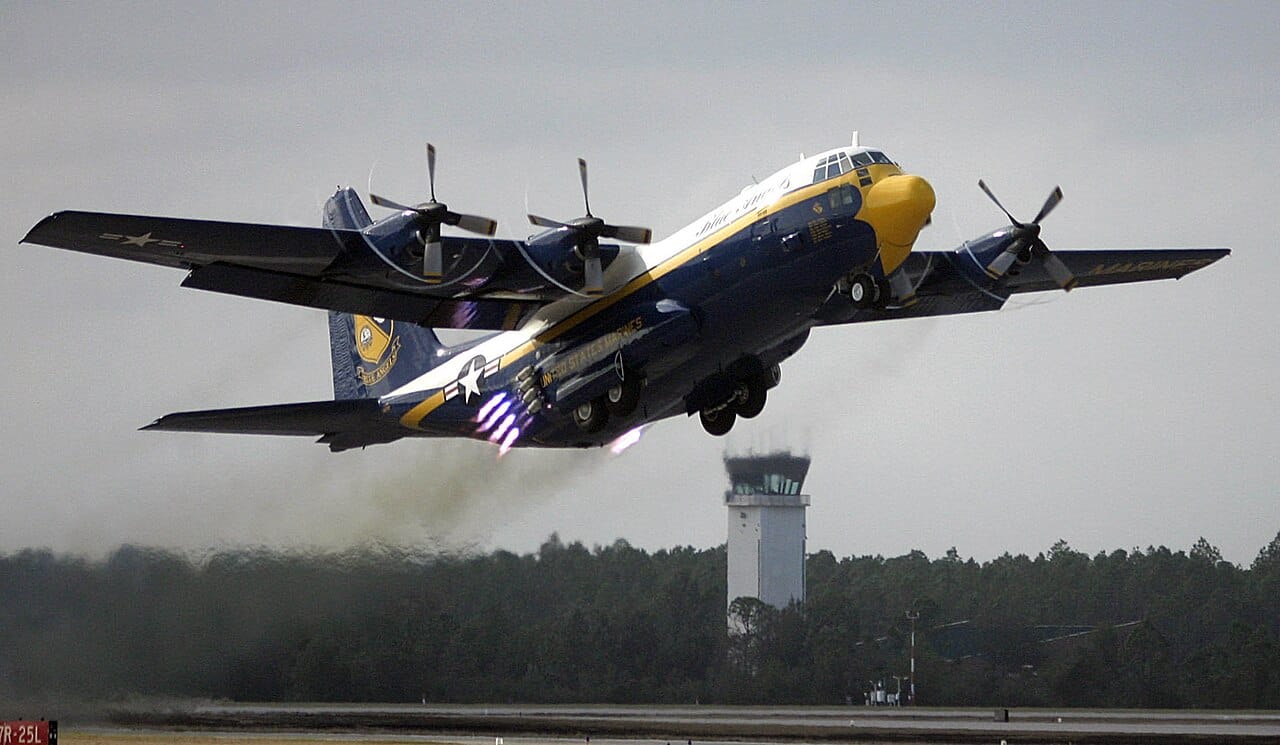
The engineering answer was brute force. Lockheed and the Air Force bolted rockets all over the airframe: motors firing forward to slam it to a stop on landing, motors firing down to cushion the descent, and motors firing backward to hurl it off the ground on takeoff. Add double-slotted flaps, a tailhook for carrier recovery, and terrain-following radar, and the XFC-130H "Super STOL" was born.
And it worked — brilliantly, at first. Test crews recorded takeoff performance that reads like science fiction.
The day it all went wrong
On 29 October 1980, at Wagner Field on the Eglin range, the crew flew the full landing profile. Then the sequence misfired: the braking rockets fired at the wrong instant while the descent-cushioning rockets did not fire at all. The Hercules dropped like a stone, slammed onto the field, and its starboard wing tore off between the engines. Fire erupted — and was smothered within seconds. Astonishingly, everyone walked away.
Days later, events overtook the machine. Iran accepted an Algerian-brokered release plan, Ronald Reagan won the presidency, and the second raid was shelved. The 52 hostages walked free on 20 January 1981. One of the surviving rocket-Hercules airframes still exists, preserved at a New York museum — proof that the maddest idea in special-operations aviation was also, very nearly, real.
Sources: Col. Jerry Thigpen, "The Praetorian STARShip"; Joseph Trevithick, War is Boring; Wikipedia.

0 Kommentare