
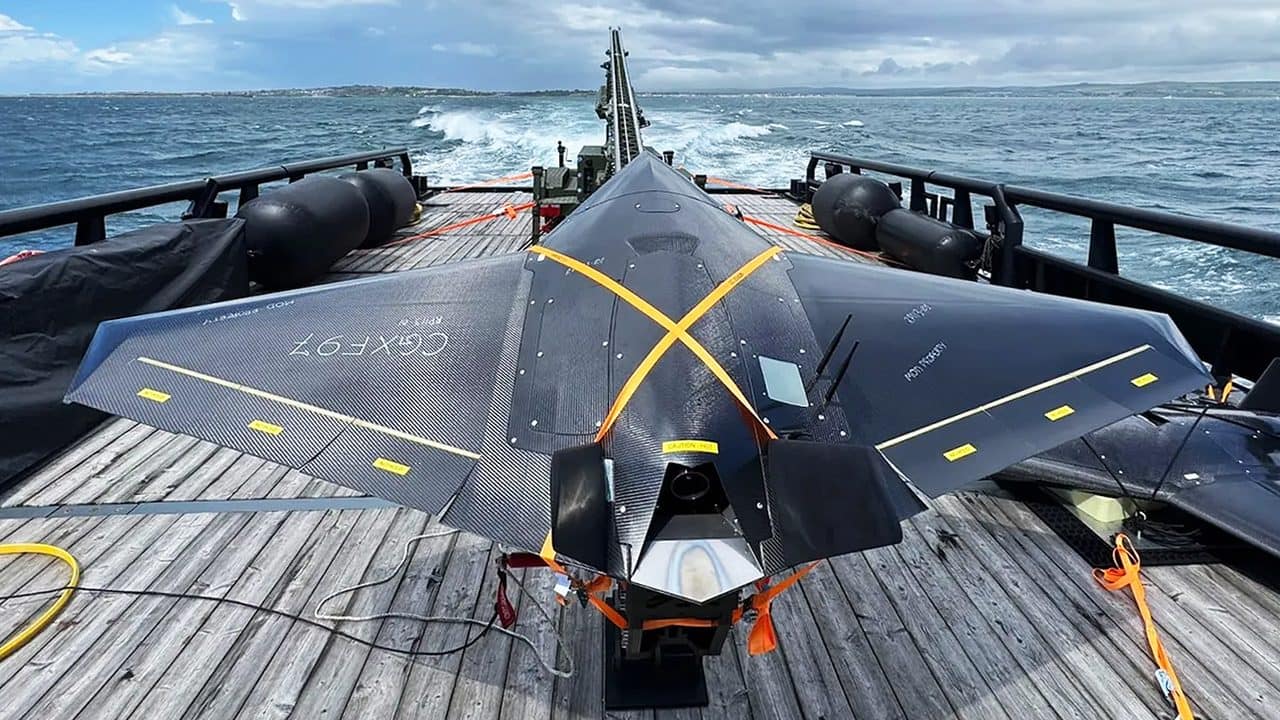
Off the south coast of England, a small black flying wing shot off a catapult rail bolted to the deck of a moving Royal Navy ship, climbed away on a whining turbojet, and flew itself to a target. No pilot, no recovery, no second chances — the Nyan is designed to fly one way. And with that single launch, the Royal Navy stepped into the age of the expendable strike drone.
The trial, revealed on July 3 and reported by The War Zone and The Aviationist, is Britain’s clearest statement yet of where its fleet is going: a “hybrid navy” where crewed warships carry magazines full of cheap, disposable aircraft.
Quick Facts: Nyan One-Way Effector
| Was ist passiert | First Royal Navy at-sea launch of the Nyan strike drone, from the experimentation ship XV Patrick Blackett |
| The trial | Exercise Neptune Reach — Royal Navy 744 NAS, British Army 26 Royal Artillery and RAF personnel |
| The drone | Carbon-fibre flying wing, turbojet-powered, ~9.5 ft wingspan, range over 150 km |
| Kosten | Under £100,000 ($132,000) per unit; more than 1,000 built so far |
| Pedigree | Built by Callen-Lenz (a BAE Systems subsidiary); combat debut in Ukrainian hands |
A Catapult on the Quarterdeck
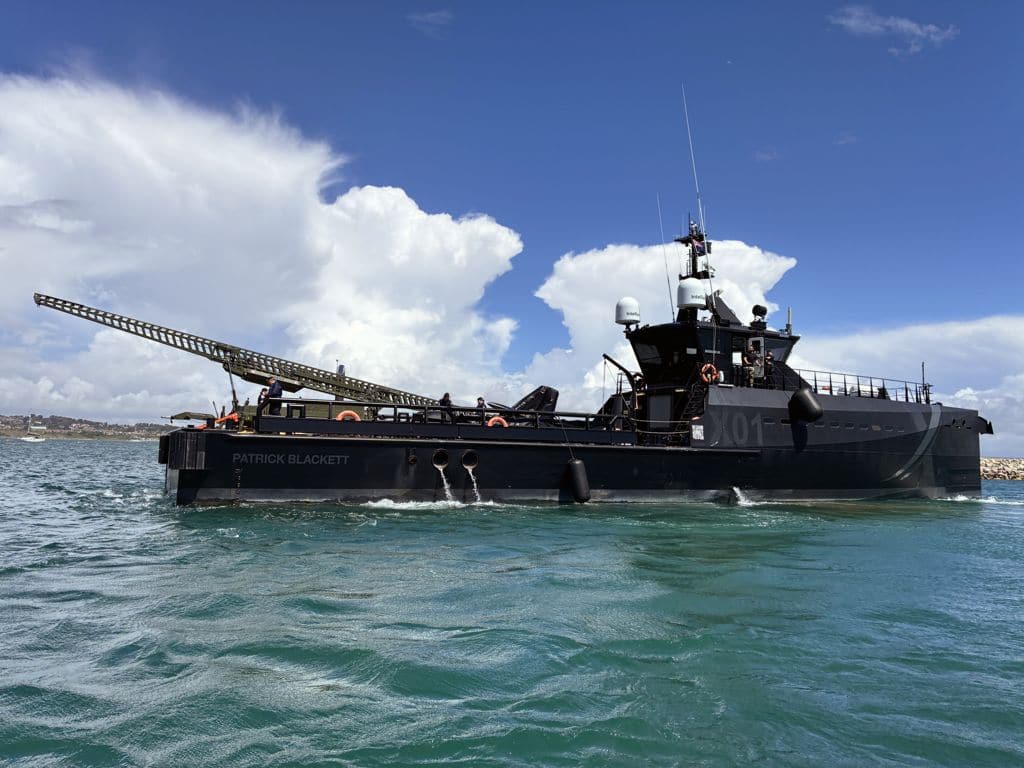
The launch platform was XV Patrick Blackett, the Royal Navy’s dedicated experimentation ship — essentially a floating laboratory for technologies the fleet wants to adopt quickly. For Exercise Neptune Reach, engineers simply installed the Nyan’s catapult launcher on deck. Operators programmed a target, the ship kept sailing, and the drone flew the strike profile autonomously.
The joint nature of the trial is the point: the British Army’s Royal Artillery already operates the Nyan on land, and it was gunners from 26 Royal Artillery working alongside the Navy’s 744 Naval Air Squadron who put it to sea. Under the tri-service Project Vantage, the Royal Navy wants one-way effectors integrated across the fleet.
Cheap, Stealthy, Expendable
The Nyan itself is a study in ruthless economics. Designed and built since 2022 by Callen-Lenz, a BAE Systems subsidiary, it is a carbon-fibre flying wing with a wingspan of roughly 9.5 feet, a small turbojet, and a reported range of more than 150 kilometres — farther than the Harpoon anti-ship missile the Royal Navy is retiring. The design even nods to stealth, with a shielded exhaust nozzle to frustrate air defences.
The price is the headline: under £100,000 per drone. That is not a typo — it is roughly one-tenth the cost of a single modern anti-ship missile. More than 1,000 have already been built, and the type has been proven the hard way: before the Royal Artillery adopted it, the Nyan made its combat debut in Ukrainian hands.
The Hybrid Fleet Takes Shape
The timing was no accident. The trial surfaced days after the UK’s Defence Investment Plan bet billions on autonomous systems — including, controversially, sacrificing a future destroyer programme to pay for drones. A frigate that can lob swarms of £100,000 strike drones from beyond missile range is a different kind of warship, and a different kind of budget line.
The Royal Navy says the Patrick Blackett trials pave the way for wider experimentation and potential deployment across the fleet. Ukraine demonstrated what cheap one-way drones do to a stronger navy; Britain, evidently, was taking notes. The next Royal Navy air wing may not have pilots at all — just crates, catapults, and coordinates.
Sources: The War Zone (TWZ), The Aviationist, UK Ministry of Defence, Royal Navy
Verwandte Fragen
What is the Nyan drone?
The Nyan is a British one-way strike drone: a carbon-fibre flying wing powered by a turbojet, designed to be launched, fly itself to a target and be destroyed in the attack, with no pilot and no recovery. Built since 2022 by Callen-Lenz, a BAE Systems subsidiary, it is part of a wave of cheap, disposable pilotless attack drones.
What is a one-way effector?
A one-way effector is a military drone built to make a single outbound flight to its target, destroying itself in the strike rather than returning. Because it is expendable, it can be produced cheaply and used in large numbers. The Royal Navy's Nyan is a one-way effector, and the service wants such weapons integrated across its fleet.
What is a loitering munition or kamikaze drone?
A loitering munition, sometimes called a kamikaze drone, is an uncrewed aircraft that flies to a target area and then attacks by crashing into the target with an onboard warhead. It blurs the line between drone and missile. Cheap, expendable designs like these are reshaping warfare, often deployed in large coordinated swarms.
Which navy launched a strike drone from a ship at sea?
The Royal Navy conducted its first at-sea launch of the Nyan strike drone, firing it off a catapult rail bolted to the deck of the experimentation ship XV Patrick Blackett. Revealed on 3 July 2026 during Exercise Neptune Reach, the trial marked Britain's entry into fielding expendable strike drones directly from warships.
Who makes the Nyan drone?
The Nyan is designed and built by Callen-Lenz, a subsidiary of BAE Systems, which has developed it since 2022. It is a carbon-fibre flying wing driven by a turbojet engine, engineered around ruthless economics so that losing one in a strike is affordable, unlike a conventional, reusable combat aircraft.
What is Project Vantage?
Project Vantage is a tri-service British effort under which the Royal Navy aims to integrate one-way effectors, expendable strike drones, across the fleet. The Nyan trial drew together Royal Navy, British Army and RAF personnel, reflecting a joint push toward a hybrid navy where crewed warships carry magazines full of cheap, disposable aircraft.
Why are navies adopting expendable strike drones?
Navies are turning to expendable strike drones because they are cheap, can be carried in large numbers, and let a crewed warship project striking power without risking aircrew. British defence officials frame it as accelerating a shift to a hybrid fleet, keeping ahead of adversaries by pairing traditional ships with mass-produced, disposable drones.


0 Kommentare