
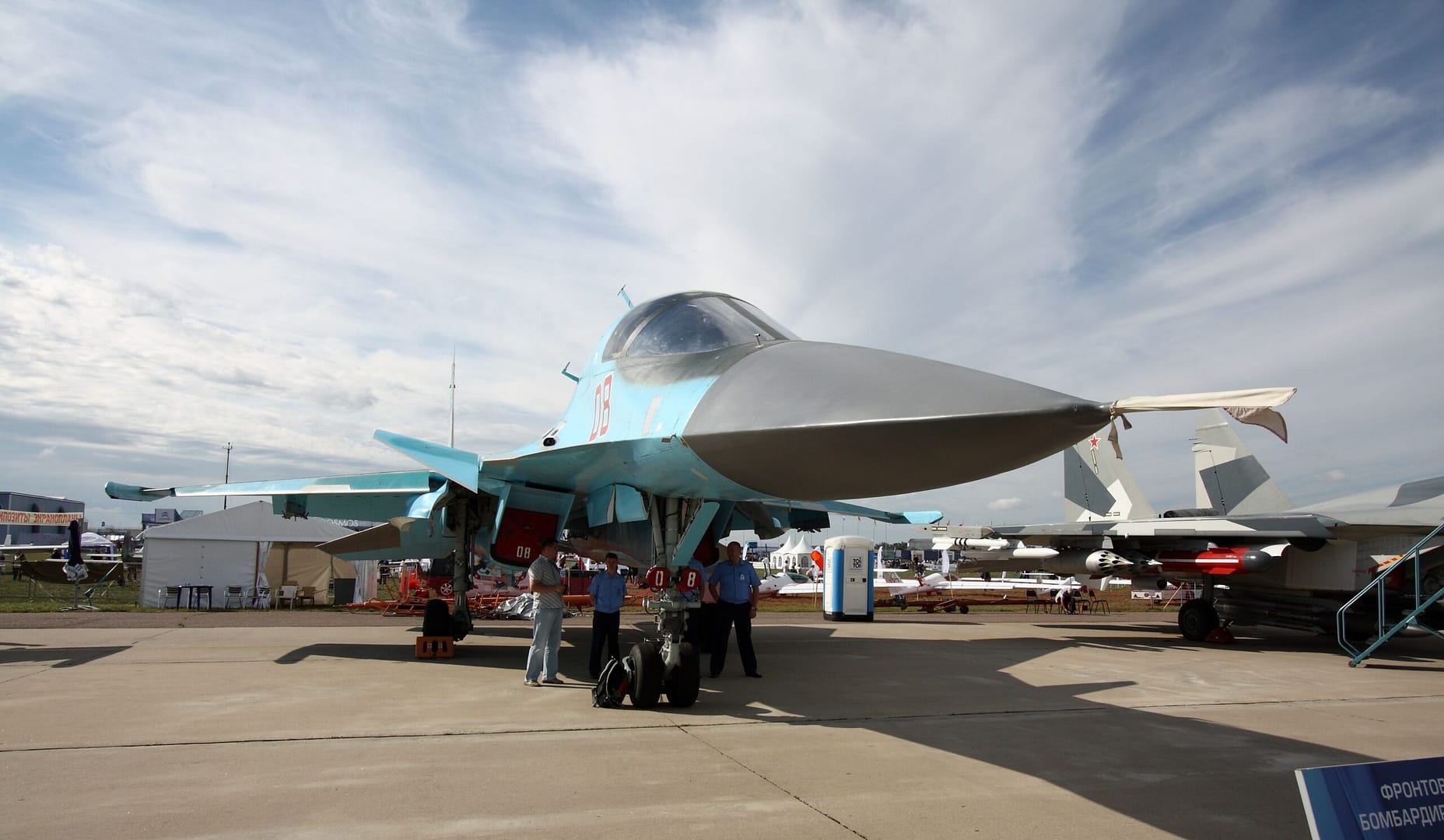
On 27 June 2025, Ukrainian Special Operations Forces struck Marinovka airbase in Russia's Volgograd region. When the smoke cleared, four Sukhoi Su-34 Fullback fighter-bombers were destroyed on the ground. Four aircraft, gone in a single strike — each one worth roughly $50 million, each one irreplaceable on any meaningful timeline.
The Su-34 was supposed to be Russia's answer to the F-15E Strike Eagle: a twin-seat, twin-engine tactical bomber capable of delivering precision-guided munitions deep behind enemy lines while defending itself in air-to-air combat. Instead, it has become the most destroyed Russian combat aircraft of the entire war in Ukraine — a grim distinction for a platform that entered service with such promise.
The Platypus: Design for a Different War
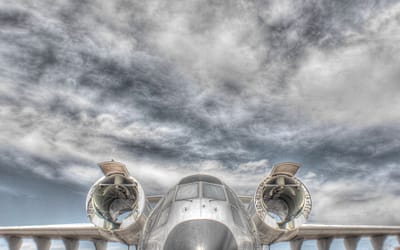
The Su-34 — NATO reporting name "Fullback" — is one of the most unusual combat aircraft in the world. Its flattened nose, which gives it a vaguely duck-billed profile that earned it the nickname "Platypus" among Russian crews, houses a Leninets V004 passive phased-array radar and a rear-facing radar in the tail stinger for missile approach warning.
The cockpit is unique among modern fighters: the crew sits side-by-side in an armoured titanium bathtub (17 mm thick, 1,480 kg total) rather than in tandem. The cabin is pressurised and large enough for the crew to stand, stretch, and even — allegedly — use a small galley and toilet on long-range missions. Two Saturn AL-31F-M1 turbofans produce 13,500 kgf each with afterburner, giving the aircraft a maximum speed of Mach 1.8 and a combat radius of approximately 1,100 kilometres on internal fuel.
On paper, the Su-34 is formidable: 12 hardpoints carrying up to 8,000 kg of ordnance, including KAB-500 and KAB-1500 guided bombs, Kh-29 and Kh-59 air-to-surface missiles, and R-73 and R-77 air-to-air missiles for self-defence. In Russian military doctrine, it was designed to replace the Su-24 Fencer as the VKS's primary tactical strike platform — flying deep interdiction missions against NATO infrastructure in the event of a European war.
41 Lost and Counting
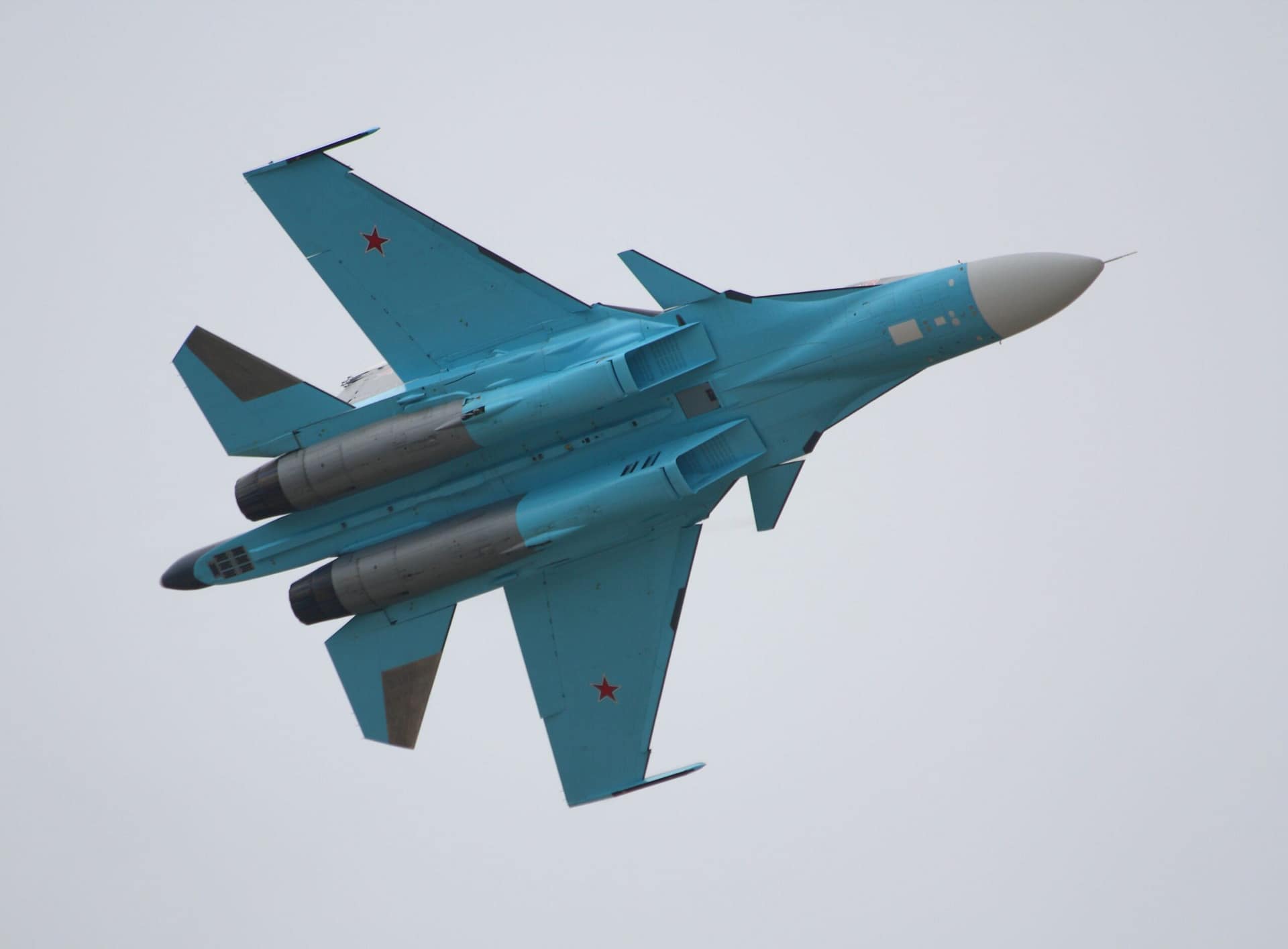
The numbers tell the story with merciless clarity. At least 41 Su-34s have been confirmed destroyed in combat since Russia's full-scale invasion of Ukraine in February 2022 — approximately 25 percent of Russia's entire Fullback fleet. That is not attrition. That is haemorrhage.
The losses have come from every direction. Ukrainian Patriot batteries, operating from well behind the front lines, have picked off Su-34s at medium altitude as they attempt to launch glide bombs. NASAMS and IRIS-T systems have caught them closer to the front. The recent Marinovka strike demonstrated that even parked aircraft hundreds of kilometres inside Russia are not safe from long-range drone and missile attacks.
British intelligence reported in early 2026 that Russia had lost over 30 Su-34s to combat alone — not including operational accidents, maintenance failures, and the growing number of aircraft grounded for lack of spare parts. The true operational loss rate may be significantly higher than the confirmed combat figure suggests.
Production Cannot Keep Up
Russia's Novosibirsk Aircraft Production Association (NAPO), the sole manufacturer of the Su-34, has struggled to compensate. Reports indicate that only four new Su-34s were delivered in the first half of 2026 — against five combat losses in a single two-week period after 14 June. The maths is brutal: Russia is losing Su-34s faster than it can build them.
The production bottleneck is not just about assembly capacity. Western sanctions have restricted access to advanced electronic components, precision bearings, and composite materials that the Su-34's avionics and airframe require. Some components are being sourced through third-country intermediaries at vastly inflated prices and with uncertain quality. Others are simply unavailable, forcing substitutions that degrade performance.
The engine situation is similarly constrained. Saturn/UEC, which produces the AL-31F-M1 turbofans, is simultaneously supplying engines for Su-30SM2, Su-35S, and Su-57 production — all of which have been accelerated to replace war losses. There are only so many engines a single manufacturer can produce, and Russia's fighter programmes are competing with each other for the same limited output.
Pushed Into the Kill Zone
The Su-34's losses are not primarily a failure of the aircraft itself. The Fullback is a capable platform when employed within its design parameters — at medium to high altitude, with adequate fighter escort and suppression of enemy air defences. The problem is that Russia's air campaign in Ukraine has repeatedly pushed Su-34 crews into conditions the aircraft was never designed to survive.
Early in the war, Su-34s flew low-level strike missions against Ukrainian ground forces — exactly the kind of mission that proved suicidal for NATO Tornados over Iraq in 1991. Ukrainian MANPADS and short-range air defences made low-altitude flight increasingly lethal. The VKS shifted to medium altitude, where longer-range SAMs — particularly the Patriot — were waiting.
The adoption of UMPK glide bomb kits — which convert unguided FAB-250, FAB-500, and FAB-1500 bombs into GPS-guided weapons with ranges of 40–70 kilometres — was supposed to solve the problem by keeping Su-34s outside the engagement envelope of most Ukrainian air defences. It has helped, but not enough. Ukrainian air defence operators have adapted their tactics, repositioning batteries to catch Su-34s during their predictable pull-up manoeuvres before bomb release.
Was es bedeutet
The Su-34's war is a case study in what happens when a capable but non-stealthy aircraft is used in a contested environment against a competent, well-equipped adversary. It is a lesson that applies far beyond Russia: any air force still relying on fourth-generation strike platforms — whether Su-34s, F-15Es, Tornado IDSs, or Su-30MKIs — must reckon with the reality that modern air defences have made the non-stealthy tactical bomber a wasting asset.
For Russia, the implications are immediate. The Su-34 fleet is shrinking at a rate that production cannot offset. Each loss represents not just an aircraft but a trained two-person crew — pilot and navigator-weapons officer — whose replacement requires years of training that the Russian military education system is not currently delivering. The VKS entered the war with approximately 130–140 Su-34s. At the current attrition rate, the fleet will fall below combat-effective strength within two years.
The Platypus is bleeding out. And the factory in Novosibirsk cannot stitch the wound fast enough.
Sources: 19FortyFive, National Interest, Defence Blog, UK Ministry of Defence, National Security Journal
0 Kommentare