
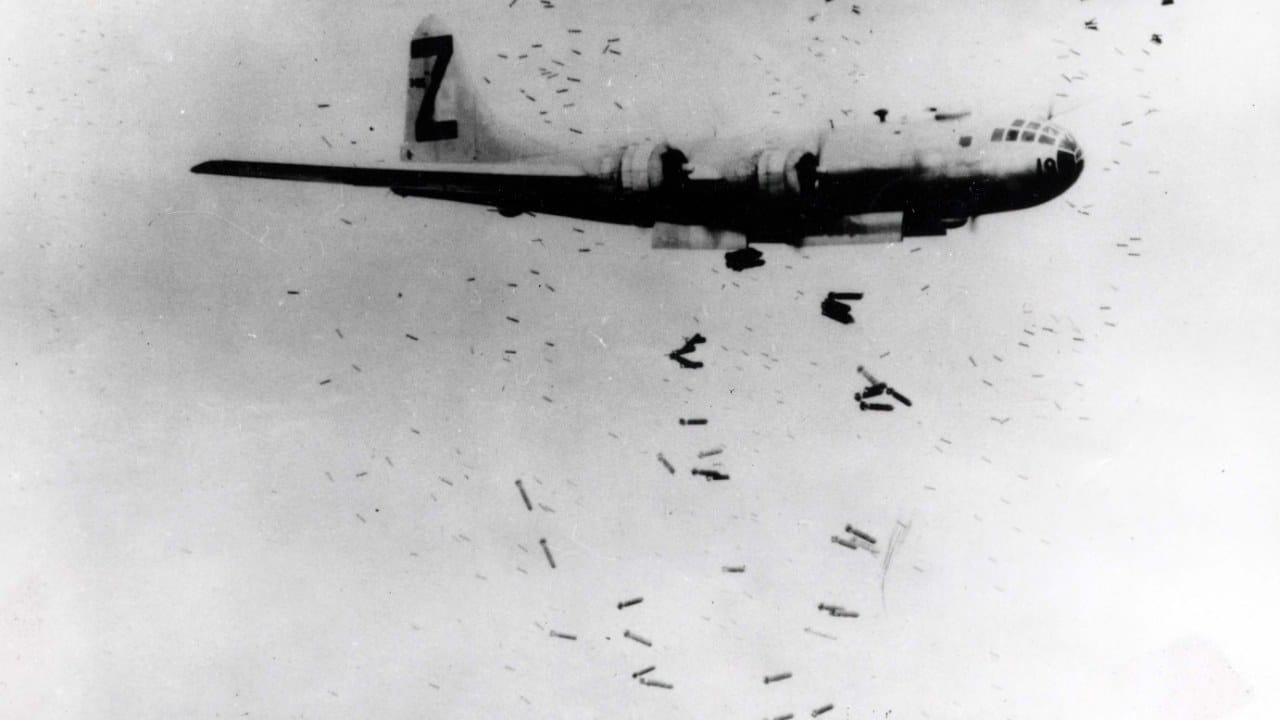
Part 8 of The Race for the Bomb, an Afterburner focus series. Part 7 left the three-billion-dollar B-29 failing at high altitude. This part is about the man who turned it around, the night that followed, and the sixty-plus cities after that. It is not an easy read; it is not meant to be.
Tokyo, eight minutes past midnight, 10 March 1945. Pathfinder B-29s of the 73rd and 313th Bombardment Wings sweep in low over Shitamachi — the packed workers’ districts east of the Imperial Palace — and burn a flaming X of napalm marker bombs into the most crowded square miles on the planet. Roughly 750,000 people live in the rectangle around that X, in houses of wood and paper. The wind at street level is blowing at up to 100 kilometres per hour.
Below, a French journalist trapped in wartime Japan, Robert Guillain, steps outside and watches the marker flares blossom. They set to work at once, he wrote, sowing the sky with fire — bursts of light flashing everywhere in the darkness like Christmas trees lifting their decorations of flame high into the night.
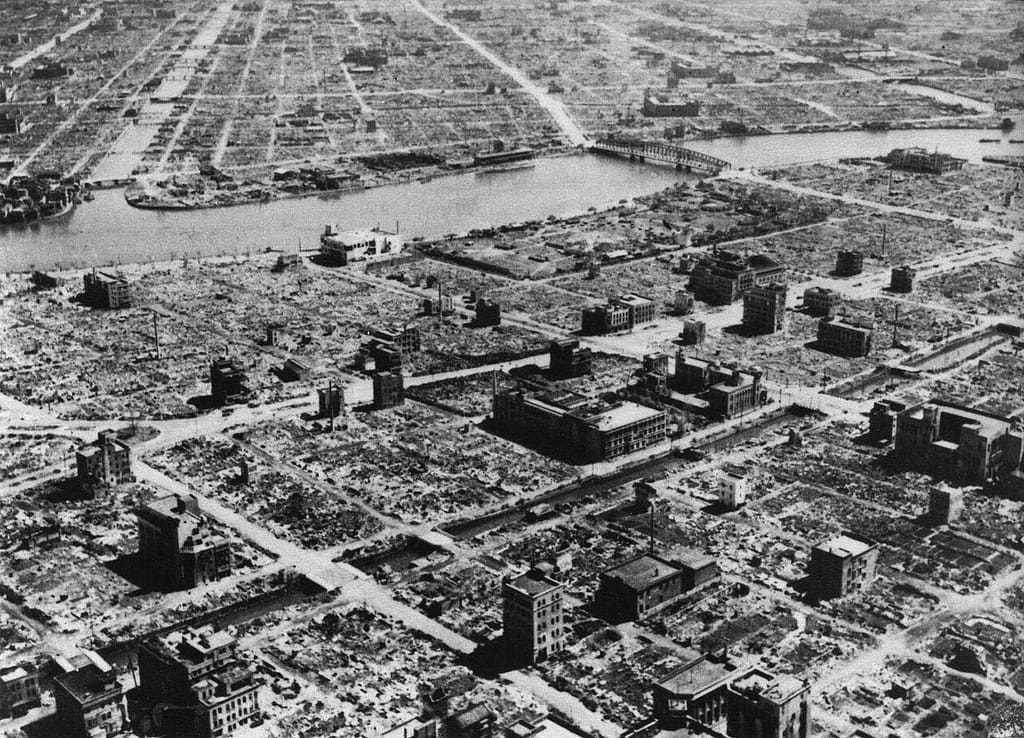
Two hours and forty minutes later, the districts under the X have ceased to exist. By the most credible estimates, around 100,000 people are dead — more than will die at Nagasaki, more than half the toll of Hiroshima, in a single night, with not one atom split. Operation Meetinghouse remains the deadliest air raid in human history, and it was a gamble one man ordered on his own authority.
Quick Facts: The Incendiary Campaign
- 279 B-29s bombed Tokyo on the night of 9–10 March 1945, of more than 320 launched
- 1,665 tons of incendiaries dropped in under three hours, from 5,000–7,000 feet
- ~100,000 dead (estimates 88,000–105,000) — the deadliest air raid in history
- 41 square kilometres of Tokyo burned; more than one million made homeless in one night
- ~980°C ground temperatures in the firestorm
- 67 cities attacked with fire by August 1945; Toyama was ~99 percent destroyed
- 14 B-29s lost that night; 96 American airmen killed or missing
- ~330,000 killed and 8.5 million made homeless across the whole campaign (USSBS-based estimates)
The Man with the Cigar
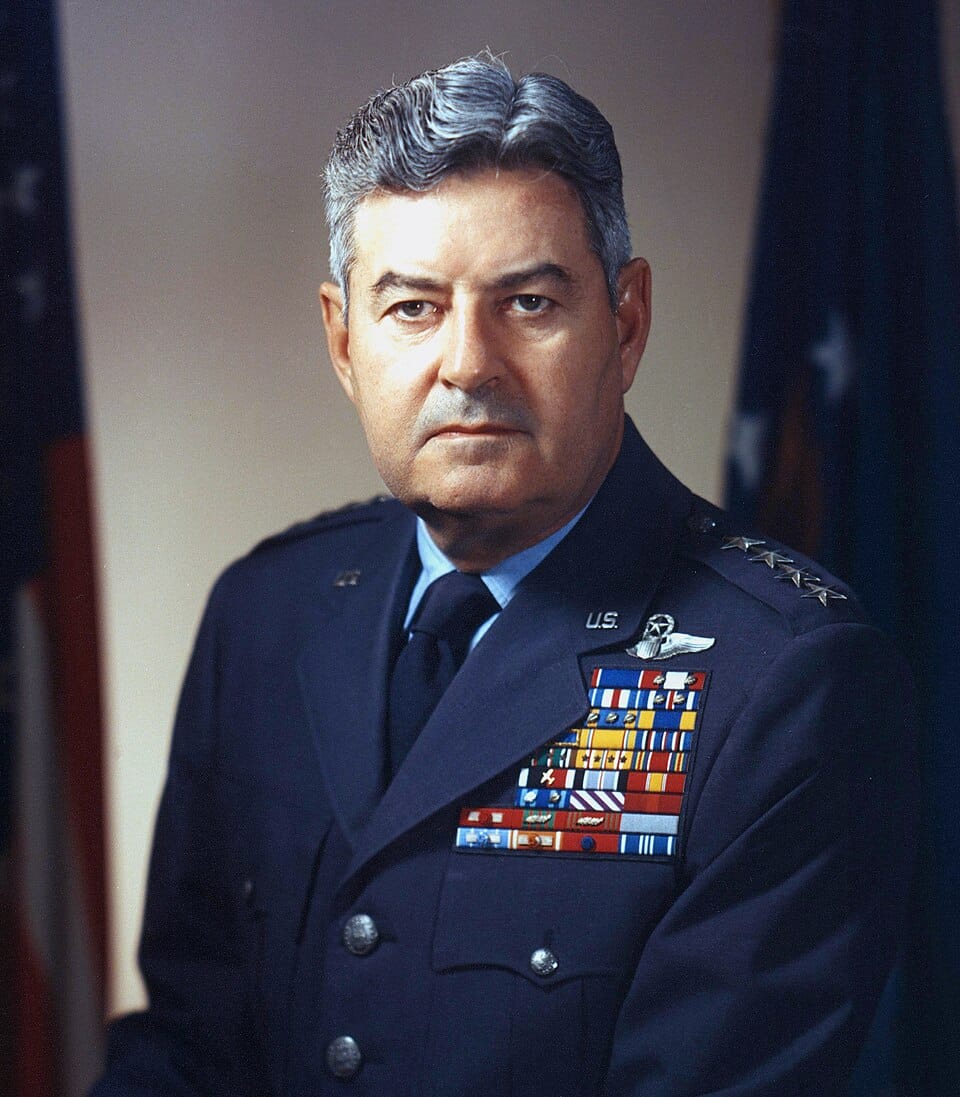
Curtis Emerson LeMay arrived in the Marianas in January 1945, aged 38, already a legend for building the Eighth Air Force’s combat-box formations over Europe and for flying the roughest missions himself, cigar clamped in a face half-frozen by Bell’s palsy. His command, XXI Bomber Command, was failing publicly: months of high-altitude precision raids had barely scratched Japan’s aircraft industry. The reasons were structural — near-permanent cloud, engines strained to breaking at altitude, and the jet stream Afterburner has covered before, which flung bombs kilometres from their targets. Chasing precision from 30,000 feet over Japan, LeMay concluded, was like searching for the Fountain of Youth: there is no such thing; never was.
His solution inverted every doctrine the Army Air Forces held sacred, and he ordered it without asking Washington for permission — he informed Arnold’s staff, and shouldered the risk alone. The B-29s would attack at night, individually, with no formations. They would come in at 5,000 to 7,000 feet — below the effective envelope of Japan’s heavy flak and above its light guns. Their defensive armament and gunners would stay on Tinian and Guam; the saved weight became bombs, six to seven tons per aircraft. And the bombs would be fire.
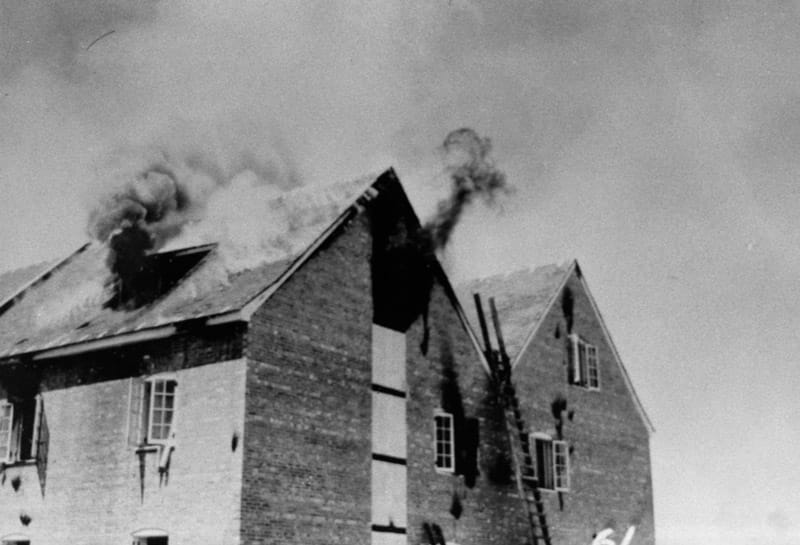
The fire had been engineered as carefully as the aircraft. The M69 incendiary was an unglamorous hexagonal steel pipe, half a metre long and weighing under three kilograms, packed with a new Harvard-developed gel called napalm; dropped in clusters of 38 that burst open at 600 metres, each bomblet steadied itself with a cotton streamer, punched through a roof, paused, and then hurled burning gel across everything within 30 metres. It had been perfected in 1943 on a purpose-built replica Japanese village — authentic timber, correct roof spacing, even tatami mats — erected by Standard Oil engineers and Hollywood set-builders at Dugway Proving Ground in the Utah desert, and burned down repeatedly until the weapon won every trial. American planners knew precisely how Japanese cities would burn, because the 1923 earthquake fires had shown the world, and because they had rehearsed on a fake one.
The Fire Wind
The crews, told on 8 March that they would fly against Tokyo at altitudes some read as a misprint, thought the plan was suicidal. LeMay spent the night of the raid in the operations room on Guam, drinking Coca-Cola and chewing his cigar beside the New Yorker writer St. Clair McKelway, to whom he admitted: I’m sweating this one out. A lot could go wrong.
Over Tokyo, the strike leader, Brigadier General Thomas Power, circled above the city for an hour and a half while his map-makers shaded in the burning districts faster than they could draw. The 45-to-67-mile-per-hour surface wind drove the thousands of separate fires into a single moving front — Japanese survivors called it akai senpū, the red wind — with ground temperatures near 1,000 degrees Celsius, hot enough that superheated air killed ahead of the flames. The canals boiled at the edges; the Sumida river filled with the drowned and burned. Guillain recorded whole walls of screaming humanity toppling from the embankments into the water. At the famous Futaba School, whose swimming pool promised safety, morning found the pool dry — the water had boiled away — and more than a thousand dead around it.
Twelve-year-old Katsumoto Saotome, in the Mukojima district, woke to a streak of light across the window and his father’s shout. He outran the fire that night, and spent the next seventy years making sure Japan did not forget it.
Six thousand feet up, the Americans met the raid’s other face. Updrafts from the firestorm tossed 60-ton bombers hundreds of feet; tail gunners watched the glow recede for well over a hundred miles; and when the bomb bay doors opened, the smell of the burning city came into the aircraft. Crews pulled on oxygen masks to keep from vomiting. Fourteen B-29s did not return. The morning tally — 41 square kilometres burned, over 267,000 buildings gone, a million homeless, and a death toll the fire brigades could only estimate by the block — made the night, by any measure, the deadliest air raid ever flown. The U.S. Strategic Bombing Survey later concluded that probably more persons lost their lives by fire at Tokyo in a six-hour period than at any time in the history of man.
The Operations Room reconstructs Operation Meetinghouse minute by minute — the pathfinders’ X, the bomber stream, and the firestorm.
Sixty-Seven Cities
Tokyo was the proof of concept. Within ten days LeMay’s command burned the hearts of Nagoya, Osaka and Kobe; by summer the campaign had worked down a list of cities most Westerners have never heard of — Toyama, Fukui, Hamamatsu, Numazu — because Japan’s famous cities had already burned. By August, 67 cities had been attacked with fire. LeMay’s staff kept a chart matching each to an American equivalent by percentage destroyed: Yokohama, 58 percent — call it Cleveland. Tokyo, 51 percent — New York. Toyama, burned on the night of 1–2 August 1945, sits at the top of the chart at roughly 99 percent destroyed: the most completely destroyed city of the war, atomic targets included. The campaign’s cumulative ledger, in the sober ranges of the postwar surveys: around 330,000 dead, some 8.5 million driven from their homes.
In late July the campaign added a strange, unprecedented instrument: warning. American aircraft dropped millions of leaflets over Japanese cities naming them as targets and urging civilians to evacuate — psychological warfare and genuine notice at once. On the night of 27–28 July, leaflets named eleven cities; six of them were burned the next day. The firebombing also reached, unknowingly, into this series’ earlier chapters: the spring raids on Tokyo destroyed Building 49 of the Riken institute, and with it Japan’s atomic bomb project.
Al Jazeera’s Witness documentary follows survivors of the 10 March raid — the night as Tokyo remembers it.
“Had to Be Done”
LeMay never softened a syllable of what he had ordered, and his own words remain the campaign’s bluntest moral document. We knew we were going to kill a lot of women and kids when we burned that town, he wrote of Tokyo in his 1965 memoir. Had to be done. In the same book he reckoned that the March raid scorched and boiled and baked to death more people than went up in vapor at Hiroshima and Nagasaki combined.
Robert McNamara — a young statistical officer on LeMay’s wartime staff, decades before Vietnam — repeated that admission in the documentary The Fog of War and appended the question that has kept philosophers employed since: what makes it immoral if you lose and not immoral if you win? The Strategic Bombing Survey judged the raids devastatingly effective against Japan’s dispersed war industry; critics then and since have answered that effectiveness is not the only test. This series takes no vote; it only insists, as the survivors did, on the numbers being remembered accurately.
One footnote on reputation: the notorious instruction to bomb them back into the Stone Age, forever welded to LeMay’s name, comes from his 1965 book about North Vietnam, not Japan — and he later disavowed the ghost-written phrase. The Tokyo record needed no embellishment.
The Museum Japan Almost Didn’t Build
Hiroshima has its Peace Memorial Park, its dome, its eternal flame. The deadliest air raid in history has a modest private museum in a Tokyo side street — the Center of the Tokyo Raids and War Damage, opened in 2002 with citizens’ donations after the city shelved plans for an official one. It exists chiefly because the boy who outran the fire, Katsumoto Saotome, grew into a writer who collected survivor testimony for half a century. The memorial hall nearby holds the names of about 105,400 dead.
Five months after Meetinghouse, a single aircraft with a single bomb would do to Hiroshima what 279 had done to Tokyo — and the crews of the 509th Composite Group, training in their stripped Silverplate B-29s, already existed inside the campaign this article has described. Their forty-three seconds over Hiroshima are the next chapter.
Target Tokyo (1945), narrated by Ronald Reagan: the official film of the first Marianas missions — the campaign as America saw it at the time.
Sources: US Strategic Bombing Survey, Wikipedia, This Day in Aviation, National WWII Museum, Warfare History Network, The Diplomat and Asia-Pacific Journal (Mark Selden), Robert Guillain: I Saw Tokyo Burning, HistoryNet, Wikiquote (LeMay, Fog of War), Richard Rhodes: The Making of the Atomic Bomb.
The Race for the Bomb — an Afterburner Focus Series
Series overview: all ten parts
Previous — Part 7: The Bomber That Cost More Than the Bomb
Next — Part 9: Forty-Three Seconds Over Hiroshima
0 Kommentare