
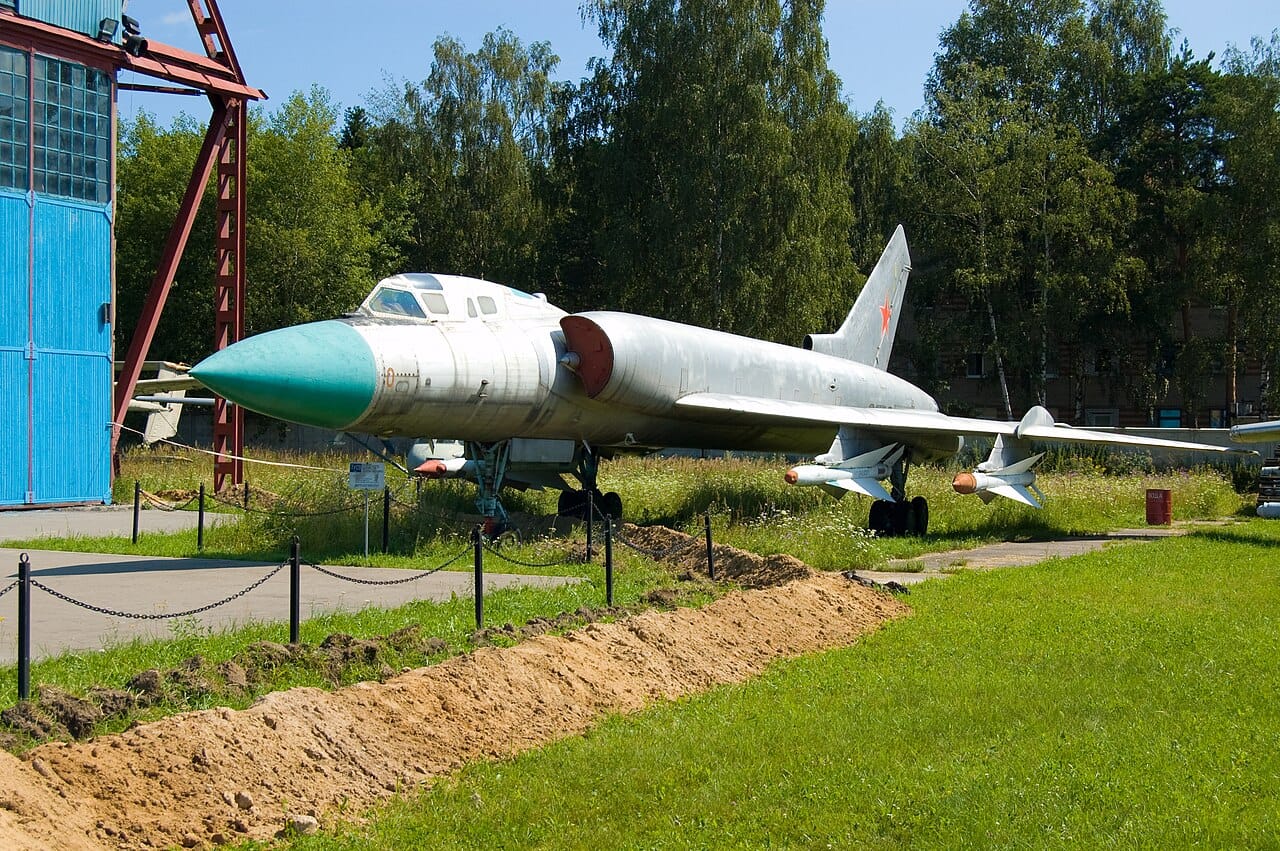
Line the Tupolev Tu-128 up next to the bombers it was built to shoot down, and you might struggle to tell the hunter from the prey. At nearly 30 metres long and around 43 tonnes, this Soviet interceptor was bigger and heavier than many of the aircraft it was meant to destroy.
It remains, to this day, the largest and heaviest fighter ever to enter serial production — and it exists for one very Soviet reason: geography.
Kurzinfo
- Typ: Long-range interceptor (NATO: Fiddler), crew of two
- Größe: ~30 m long, ~43 tonnes max takeoff weight
- Herkunft: Developed from the abandoned Tu-98 supersonic bomber
- Erster Flug: 18 March 1961; in service 1964–1990
- Gebaut: 198 aircraft, Soviet PVO only (never exported)
- Leistung: Two Lyulka AL-7F-2 turbojets; four Bisnovat R-4 missiles
- Reichweite: ~2,565 km; endurance well over three hours
A fighter the size of a bomber, for a country the size of a continent
The Soviet Union faced a defensive nightmare: thousands of kilometres of Arctic coastline and Siberian frontier, thinly covered by radar and served by only a handful of airfields. Across that emptiness, American strategic bombers such as the B-52 could in theory approach from the north. Small, short-legged interceptors had no hope of patrolling such distances.
The answer was to go big. The Tu-128 grew out of the cancelled Tu-98 “Backfin” supersonic bomber, inheriting the size to carry a heavy radar, four large missiles, and enough fuel to loiter for hours over the tundra. It was less a dogfighter than a flying missile battery with the legs to reach the middle of nowhere and wait.
The Tu-128 Fiddler: history of the Soviet Union's giant interceptor.

Radar, missiles and patience
First flown on 18 March 1961, the Fiddler entered service in 1964 and soldiered on until 1990. Two Lyulka AL-7F-2 afterburning turbojets pushed the 43-tonne machine to supersonic dash speeds, while its Smerch radar and four Bisnovat R-4 air-to-air missiles let a single crew of two find and kill a target on their own, far beyond ground-radar coverage. With up to thirteen tonnes of fuel, it could stay airborne for well over three hours — exactly what patrolling the Arctic demanded.
Its targets were not only bombers. The Tu-128 was also tasked against the high-altitude automatic reconnaissance balloons that drifted across Soviet territory during the Cold War — slow, awkward prey for such an enormous, fast machine.
Tu-128: defender of the Soviet Arctic sky.

The end of the giants
By 1990, faster and more capable interceptors such as the MiG-31 had taken over the long-range guard duty, and the last Fiddlers were retired. Only 198 were ever built, and none left Soviet service — there was no other country with the same impossible problem to solve.
The Tu-128 is a monument to a very specific kind of thinking: when the map is your enemy, sometimes the right fighter is the biggest one you can build. Nothing before or since has matched it, and given how air defence has evolved, nothing ever will.
Sources: Wikipedia (Tupolev Tu-28); War History Online; Air Data News; military-factory.com.
Ähnliche Beiträge

0 Kommentare