
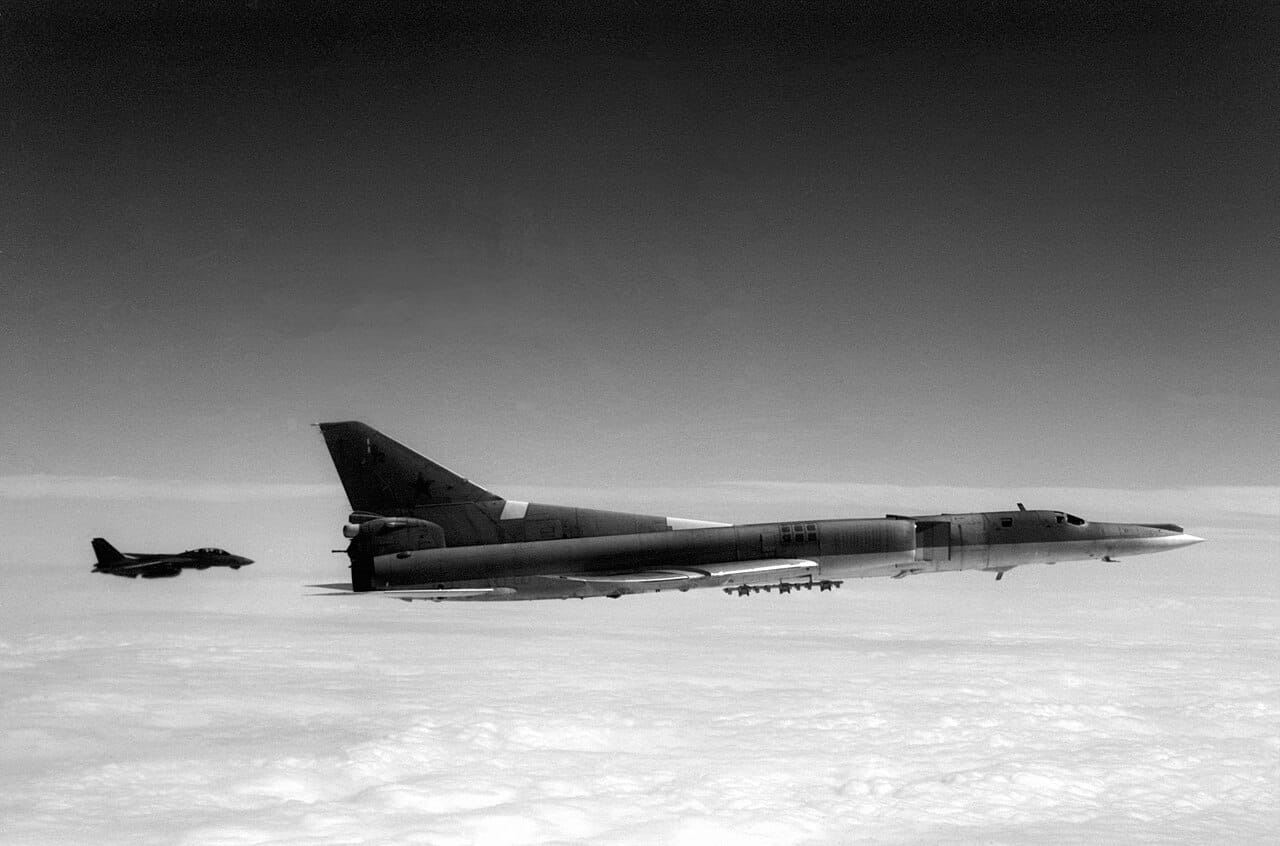
In the autumn of 1982, eight Soviet bombers came down on the USS Enterprise and USS Midway in the North Pacific and locked their radars on both carriers from about 190 kilometres out. The US Navy’s response was deliberately restrained, because watching how they did it was worth more than chasing them off.
The aircraft was the Tu-22M, and for thirty years it was the specific thing the US carrier fleet was most afraid of.
It was also, in the argument that consumed half a decade of arms control negotiations, either a strategic weapon capable of striking America or a medium bomber that could not. Both sides had a great deal riding on the answer.
Kurzinfo
| Typ | Supersonic variable-sweep long-range strategic and maritime strike bomber |
| NATO reporting name | Backfire (A / B / C by variant) |
| Design bureau | Tupolev |
| Erster Flug | 30 August 1969 |
| Introduced | 1972; production 1967–1993 |
| Anzahl gebaut | 497, all variants including pre-production |
| Crew | 4 |
| Kraftwerk | 2 × Kuznetsov NK-25 afterburning turbofans, 247.9 kN each |
| Max speed | Mach 1.88 (~1,997 km/h) at 9,150 m; Mach 2.05 in some sources |
| Spannweite | 34.28 m spread / 23.3 m swept |
| Primary weapon | Raduga Kh-22 / Kh-32 missiles, up to three carried |
It Is Not a Tu-22, Whatever the Name Says
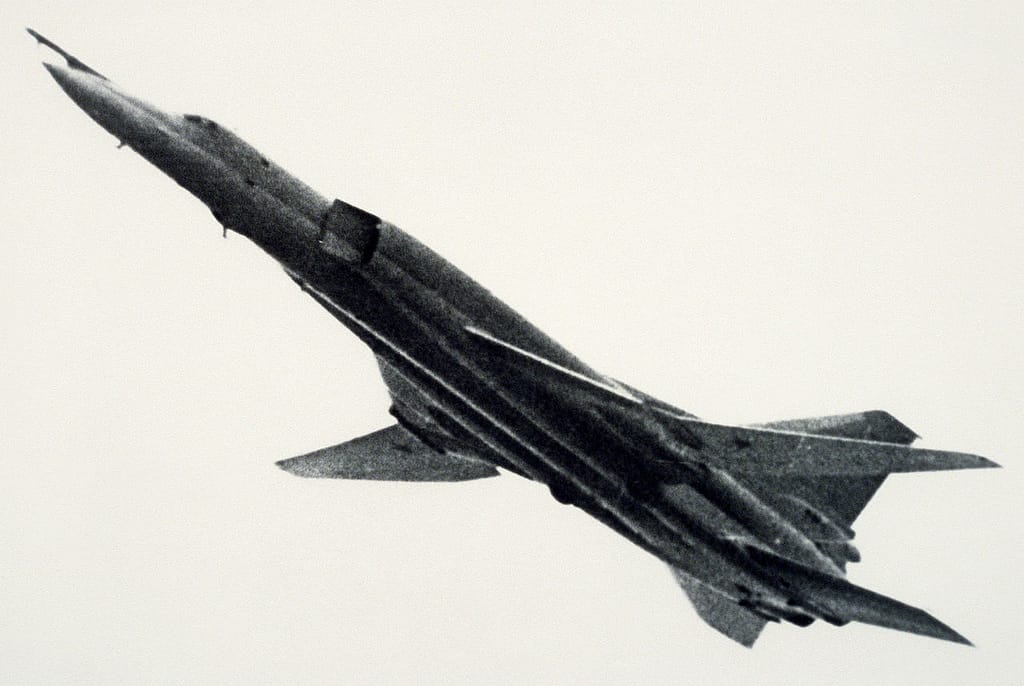
The designation is one of the great pieces of Soviet bureaucratic misdirection. The Tu-22M is not a modified Tu-22 Blinder. It is a different aeroplane.
The Blinder was a disappointment: its landing speed was about 100 km/h higher than the bombers it replaced, it had a habit of pitching up and striking its own tail on landing, visibility was poor and serviceability worse. By 1962 the Soviet Air Force had concluded it was inadequate.
What Tupolev built to replace it, internally “Samolyot 145”, was a new swing-wing design that borrowed the Blinder’s weapon system and its Kh-22 missile. Calling it a modification of an existing type made it far easier to push through the Soviet approval and budget machinery. It worked.
The Argument About How Far It Could Fly
Everything about the Backfire in Western eyes came down to range. A medium bomber threatening Europe and Asia was one thing. A bomber that could reach the continental United States was a strategic system, and therefore something that had to be counted under SALT.
The estimates were not close to each other. Tupolev claimed a combat radius of only 2,200 km for early aircraft. The CIA assessed somewhere around 3,700 km, later 3,360 to 3,960. The Defense Intelligence Agency initially said about 5,000 km — which would have made it unambiguously strategic — before revising down to around 4,000.
The American intelligence community could not agree with itself, and said so in writing.
The dispute was ultimately settled not by intelligence but by a promise. On 16 June 1979 Leonid Brezhnev handed President Carter a written statement, which became an annex to SALT II.
Note the construction. Not cannot. Does not intend to. The Soviets also undertook not to fit it for in-flight refuelling and not to raise the production rate. An arms control problem solved by an assurance about intent.
The Carrier Killer
The Backfire’s actual job was simpler than the negotiations suggested: get within range of an American carrier battle group and launch a Kh-22 from outside the group’s defensive envelope.
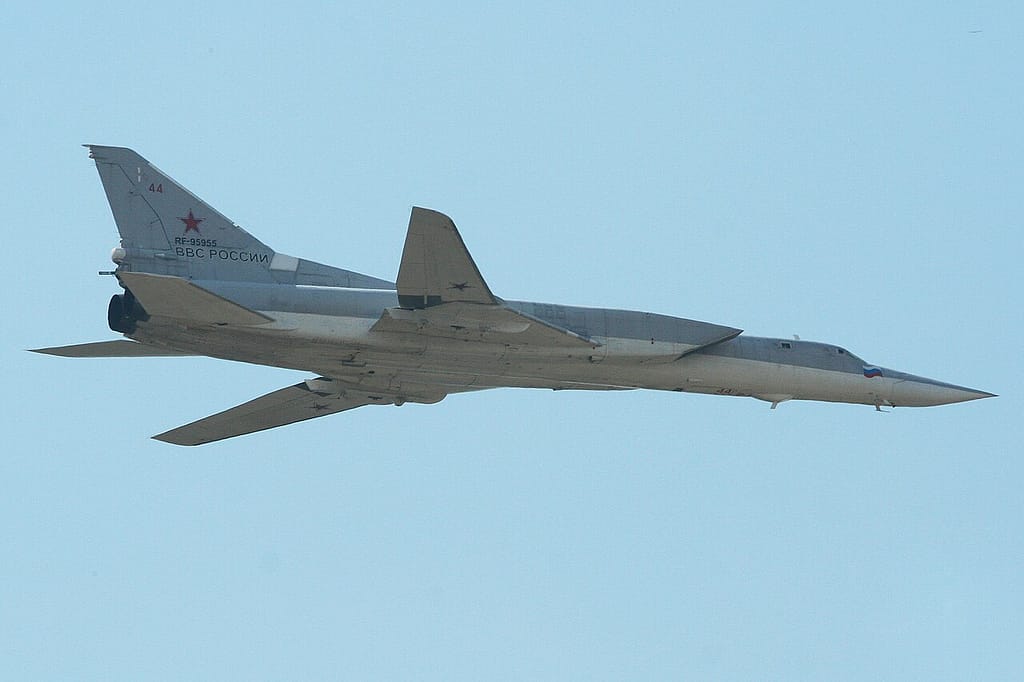
The Kh-22 is enormous, fast and inaccurate by modern standards, which mattered less when the alternative was a nuclear warhead. A regiment of Backfires arriving from different bearings and launching simultaneously was the scenario that shaped US Navy air defence thinking for a generation — and, not incidentally, justified the F-14 Tomcat and the AIM-54 Phoenix.
Its combat career came later and elsewhere. Afghanistan from December 1987, supporting the attempt to relieve Khost and later covering the Soviet withdrawal. Grozny in 1995. Syria from January 2016, including missions flown from Iran’s Hamedan airbase.
Still Flying, Barely
Serviceability was always the Backfire’s weak point. In August 1991 the mission-capable rate was somewhere between thirty and forty per cent, and the Air Force at one stage wanted to prosecute Tupolev for rushing the aircraft into service.
In Ukraine it has been used almost entirely as a standoff missile launcher, firing Kh-22 and Kh-32 from Russian airspace and over the Black and Azov Seas. By late 2023 roughly three hundred Kh-22s had been launched, none of them intercepted at that point.
Losses have been on the ground more than in the air: Soltsy-2 in August 2023, Olenya, and at least four destroyed at Belaya during Ukraine’s Operation Spiderweb on 1 June 2025. One aircraft came down near Stavropol on 19 April 2024; Ukraine claims a modified S-200 shot it down, Russia says technical malfunction. If Ukraine is right it is the first air-to-air loss of the type in fifty-five years.
Ukrainian military intelligence assessed in 2023 that only twenty-seven airframes remained in operable condition, against fleet figures usually quoted around sixty. That is an interested party’s number and should be read as one. But the direction of travel is not in dispute: the aircraft that once frightened the United States Navy is now a rapidly shrinking force firing 1960s missiles at power stations.
Sources: SALT II Treaty text, Soviet Backfire Statement; Foreign Relations of the United States, 1969–1976, Vol. XXXIV, Doc. 225; FAS and GlobalSecurity range assessments; BBC verification of Soltsy-2 imagery; Ukrainian Defence Intelligence (HUR).
0 Kommentare