
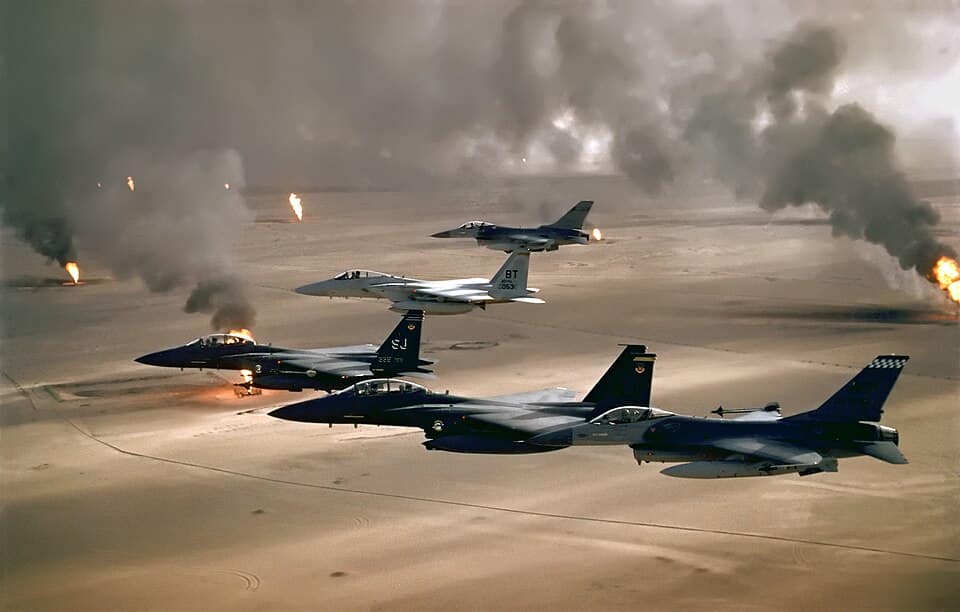
✈ Quick Facts
- Date: January 17, 1991, beginning at 02:38 local time
- Operation: Desert Storm — liberation of Kuwait
- First strike: Task Force Normandy — 8 AH-64 Apaches destroy 2 radar sites
- First night sorties: 1,300+ coalition combat sorties
- Tomahawks launched: ~100 in the first wave
- F-117 missions: 36 stealth fighters struck 34 targets in Baghdad
- Iraqi aircraft losses (first 24h): 8 confirmed air-to-air kills
- Coalition aircraft lost (first night): 1 F/A-18C (Lt Cdr Scott Speicher)
Task Force Normandy: The Door Kickers
The entire air campaign hinged on two radar stations in the Iraqi desert. These early-warning sites — codenamed Objectives Nebraska and Oklahoma — would detect incoming coalition aircraft and give Baghdad's air defense network time to react. They had to die first, and they had to die silently. The job went to Task Force Normandy: eight AH-64A Apaches from the 101st Airborne Division, led by Lieutenant Colonel Dick Cody. The helicopters launched from a forward staging base at Al Jouf, near the Iraqi border, and flew roughly 90 miles into Iraq, navigating at night across featureless desert using forward-looking infrared (FLIR) systems and GPS — technology that was cutting-edge in 1991. At precisely 2:38 a.m. — twenty-two minutes before the main air campaign was scheduled to begin — the Apaches opened fire with Hellfire missiles and 2.75-inch rockets. Both radar stations were destroyed within four minutes. The gap in Iraq's radar fence was open.The Stealth Fighters Over Baghdad
As the radar stations burned, 36 F-117A Nighthawk stealth fighters were already inbound to Baghdad. The F-117 was the coalition's ace card: an aircraft invisible to radar, capable of delivering laser-guided bombs with surgical precision on the most heavily defended targets in Iraq. The F-117s struck 34 high-value targets on the first night: air defense command centers, telecommunications hubs, government ministries, and military headquarters. Each aircraft carried two 2,000-pound GBU-27 Paveway III laser-guided bombs. The pilots dropped into the densest air defense environment since Hanoi in 1972 — and none were hit. Baghdad's anti-aircraft guns lit up the sky in what CNN broadcast live to a global audience. The tracers were spectacular but ineffective: the gunners were firing blind, unable to see or track the stealth aircraft above them.Tomahawks: The Opening Salvo
Simultaneously with the F-117 strikes, the U.S. Navy launched approximately 100 BGM-109 Tomahawk cruise missiles from battleships and cruisers in the Persian Gulf and Red Sea. The USS Wisconsin and USS Missouri — both World War II-era battleships — were among the launch platforms, making the Tomahawk's combat debut from ships that had fought at Iwo Jima and Okinawa. The Tomahawks hit power plants, command bunkers, and air defense nodes across Iraq. Flying at low altitude on pre-programmed terrain-following routes, they arrived over their targets without warning. For Iraqi defenders, the first indication of attack was the explosion. This was the Tomahawk's first use in combat. The weapon worked. Its success in Desert Storm established the cruise missile as the preferred opening move for every major U.S. military operation that followed — Kosovo, Afghanistan, Iraq 2003, Libya, Syria, and now Iran.The Wild Weasels and the SEAD Campaign
While the F-117s and Tomahawks hit fixed targets, F-4G Wild Weasels and EF-111 Ravens waged electronic warfare against Iraq's integrated air defense system (IADS). The Wild Weasels carried AGM-88 HARM anti-radiation missiles designed to home in on radar emissions. The message to Iraqi radar operators was simple: turn on your radar and die. The Suppression of Enemy Air Defenses (SEAD) campaign was devastatingly effective. Within hours, Iraqi radar operators began shutting down their systems rather than risk a HARM strike. By dawn, Iraq's once-formidable IADS — modeled on the Soviet system that had mauled Israeli aircraft in 1973 — was operationally paralyzed. The coalition also employed BQM-74 drones as decoys, tricking Iraqi radars into activating and revealing their positions. When the radars came up, HARMs went in. The combination of decoys, jamming, and anti-radiation missiles created a lethal dilemma with no good answer.The Air Superiority Sweep
As the strike packages went in, F-15C Eagles flew air superiority patrols to intercept any Iraqi fighters that managed to get airborne. Iraq had the sixth-largest air force in the world, with over 700 combat aircraft including MiG-29 Fulcrums, MiG-25 Foxbats, Mirage F1s, and Su-24 Fencers. On the first night, coalition fighters shot down 8 Iraqi aircraft in air-to-air combat. The Iraqi Air Force never recovered. Over the course of the war, 33 Iraqi aircraft were destroyed in aerial combat — all by coalition fighters, none by Iraqi ones. The one-sided air war became a rout: Iraqi pilots began flying their aircraft to Iran rather than face coalition fighters. The only coalition aircraft lost on the opening night was an F/A-18C Hornet flown by Lieutenant Commander Michael Scott Speicher. The cause was officially listed as unknown for years — the Navy initially attributed it to a surface-to-air missile, while later assessments concluded he was most likely downed by an Iraqi MiG-25. Speicher became the first American combat casualty of the war.The Blueprint for Modern Air War
The opening night of Desert Storm did not just win a battle — it wrote the playbook. Every major air campaign since has followed the same template: stealth aircraft and cruise missiles hit air defenses and command nodes first; SEAD assets suppress radar; electronic warfare blinds and confuses; and air superiority fighters sweep the sky clean. The 43-day air campaign that followed reduced Iraq's fielded military by roughly 50 percent before the ground war even began. When the ground assault launched on February 24, it was over in 100 hours. Desert Storm's opening night proved that air power, properly applied, could paralyze a modern military in hours. It was the night that rewrote the rules of warfare. Sources: Gulf War Air Power Survey (USAF), "Every Man a Tiger" by Tom Clancy/Chuck Horner, CENTCOM after-action reports, Air Force Historical Research AgencyRelated Questions
When did Operation Desert Storm begin?
The air war of Operation Desert Storm began in the early hours of 17 January 1991, at about 02:38 local time. A massive coalition air assault struck Iraq to liberate Kuwait, opening one of the most decisive air campaigns in history.
What was the first strike of Desert Storm?
The opening blow came from Task Force Normandy — eight U.S. AH-64 Apache helicopters that destroyed two Iraqi early-warning radar sites, punching a hole in the air-defence network so the main strike packages could pour through undetected.
What role did the F-117 play in Desert Storm?
Stealth was central. On the first night, 36 F-117 Nighthawks struck 34 high-value targets in heavily defended Baghdad, hitting command centres and air-defence nodes that conventional aircraft couldn't reach safely. Their invisibility to radar made the opening attack possible.
How many sorties were flown on the first night of Desert Storm?
The coalition flew more than 1,300 combat sorties on the opening night, alongside roughly 100 Tomahawk cruise missiles launched in the first wave — an overwhelming, tightly coordinated assault that crippled Iraq's defences within hours.
How effective was the opening night of Desert Storm?
Devastatingly so. In the first 24 hours the coalition scored eight confirmed air-to-air kills and shattered Iraq's air defences while losing only one aircraft, an F/A-18C. The night demonstrated the power of stealth, precision weapons and coordinated air planning.
0 Comments