
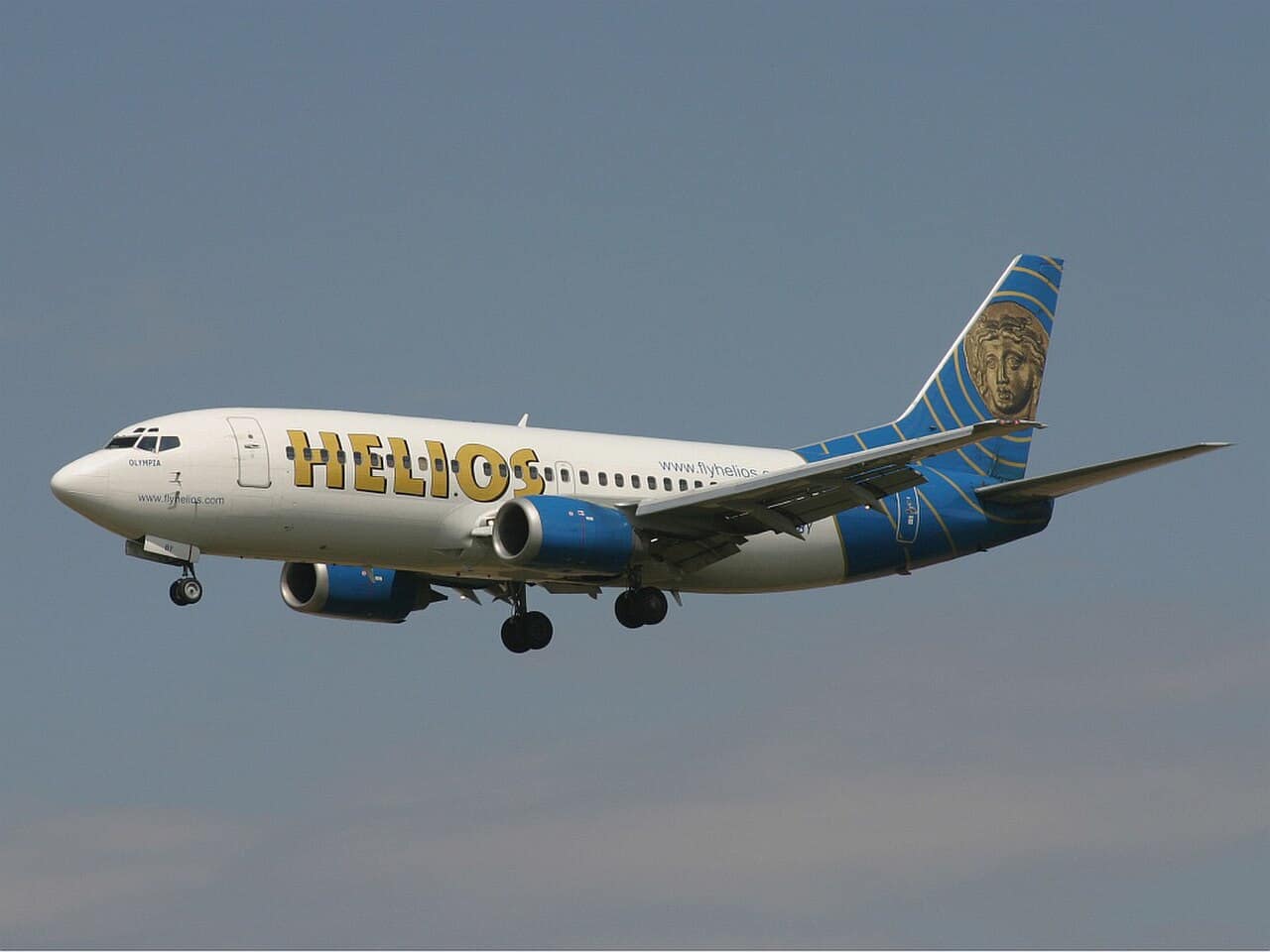
Twenty-one years ago today, on August 14, 2005, a Boeing 737 crossed the sky over Greece with everyone aboard already beyond saving. It flew straight and level, obedient to its autopilot, holding its assigned altitude and following its route as if nothing were wrong.
Inside, the passengers and crew of Helios Airways Flight 522 had slipped into unconsciousness one by one. When Greek fighter pilots pulled alongside and looked into the cockpit, they found the captain's seat empty and the co-pilot slumped over the controls.
It is one of the most haunting stories in aviation, and it changed how every pilot is taught to fear a quiet, invisible killer.
Datos rápidos
- Vuelo: Helios Airways 522
- Fecha: August 14, 2005
- Aeronave: Boeing 737-300
- Ruta: Larnaca, Cyprus to Prague, via Athens
- Causa: Cabin pressurization left on manual, undetected
- What killed them: Hypoxia, oxygen starvation, at altitude
- Peaje: All 121 people on board
- Legado: Clearer cockpit warnings for cabin pressure
A switch in the wrong position
The chain began on the ground, with a small and ordinary act. An engineer had set the cabin pressurization system to manual to run a test, and, most likely, forgot to return it to automatic. During their pre-flight checks, the crew did not catch it.
It was the kind of tiny oversight that happens in aviation every day and almost always means nothing. This time it meant everything, because with the system on manual, the cabin would not pressurize as the aircraft climbed.
The silent climb
As Flight 522 rose, the air inside thinned along with the air outside. A warning horn sounded in the cockpit, but on this aircraft that same horn is used for a takeoff configuration problem, something the crew had already cleared on the runway. Confused and already starved of oxygen, they misread it.
Hypoxia is a gentle assassin. It does not hurt. It clouds judgment, slows thought, and slips its victims into unconsciousness without alarm. Both pilots succumbed, and the 737 levelled off at cruising altitude and flew on alone, guided only by its autopilot toward Athens.
Fighters find a ghost
When the airliner reached Greek airspace and answered no radio calls, the air force scrambled two F-16s to intercept it. What their pilots saw has stayed with the aviation world ever since: oxygen masks dangling in the cabin, the captain's seat empty, the first officer motionless at the controls.
The jet was, for all practical purposes, a ghost plane, full of people yet flown by no one.
One man, awake
There was a final, heartbreaking twist. A flight attendant, Andreas Prodromou, had stayed conscious by using a portable oxygen supply, and he held a commercial pilot's licence of his own. In the last minutes he made his way to the cockpit and took the controls.
But he had reached them too late. The 737 had been flying on autopilot for hours, and its fuel was almost gone. One by one the engines fell silent, and there was nothing left with which to save the aircraft.
What Helios changed
Flight 522 came down in the hills near Grammatiko, northeast of Athens. All 121 people aboard were lost, in the deadliest aviation accident in Greek history.
The tragedy forced a reckoning with two quiet dangers: the ease with which a pressurization setting can be missed, and the ambiguity of a warning horn that meant two different things. In the years that followed, regulators required clearer, unmistakable cabin-altitude alerts, so that no crew would ever again mistake the sound of suffocation for a routine reminder. It is a hard lesson, written in the memory of everyone who never came home that August day.

Sources: Greek Air Accident Investigation Board (AAIASB) final report, Wikipedia, Simple Flying
0 Comentarios