

In the mid-1970s, two American planemakers built four extraordinary transport prototypes that could land almost anywhere and stop almost immediately. Both designs worked brilliantly. Both lost. And then one of them quietly went on to father one of the most successful airlifters ever built.
This is the story of the Boeing YC-14, the McDonnell Douglas YC-15, and the competition that produced no winner but changed military airlift forever.
Datos rápidos
- Programa: USAF Advanced Medium STOL Transport (AMST), to replace the C-130
- Competidores: Boeing YC-14 (twinjet) and McDonnell Douglas YC-15 (four-engine)
- Primeros vuelos: YC-15 in August 1975; YC-14 in August 1976
- Construido: Two prototypes each
- Resultado: Both exceeded requirements; AMST cancelled in 1979 with no winner
- Legado: The YC-15's design led directly to the C-17 Globemaster III
Two clever answers to the same question
The AMST program set a hard challenge: build a tactical transport that could haul heavy loads into short, rough forward airstrips far better than the C-130. Boeing and McDonnell Douglas each got contracts for two prototypes, and each chose a different trick to bend the airflow and generate huge lift at low speed.
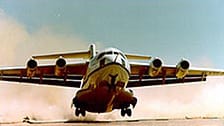
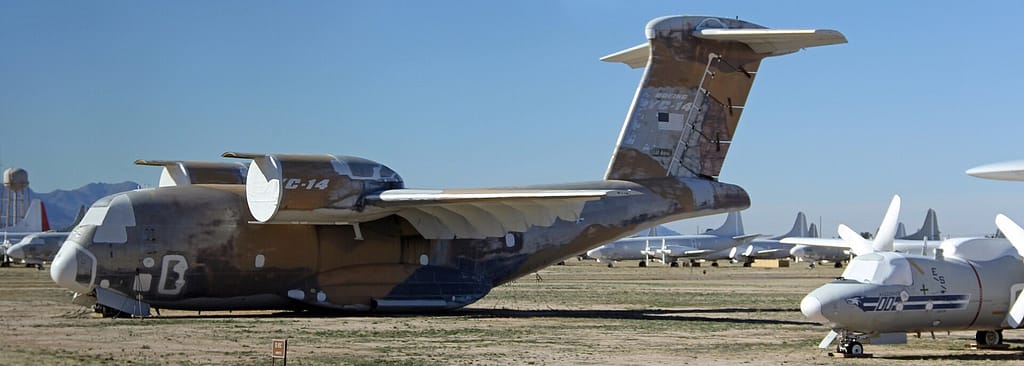
Boeing's YC-14 mounted its two engines high and forward, blowing their exhaust directly over the top of the wing — “upper-surface blowing” — to pull air down and multiply lift. McDonnell Douglas's YC-15 took the opposite approach, using four engines under the wing to blast air through large, slotted “externally blown flaps.” Both let the aircraft fly startlingly slowly and land in remarkably little space.
Boeing's YC-14 STOL transport prototype in action.
Winners with nowhere to go
The trouble was not the aircraft — it was the mission. As both prototypes were proving they could do everything asked of them, the Air Force's priorities shifted. It no longer wanted a medium tactical transport to replace the C-130; it wanted a bigger aircraft with the range to move heavy loads strategically, across oceans. In 1979, with budgets tightening, the AMST program was cancelled outright. Neither the YC-14 nor the YC-15 would ever enter production.
How the YC-14's upper-surface blowing generated its remarkable lift.
The loser that won in the end
Here is the twist. When the Air Force launched the follow-on C-X program for a larger airlifter, McDonnell Douglas reached straight back to the YC-15. The new aircraft was bigger and longer-legged, but it inherited the YC-15's layout, its externally blown flaps, and its hard-won short-field lessons. In 1981 the contract was awarded, and the result entered service as the C-17 Globemaster III — one of the most capable and heavily used transports in the world.
So the AMST competition that produced “no winner” actually produced one of the biggest winners in airlift history. It just took a cancelled program, a fresh start, and about a decade for the payoff to arrive.
Sources: Wikipedia (Boeing YC-14; McDonnell Douglas YC-15; AMST); AvGeekery; GlobalSecurity.
Publicaciones relacionadas
El Hércules propulsado por cohetes, construido para aterrizar en un estadio.

0 Comentarios