
Somewhere in the western Pacific, on an island runway that does not appear on any commercial aviation chart, the next war will be won or lost by whoever can land a transport aircraft on 3,000 feet of compacted coral, unload fuel and munitions in under an hour, and take off again before the first cruise missile arrives.
That is the scenario driving the United States Air Force's Next-Generation Airlifter programme — the most ambitious military transport project since the C-17 Globemaster III entered service three decades ago. And the requirement that matters most is not how much the aircraft can carry or how far it can fly. It is whether it can land on a dirt road.
Why Dirt Roads Matter
For most of the post-Cold War era, American air power operated from a network of large, well-equipped bases with concrete runways 10,000 feet long, climate-controlled hangars, and extensive maintenance infrastructure. In Europe, the Middle East, and the Pacific, these bases were effectively sanctuaries — no adversary had the capability or the will to strike them.
China has changed that calculus. The People's Liberation Army Rocket Force fields more than 2,000 conventional ballistic and cruise missiles capable of reaching every major American air base in the western Pacific. Kadena in Okinawa, Andersen in Guam, Misawa and Yokota in Japan — all are within range of weapons that can crater runways, destroy fuel storage, and render a billion-dollar base unusable in minutes.
The Air Force's answer is a concept called Agile Combat Employment, or ACE. Instead of concentrating aircraft at a handful of large bases, ACE disperses small packages of fighters, tankers, and support personnel across dozens of austere locations — civilian airstrips, highway strips, remote island runways, and yes, dirt roads. The logic is simple: you cannot destroy what you cannot find, and you cannot find fifty small sites as easily as five big ones.
But ACE only works if you can keep those dispersed sites supplied. And that means landing heavy transport aircraft on surfaces that were never designed for them.
What the Air Force Has Now
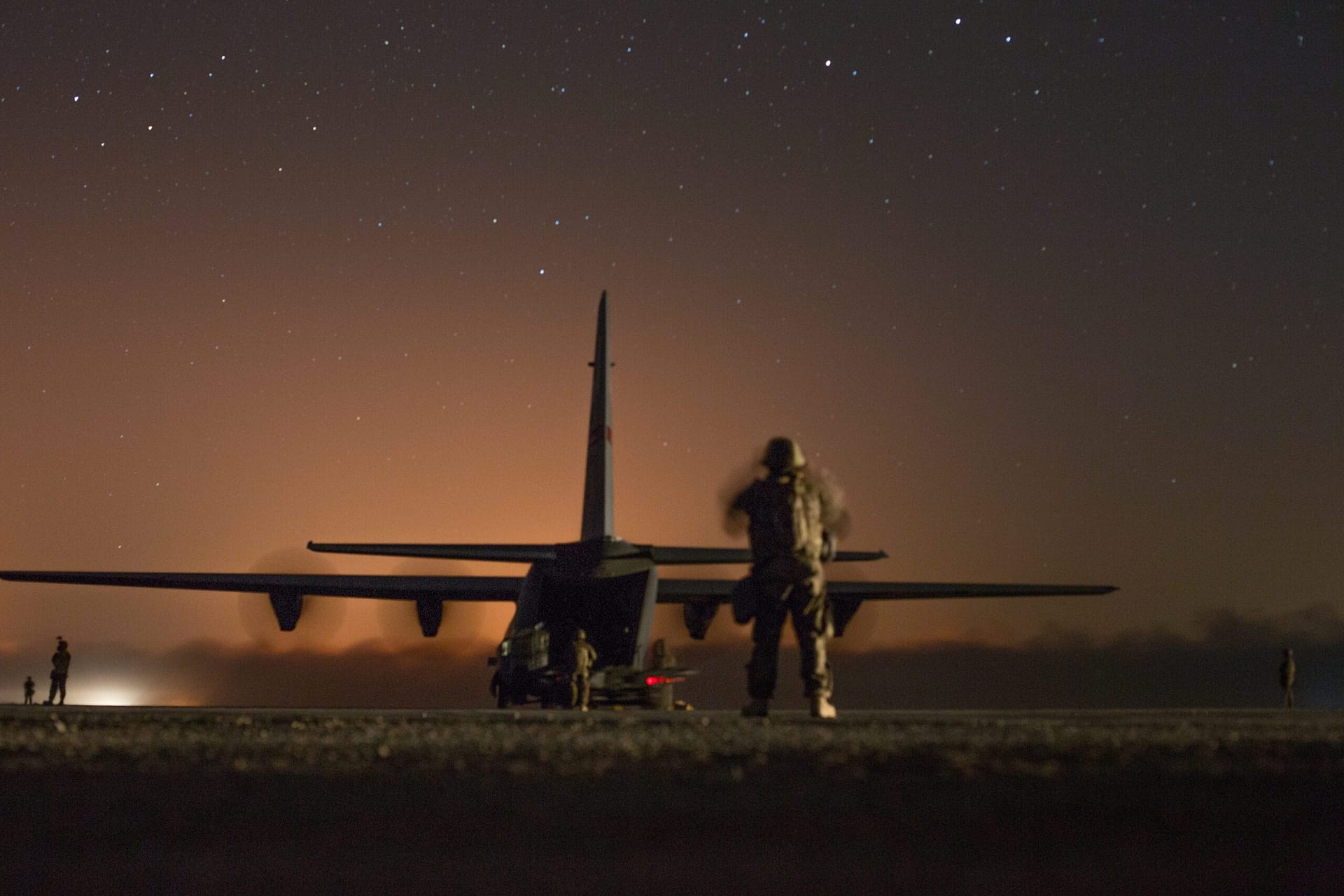
The current tactical airlift fleet centres on two aircraft. The C-130J Super Hercules, built by Lockheed Martin, is the workhorse — a four-engine turboprop that has been the backbone of tactical airlift since the original C-130A entered service in 1956. The C-130J can operate from unpaved strips as short as 3,000 feet and has proven its dirt-runway credentials in Afghanistan, Africa, and Arctic exercises. But the design is seventy years old. Even the latest J-model is an incremental improvement on a platform conceived before the Space Age.
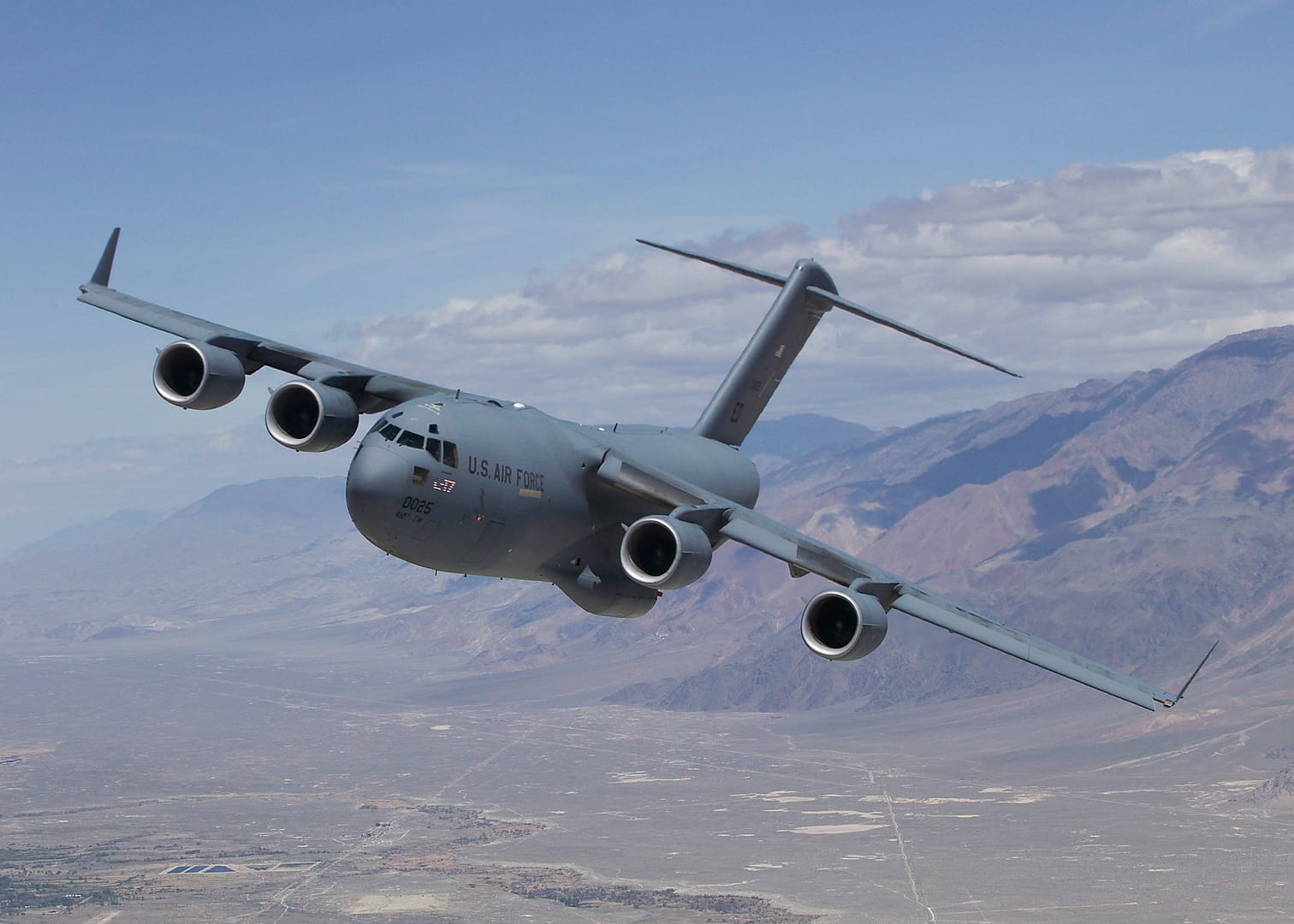
The C-17 Globemaster III handles the heavy end. Boeing's four-engine jet can carry 77 tonnes of cargo and land on runways as narrow as 90 feet, including unpaved surfaces. The C-17 was designed with austere operations in mind, and it regularly practices dirt-strip landings at ranges across the American West. But the production line closed in 2015, and the 222 aircraft in the fleet are ageing. The Air Force now expects them to serve until 2075 — half a century from now.
Neither aircraft was designed for the specific threat environment of a Pacific conflict against a peer adversary with precision-strike capabilities. The C-130 is too slow and too short-ranged. The C-17 is too dependent on ground support equipment and too large a target on a small island strip. What the Air Force needs is something new.
The Next-Generation Airlifter
In late 2025, the Air Force released its Airlift Recapitalisation Strategy, which outlined the requirement for what it calls the Next-Generation Airlifter, or NGAL. The programme is ambitious in scope: NGAL is intended to replace both the C-5M Super Galaxy and the C-17 Globemaster III with a new family of aircraft that can handle strategic, operational, and tactical airlift missions.
The request for information sent to industry specifically asked how proposed designs would reduce reliance on material handling equipment, enable operations from semi-prepared or austere runways, and support the Agile Combat Employment concept. In other words, the Air Force is telling manufacturers: build us something that can land where there is no airport.
The timeline is measured in decades. An accelerated analysis of alternatives is planned for fiscal year 2027. Production could begin in 2038. Initial operational capability is targeted for 2041. In the meantime, the C-17 will keep flying and the C-5M will soldier on until the mid-2040s.
What It Might Look Like
The Air Force has not published a detailed specification, but the requirements point toward several design features. The aircraft will almost certainly need short takeoff and landing performance — the ability to operate from runways of 3,000 feet or less, on surfaces ranging from concrete to gravel to compacted earth. It will need to be largely self-sufficient, with built-in cargo handling equipment that eliminates the need for forklifts and K-loaders at austere sites.
Range will be critical. Pacific distances are vast — it is 1,500 nautical miles from Guam to the Philippines, 1,900 from Hawaii to the Marshall Islands. An aircraft that can only shuttle supplies 500 miles is useless in a theatre measured in thousands. The NGAL will likely need to carry a meaningful payload — at least 30 to 40 tonnes — over distances exceeding 3,000 nautical miles without refuelling.
Survivability is another factor. In a contested environment, a lumbering transport aircraft is a target. Future designs may incorporate reduced radar signatures, infrared suppression, and defensive systems that are currently found only on combat aircraft. Some concepts envision autonomous or optionally manned variants that could fly resupply missions into the most dangerous airstrips without risking aircrew.
Several manufacturers have already signalled interest. Northrop Grumman has proposed a blended-wing-body design. Lockheed Martin will almost certainly offer a next-generation Hercules derivative. Boeing, despite closing the C-17 line, retains the engineering expertise. And newer entrants like Electra, which is developing hybrid-electric short-takeoff aircraft, have launched dedicated defence units to pursue the tactical airlift mission.
The Billion-Dollar Bet on Unpaved Runways
The next-generation airlifter programme will cost tens of billions of dollars and take two decades to deliver. In a Pentagon that struggles to field a new fighter in under twenty years, that timeline is both realistic and deeply uncomfortable. The threat from China's missile force exists today, not in 2041.
In the interim, the Air Force is investing in making its current fleet more austere-capable. C-17 crews are training on dirt strips across Alaska and the Pacific islands. C-130J units are practicing rapid-turn logistics at bare-base exercises. And the service is exploring commercial-derivative solutions — including the KC-390 Millennium — that could bridge the gap until NGAL arrives.
But the fundamental problem remains. The aircraft that won the wars of the last thirty years were designed for a world where air bases were safe. The aircraft that will fight the next war must assume that every base is a target — and that the runway might be a road cut through a coconut plantation on an island no one has heard of. The nation that builds the best dirt-road airlifter will have a decisive advantage. The Air Force knows it. Now it has to build it.
0 Comentarios