
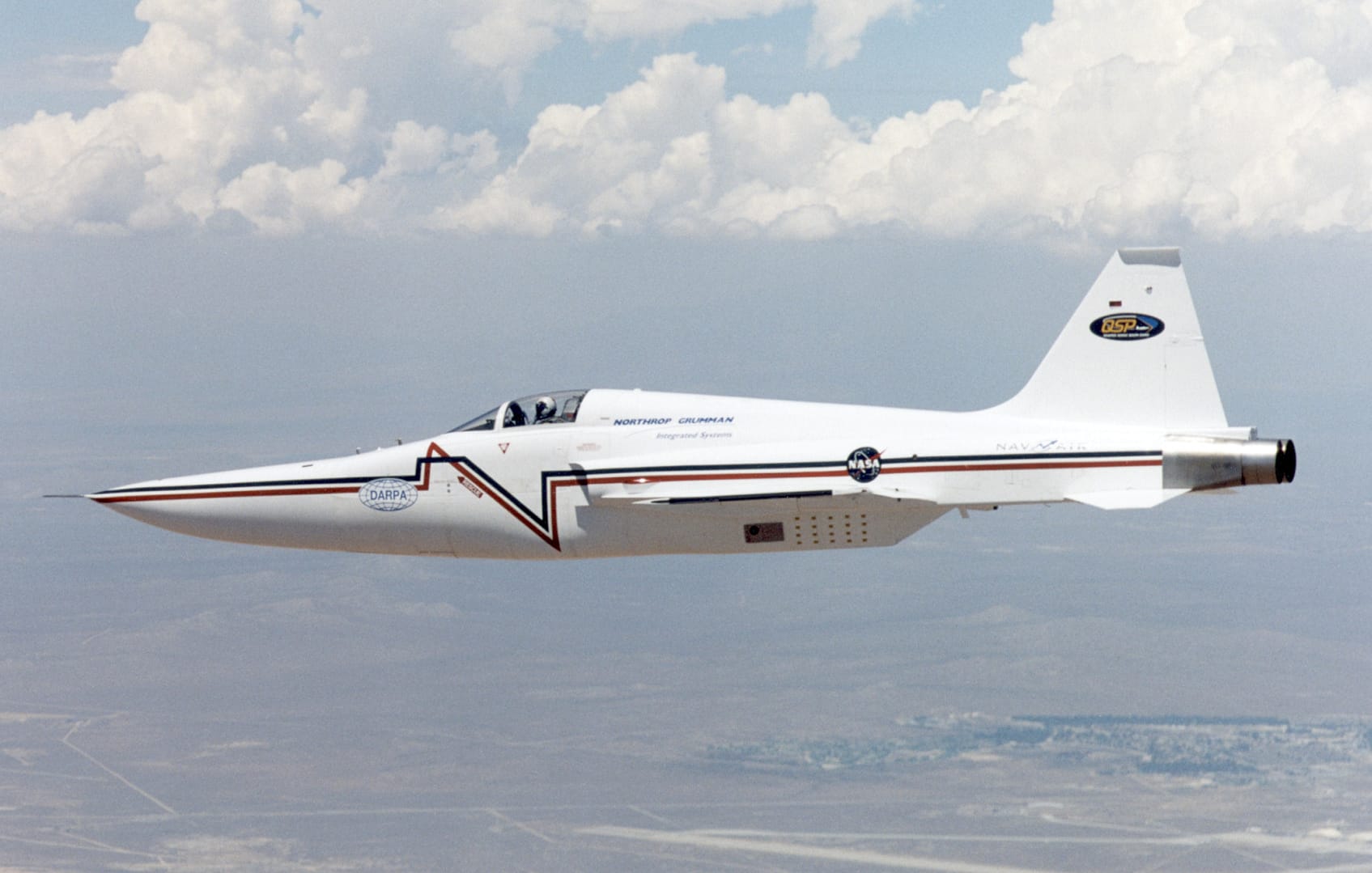
If you have ever seen a photo of the Shaped Sonic Boom Demonstration aircraft and thought it looked like someone glued the bow of a fishing boat onto a fighter jet, you are not alone. The internet has been comparing it to pelicans, pregnant guppies, and various aquatic vessels since the first images surfaced. But behind the bizarre profile of this modified F-5E lies one of the most important aeronautical experiments of the twenty-first century — and a technology that is about to change civilian aviation.
The Problem With Going Fast
The Concorde could cross the Atlantic in three and a half hours. It was beautiful, fast, and revolutionary. It was also banned from flying supersonically over land because its sonic boom shattered windows, terrified livestock, and generated noise complaints from people who were not even on its flight path. The FAA prohibited supersonic flight over the continental United States in 1973, and similar restrictions exist in virtually every country on earth.
That single regulation killed supersonic commercial aviation more effectively than any engineering failure or economic downturn. Without overland routes, supersonic airliners were restricted to oceanic crossings — a tiny fraction of global air traffic. Concorde retired in 2003. The Soviet Tu-144 lasted even less long. And for the next two decades, nobody flew passengers faster than the speed of sound.
The sonic boom is not an optional feature of supersonic flight. It is physics. When an aircraft exceeds Mach 1, it generates shock waves that propagate to the ground as a sharp pressure pulse — the classic double bang that sounds like a thunderclap. The intensity depends on the aircraft's size, shape, speed, altitude, and the atmosphere it is flying through. For the Concorde, the overpressure at ground level was roughly two pounds per square foot — enough to rattle dishes and set off car alarms.
But what if you could change the shape of the shock wave?
The Fishing Boat Solution
In the late 1990s, DARPA launched the Quiet Supersonic Platform programme to investigate whether supersonic aircraft could be designed to produce significantly quieter booms. Northrop Grumman won a contract to prove the concept, and they did it in the most visually startling way possible: they took a retired US Navy F-5E Tiger II and gave it a nose job that would make a plastic surgeon weep.
The modification added a bulbous, elongated nose fairing to the F-5E's normally sleek profile. The result looked absurd — hence the fishing-boat comparisons — but the aerodynamics were deadly serious. By carefully shaping the forward fuselage, Northrop Grumman's engineers altered the pattern of shock waves generated by the aircraft in supersonic flight. Instead of a sharp, N-shaped pressure wave that hits the ground as a loud bang, the modified shape produced a gentler, more spread-out pressure signature — a soft thump instead of a crack.
Proof Over Edwards
The Shaped Sonic Boom Demonstration aircraft flew its test campaign from NASA's Dryden Flight Research Center at Edwards Air Force Base, California, in August 2003 and January 2004. Over approximately thirty supersonic test flights, an F-15B chase aircraft flew behind the modified F-5E at various distances and orientations, using a specially instrumented nose boom to measure shock wave patterns. On the ground, an array of microphones recorded the sonic boom signature as the aircraft passed overhead.
The results, published from 1,300 individual recordings, were unambiguous. The SSBD aircraft produced a sonic boom that was roughly one-third less intense than that of an unmodified F-5E flying at the same speed and altitude. The shape of the pressure wave matched the theoretical predictions almost exactly. For the first time in aviation history, engineers had proven in flight that sonic boom intensity could be deliberately reduced by modifying aircraft shape.
It was not a small achievement. The theoretical framework had existed for decades, but until the SSBD programme, no one had demonstrated it with a real aircraft at real supersonic speeds over real ground sensors. The ugly nose worked.
From the F-5E to the X-59
The SSBD was always a proof of concept. The real goal was to take the validated principle and apply it to a purpose-built aircraft that could demonstrate quiet supersonic flight over populated areas — and potentially convince regulators to lift the overland supersonic ban.
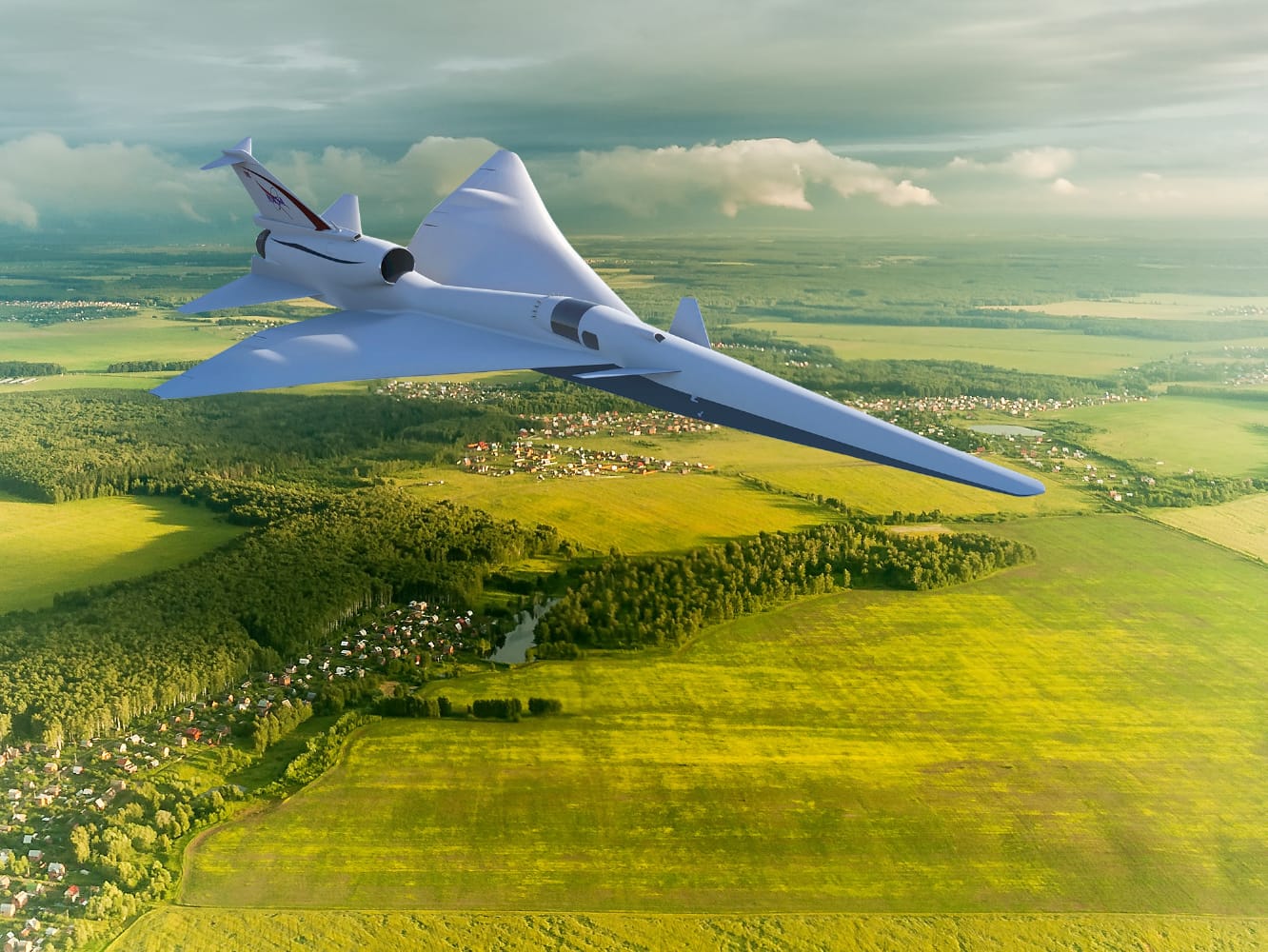
That aircraft is the Lockheed Martin X-59 QueSST, built for NASA's Quesst mission. Where the SSBD reduced sonic boom intensity by one-third, the X-59 is designed to reduce it to a barely perceptible 75 decibels — roughly the sound of a car door closing. The aircraft's entire airframe is shaped to manage shock waves: a long, tapered nose, a wing positioned to minimise wave coalescence, and an engine inlet mounted above the fuselage to shield the ground from engine noise.
The X-59 made its first flight on 28 October 2025 from Air Force Plant 42, with NASA test pilot Nils Larson at the controls. On 5 June 2026, it broke the sound barrier for the first time, reaching Mach 1.1 at 43,400 feet. A week later, it hit Mach 1.4 at 55,000 feet — the target speed and altitude for future community overflight tests.
What Comes Next
NASA plans to fly the X-59 over several American cities and measure the public response to its low-boom signature. If the data shows that people on the ground barely notice — or do not notice at all — the agency will present the findings to the FAA and the International Civil Aviation Organization. The goal is to replace the blanket ban on overland supersonic flight with a noise-based standard that quiet supersonic aircraft could meet.
If that happens, the floodgates open. Companies like Boom Supersonic, which is developing the Overture airliner, are watching the X-59 programme with intense interest. An overland supersonic standard would make routes like New York to Los Angeles, London to Dubai, and Tokyo to Sydney commercially viable at supersonic speeds — something that has been impossible since Concorde's retirement.
And it all traces back to that ridiculous-looking F-5E with the fishing-boat nose, parked at the Valiant Air Command Warbird Museum in Titusville, Florida, where visitors still walk past it wondering what on earth they are looking at. The answer is: the aircraft that proved supersonic flight does not have to be loud. It just has to be shaped right.
0 Comentarios