
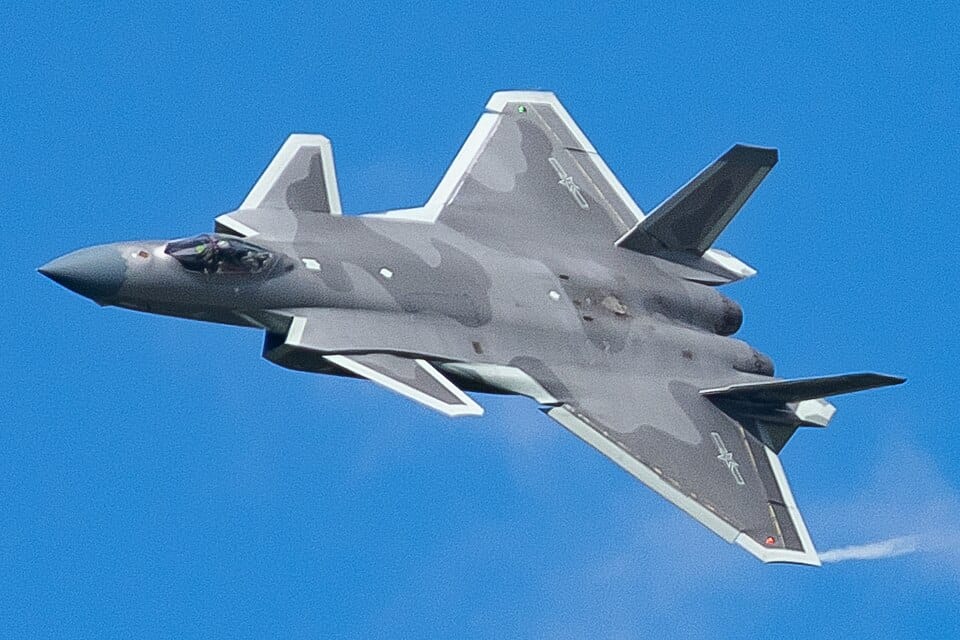
China's People's Liberation Army has released the first official footage of its sixth-generation fighter jet — believed to be the Chengdu J-36 — in a military video published on 29 June 2026. The brief but unmistakable appearance marks the first time Beijing has officially acknowledged the existence of an aircraft that was first spotted by civilians over Chengdu eighteen months ago.
- Designation: J-36 (unofficial, based on serial number 36011)
- Type: Sixth-generation stealth multirole fighter
- Manufacturer: Chengdu Aircraft Corporation (CAC)
- Configuration: Tailless diamond-double-delta wing, trijet
- First observed: 26 December 2024 (test flight over Chengdu)
- Official footage: 29 June 2026 (PLA China Military Bugle video)
- Status: Flight testing, at least 3–4 prototypes observed
The PLA Video
The footage appeared in a four-minute video published by China Military Bugle, the official press account of the PLA, celebrating the Y-20 military transport aircraft. In the video, two pilots aboard a Y-20 are shown in conversation. The co-pilot asks who they are refuelling that day. The captain replies: "First the 'Master Six,' then the 'Little Six'" — before a fighter jet streaks across the sky outside the cockpit window.
"Master Six" is an established nickname for the H-6 bomber. "Little Six" — "Xiao Liu" in Mandarin — points directly to the sixth-generation fighter. The aircraft is visible only briefly during a sharp climbing turn, but the tailless diamond-wing planform is unmistakable. Analysts described the sequence as the first implicit official acknowledgment of the programme in Chinese military media — a marked shift from the total silence that surrounded the project until now.
What We Know About the J-36
The aircraft first appeared publicly on 26 December 2024, when civilians photographed a large tailless jet conducting test flights over Chengdu, Sichuan Province — home to the Chengdu Aircraft Corporation, which also produces the J-20 stealth fighter. The serial number 36011, visible on the airframe, led analysts to assign the unofficial designation J-36, following the PLA Air Force's naming convention where the first digits indicate the type.
Since that first sighting, at least three to four prototypes have been observed. The aircraft features a diamond-shaped double-delta wing with no vertical or horizontal tail surfaces — a configuration optimised for extreme stealth from all aspects. Most notably, it appears to be powered by three engines: two in the main fuselage and a third dorsal engine with a separate intake, a configuration unprecedented in fighter design.
A Trijet Fighter
The three-engine layout has drawn particular attention from Western analysts. No previous fighter aircraft has used a trijet configuration. The third engine may serve multiple purposes: providing additional thrust for supercruise, powering directed-energy weapons or advanced sensors that demand enormous electrical power, or simply giving the aircraft the performance margin needed for its apparent size — the J-36 appears significantly larger than the J-20, closer to a medium bomber in scale.
The tailless design eliminates the radar returns generated by conventional tail surfaces, potentially giving the J-36 all-aspect stealth characteristics that even the F-22 Raptor and J-20 cannot match. The trade-off is reduced agility at low speeds, though recent footage of the aircraft — analysed in our earlier coverage — showed it performing a sharp climbing turn that surprised observers who expected a tailless design to be sluggish.
Two Sixth-Gen Programmes
China is running two parallel sixth-generation fighter programmes. While Chengdu develops the J-36, the Shenyang Aircraft Corporation is working on the J-50 — a twin-engine tailless design that appears smaller and more conventional than its Chengdu counterpart. Both aircraft have been photographed in flight testing, putting China ahead of the United States, where the Next Generation Air Dominance (NGAD) programme was restructured in 2024 amid cost concerns.
The simultaneous development of two competing sixth-generation designs mirrors the approach China took with its fifth-generation fighters, the Chengdu J-20 and Shenyang J-31 (now FC-31/J-35). It also echoes Britain's V-bomber programme of the 1950s, where three manufacturers were given the same requirement because no one was certain which design philosophy would prove correct.
What It Means
The decision to include the J-36 in an official PLA video — even briefly — signals that Beijing is now willing to let the world know the aircraft exists. Previous Chinese stealth programmes were developed in near-total secrecy until they were ready for public unveiling. The shift suggests confidence in the programme's progress and a deliberate messaging strategy aimed at both domestic audiences and foreign competitors.
For the United States and its allies, the footage underscores the urgency of their own sixth-generation programmes. The GCAP consortium (UK, Japan, Italy) recently locked in £8.6 billion in UK funding, while the U.S. Air Force's NGAD winner, the Boeing F-47 awarded in March 2025, is not expected to fly until 2028. China having at least two sixth-generation designs in active flight testing — with official footage now released — changes the calculus for every Western air force planning its next fighter.
Sources
- Wikipedia — Chengdu J-36
- 19FortyFive — China's New J-36 6th Generation Stealth Fighter Officially Just Broke Cover
- The Defense Post — China Offers First Official Glimpse of Its Secretive Sixth-Gen Fighter Jet
- The Star — What signal is China sending with first official footage of sixth-generation fighter?

0 Comentarios