
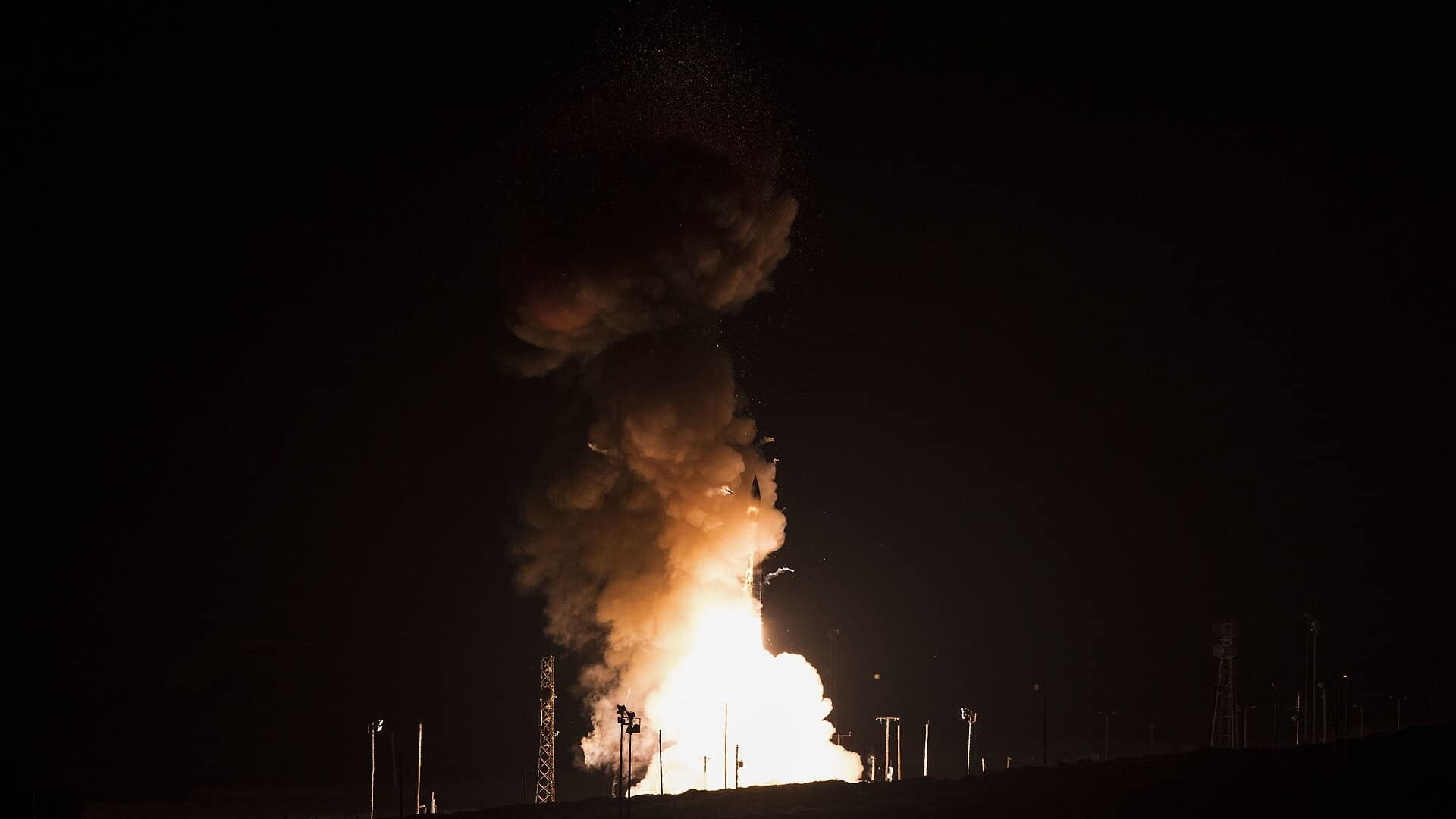
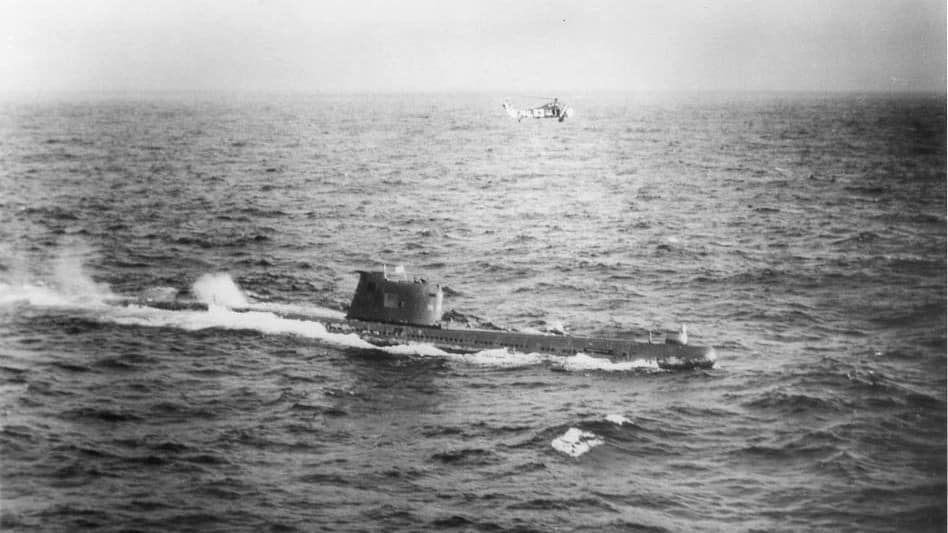
It is the evening of 27 October 1962, and inside Soviet submarine B-59, somewhere north of Cuba, the temperature has passed 45 degrees Celsius and the air is running out. The batteries are almost dead. Men are fainting at their stations. For hours, American depth charges have been going off around the hull — blow after blow, which the boat’s radio-intercept officer would later compare to sitting inside a metal barrel while somebody pounds it with a sledgehammer.
The submarine has heard nothing from Moscow in days. Her captain, Valentin Savitsky, cannot know that the charges are signals, not an attack — the message never reached him. By one crewman’s account he is now shouting for his special weapon, the nuclear torpedo in the bow, to be made ready: if there is a war above, he will not die for nothing. In the crowded control room, a 36-year-old staff officer named Vasili Arkhipov — whose agreement the launch requires — quietly refuses.
That refusal stayed secret for forty years. And it was not a freak event. Three times between 1962 and 1995 — twice at the height of the Cold War, once in supposed peacetime — the machinery built to warn of nuclear attack instead marched the world to the edge of one, and a single human judgment, exercised in minutes, walked it back. This series tells all three stories in full. This is the map.
Quick Facts: Three Nights, One Pattern
| 27 October 1962 | Submarine B-59, depth-charged and cut off, nearly fires a nuclear torpedo; Vasili Arkhipov says no — on the same day a U-2 is shot down over Cuba and another strays into Soviet Siberia |
| 26 September 1983 | Soviet satellites report five US ICBMs inbound; Lt Col Stanislav Petrov calls it a malfunction — correctly |
| 25 January 1995 | A Norwegian science rocket is read as a Trident missile; Boris Yeltsin’s nuclear briefcase is activated — the only known time |
| The pattern | Fallible sensors, impossibly short decision windows, and one person in the loop |
| The aviation thread | Spy planes, bombers on alert, and rockets mistaken for missiles run through every incident |
The Pattern Nobody Designed
Every nuclear near-miss in this series has the same three ingredients, and none of them is malice. First, a sensor tells a story that happens to be false — a radar reads a science rocket as a Trident, a satellite reads sunlight on clouds as five rising boosters, a submarine crew reads signalling charges as an attack. Second, the clock: the machinery of deterrence allots minutes, sometimes single-digit minutes, to decide whether the story is true. Third — and this is the unsettling part — the final safeguard turns out to be not a system but a person, who must choose to distrust the very tools built to inform him.
The Cold War produced dozens of lesser false alarms; these are the three where the chain ran furthest towards the end. Looked at together, they read less like three lucky escapes than like one recurring failure mode, dressed in different decades.
Take them in order — from the deep water off Cuba, to a concrete bunker south of Moscow, to a snow-covered launch pad in Arctic Norway.
1962: Black Saturday
The worst single day of the Cuban Missile Crisis packed three separate near-misses into 24 hours. Over Cuba, a surface-to-air missile killed U-2 pilot Rudolf Anderson — the crisis’s only combat death, and very nearly the trigger for a full American strike. Over the Arctic, another U-2, its pilot blinded by the aurora on a routine sampling flight, wandered deep into Soviet airspace with MiGs climbing after it and nuclear-armed American F-102 interceptors scrambling to meet it.
And beneath the Sargasso Sea, B-59’s exhausted captain called for his nuclear torpedo. The US Navy ships above did not learn what had nearly hit them until a Havana conference in 2002, when Russian veterans and declassified records finally told the story — and the director of the US National Security Archive concluded, simply, that a man called Arkhipov had saved the world.
Kennedy’s advisor Arthur Schlesinger Jr. needed no hindsight to rank the day.
Read the full story: Black Saturday: Three Near-Misses in One Day
1983: The Night One Man Ignored the Sirens
Twenty-one years later the danger had moved indoors, into a bunker called Serpukhov-15, where the Soviet Union’s new Oko satellites watched America’s missile fields. Just past midnight on 26 September 1983, the sirens howled and a red screen lit up with the word LAUNCH: one Minuteman ICBM rising from Montana, then five, with the system reporting its own confidence as maximum.
The duty officer, Lieutenant Colonel Stanislav Petrov, had perhaps a quarter of an hour of usable time, a brand-new system he did not fully trust, and ground radars that saw nothing. He reported a malfunction — then sat for 23 minutes, feeling, as he put it, like a man on a hot frying pan, waiting to find out if he had just gambled away his country. He had not: the satellites had mistaken sunlight glinting off high clouds for booster plumes.
His reasoning was pure engineer — and one line of it has outlived him.
The timing made the call heavier still. Three weeks earlier, Soviet air defence had shot down Korean Air Lines Flight 007, killing 269 people; six weeks later, NATO’s Able Archer exercise would rattle Moscow’s nerves again. Into that autumn of paranoia, a formal report of five inbound ICBMs might not have been treated as a technical curiosity.
Read the full story: The Night One Man Ignored the Sirens
1995: The Rocket From Andøya
The strangest entry on the list happened after the Cold War was over. On 25 January 1995, Norwegian and American scientists launched a four-stage Black Brant XII from Andøya to study the northern lights. On Russian radar, the biggest rocket the range had ever flown looked like a Trident missile climbing out of the Norwegian Sea — and a lone Trident fitted the nightmare scenario of a high-altitude EMP burst meant to blind Russia’s defences ahead of a real attack.
For the only time in the nuclear age, as far as public record goes, a head of state’s nuclear briefcase was activated in response to a live warning. Boris Yeltsin was connected with his defence minister and chief of the General Staff while the track was watched; most of the ten-minute window was gone before the trajectory bent harmlessly towards Svalbard. Yeltsin confirmed it himself to reporters the next day — he had used his “little black case” for the first time.
The cause was neither hardware nor hostility. Norway had notified Russia in writing a month in advance; the letter simply never reached the radar crews. The most dangerous minutes of the post-Cold-War era came down to an unforwarded piece of paper.
Read the full story: The Science Rocket That Opened the Nuclear Briefcase
And the Pilot Who Never Came Home
One thread of Black Saturday deserves — and today receives — its own telling. Major Rudolf Anderson Jr. was the man in the U-2 over eastern Cuba, photographing the missile sites the whole crisis revolved around, when an SA-2 burst beside his aircraft at 72,000 feet. He was the only person killed by enemy fire in the entire thirteen days — and his death, absorbed rather than avenged by Kennedy, may paradoxically have helped end the crisis rather than escalate it.
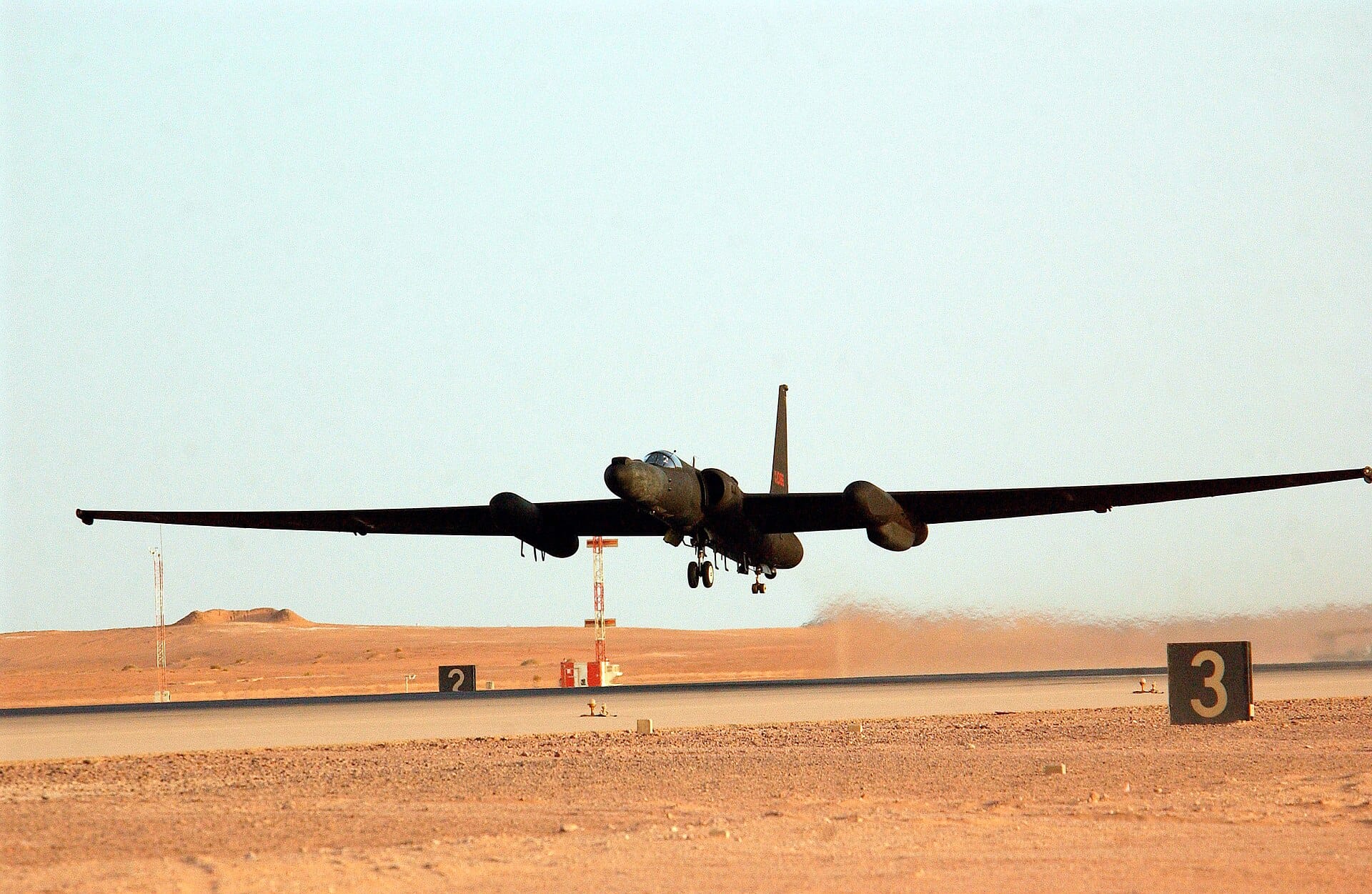
The shootdown of Rudolf Anderson — the full story of Black Saturday’s only casualty — is here.
Why It Was Always About Aircraft
Run a finger along all three stories and you keep touching wings. It was a spy plane’s photographs that started the Cuban crisis and a spy plane’s wanderings that nearly widened it; nuclear-armed interceptors that rose to meet a lost pilot; bombers holding at their failsafe points that gave every miscalculation its weight. In 1983, the satellites that cried wolf existed to watch for missiles that had made the bomber’s job of warning obsolete — and compressed the world’s decision time from hours to minutes in the process. In 1995, the object at the centre of it all was itself a flying machine, a research rocket whose only crime was resembling a military one.
Aviation built the nuclear age — delivered its first weapons, carried its cameras, flew its bluffs — and aviation’s hardest lesson applies to it exactly: the system is never the whole story. Checklists, sensors and automation fail, quietly and confidently, and when they do, everything narrows to a human being with partial information and no time. An exhausted staff officer in a sweltering submarine. An engineer distrusting his own screens. Radar crews watching a track bend away with two minutes to spare.
Three nights, three decades, one margin: somebody, at the worst possible moment, chose to wait. The full stories — told in this series — are worth your time, because the pattern they describe has not retired. The sensors are better now. The minutes are just as short.
Sources: National Security Archive; BBC; Washington Post; Nuclear Museum / Atomic Heritage Foundation; Center for Arms Control and Non-Proliferation; Michael Dobbs, One Minute to Midnight; Peter Vincent Pry, War Scare; Wikipedia.
0 Comentarios