

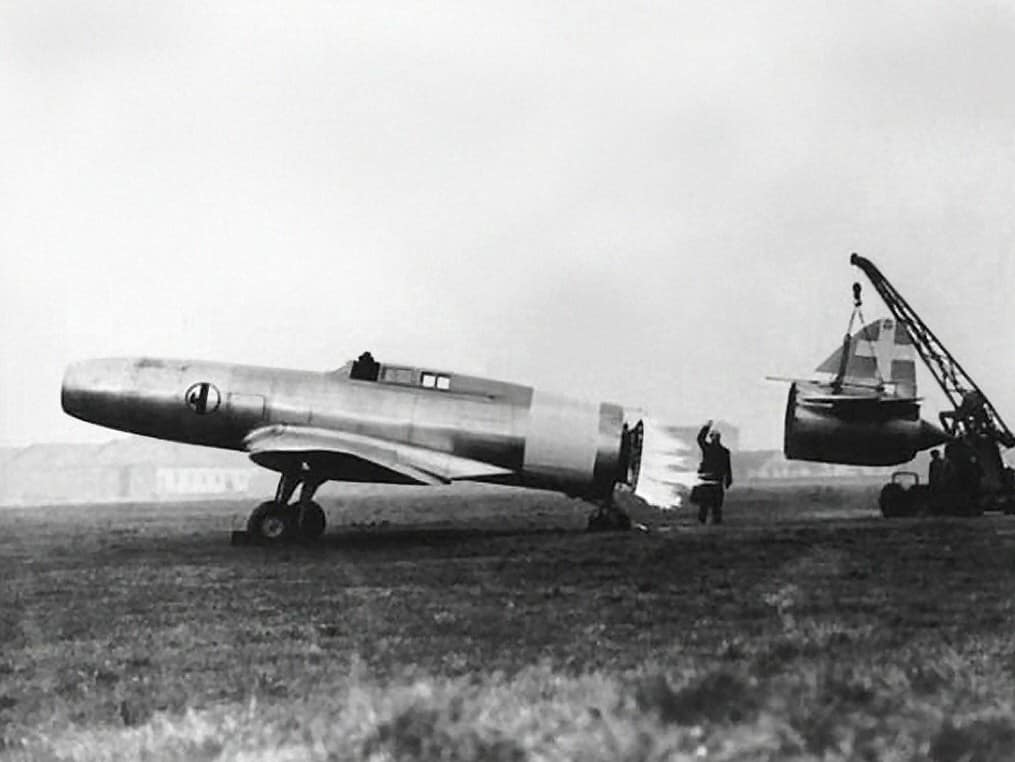
For a single year, Italy believed it had built the first jet aeroplane in history. On 27 August 1940, a sleek, barrel-shaped machine howled into the sky over Milan with no propeller anywhere to be seen — and the world’s aviation authority duly recorded it as the first successful flight by a jet aircraft. It was a triumph of Fascist engineering, splashed across newsreels.
It was also, in a sense, a beautiful lie. The Caproni Campini N.1 was not a true jet at all. And a year earlier, in total secrecy, Germany had already flown the real thing.
DATOS RÁPIDOS
| Role | Experimental jet-propulsion demonstrator |
| Primer vuelo | 27 August 1940 (pilot Mario de Bernardi) |
| Motor | "Motorjet": 900 hp Isotta Fraschini piston engine driving a compressor, with afterburner |
| Empuje | ~1,600 lbf |
| Velocidad máxima | 233 mph (375 km/h) — slower than piston fighters of the day |
| Número construido | 2 (one survives at Vigna di Valle) |
A jet without a jet engine
The N.1 was the work of engineer Secondo Campini, who had been studying jet propulsion since 1931 and had even demonstrated a jet-powered boat in Venice to prove the principle. But he did not have a turbojet. Instead he built a "motorjet" — a hybrid in which an ordinary 900-horsepower Isotta Fraschini piston engine, buried in the fuselage, drove a compressor that forced air through a duct, where a burner added a final kick of thrust.
It worked, after a fashion. But it was heavy, complicated, and thirsty, and it produced only about 1,600 pounds of thrust — enough for a top speed of just 233 mph, slower than the propeller fighters it was meant to render obsolete. The cockpit ran so hot the two-man crew flew with the canopies open.
Historian Sterling Michael Pavelec sums the machine up in three words.
First — until the secret got out
Because Germany had kept the 27 August 1939 flight of its Heinkel He 178 — a genuine turbojet — a state secret, the Fédération Aéronautique Internationale credited the Campini N.1 as the world’s first jet aircraft. For a while, Italy owned one of the great firsts in aviation. Then the truth about the He 178 emerged, and the record quietly changed hands. The He 178 had beaten the Italians into the air by exactly one year.

The motorjet was an evolutionary dead end. Within a few years, Frank Whittle’s and Hans von Ohain’s true turbojets made Campini’s clever hybrid obsolete forever. But strip away the "first jet" mythology and something real remains: a brave, imaginative attempt to leap into the jet age using the tools one country actually had. It flew. It just flew into the wrong future.
Sources: Sterling Michael Pavelec, "The Jet Race and the Second World War"; Vintage Aviation News; Wikipedia.

0 Comentarios