

There is a particular elegance to watching a country refuse to choose sides. For half a century Egypt bought its wings where the politics of the moment allowed, Soviet MiGs, then American Falcons, then French Rafales, always a client, never a builder. Now Cairo proposes something more audacious: to help manufacture a fifth-generation stealth fighter, the KAAN, on Egyptian soil, in partnership with Turkey. It is the kind of move that rearranges a map not by conquest but by industrial policy, and it deserves to be read as such.
The reports began circulating in the summer of 2025 and have hardened through 2026: technology transfer, a joint production line, and an eventual procurement of KAAN for the Egyptian Air Force. Should it hold, Egypt would become the first African nation to co-produce a fifth-generation aircraft, and the Mediterranean would acquire a new axis of airpower that owes nothing to Washington.
Datos rápidos
- Aeronave: KAAN — twin-engine, fifth-generation stealth fighter by Turkish Aerospace Industries (TAI), launched 2016 as TF-X / Milli Muharip Uçak
- Primer vuelo: 21 February 2024 — 13 minutes, 8,000 ft, 230 knots, chased by a Turkish F-16D
- Motores: Two General Electric F110-GE-129 today; an indigenous TEI turbofan (~35,000 lb thrust) targeted for the early 2030s
- Service / production: Serial-production readiness targeted for 2028; Turkish squadron service by the late 2020s
- Egypt’s role: Reported technology transfer, a joint production line and a plan to buy KAAN for the Egyptian Air Force; would be the first African country to help build a fifth-gen fighter
- When it broke: Reports surfaced in summer 2025 and firmed through 2026; sits within the post-2013 Turkey–Egypt rapprochement
- Other partners: Indonesia signed for 48 KAAN (~US$10bn) at IDEF 2025; Saudi Arabia and the UAE have expressed interest
A fighter still learning to fly
Let us be precise about the object of all this ambition. The KAAN is Turkish Aerospace Industries’ twin-engine stealth fighter, conceived in 2016 under the designation TF-X, the Milli Muharip Uçak, or National Combat Aircraft, as Ankara’s riposte to its expulsion from the American F-35 programme. It made its maiden flight on 21 February 2024: thirteen minutes aloft, 8,000 feet, 230 knots, shadowed by an F-16 chase plane. A handsome silhouette, faceted for low observability, internal weapons bays, an ASELSAN AESA radar. On paper, everything a modern air force covets.
And yet the KAAN today flies on two American engines, the General Electric F110, the very dependence Turkey built the aircraft to escape. An indigenous turbofan is promised for the early 2030s; serial production is targeted for 2028; Turkish squadron service for the late 2020s. This is, in other words, a fighter still learning to fly, sold on the strength of its trajectory rather than its track record. Readers who have followed our earlier KAAN coverage will recognise the pattern: bold milestones, ambitious dates, and a great deal riding on the years still ahead.
Cairo’s long goodbye to a single patron
To understand why Egypt would gamble on an unfinished aircraft, look at the fleet it already keeps. Roughly 210 F-16s form the backbone; above them fly 54 French Rafales ordered since 2015, alongside MiG-29Ms and ageing Mirages nearing retirement. Cairo has trained beside Chinese J-10Cs and courted South Korea for FA-50s. This is not indecision. It is doctrine, a deliberate diversification designed so that no single capital in Washington, Paris or Moscow can ever again hold Egyptian airpower hostage to a diplomatic quarrel.
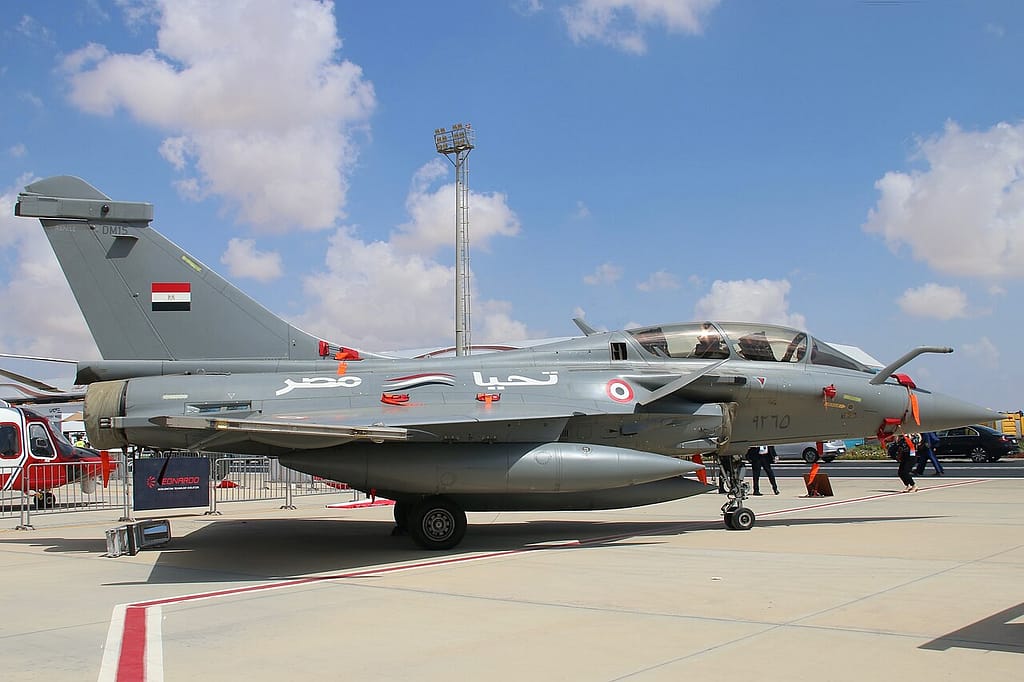
The KAAN answers that doctrine perfectly. The United States will not sell the F-35 to Egypt, Saudi Arabia or the UAE; the fifth generation has been, for the Arab world, a locked door. Turkey now offers the key, and more than the key, a share of the workshop.
A decade of estrangement, undone
What makes this remarkable is who is extending the hand. For a decade after 2013, Ankara and Cairo barely spoke; Turkey’s condemnation of the ouster of Mohamed Morsi froze relations into open rivalry. The thaw came slowly, reconciliation talks from 2021, ambassadors exchanged in 2023, President Erdoğan in Cairo in early 2024, President el-Sisi in Ankara that September, where he first signalled interest in the KAAN. That two former antagonists should now contemplate building a stealth fighter together is the surest measure of how completely the regional chessboard has been reset.
The strategic logic runs deeper than sentiment. A fifth-generation Egypt would erode the aerial monopoly Israel has enjoyed as the Middle East’s sole F-35 operator, a point Cairo’s advocates make without embarrassment.
The axis takes shape
Egypt does not join alone. In 2025 Indonesia signed for 48 KAAN in a deal reported at some ten billion dollars, Turkey’s largest defence export to date, complete with local assembly and technology sharing. Saudi Arabia and the UAE have circled the programme with evident appetite. What emerges is less a sale than a coalition: a Turkey-anchored bloc conceived expressly to sidestep the West’s fifth-generation gatekeeping. For Ankara, each new partner spreads the development cost and validates the export case. For Cairo, Jakarta and the rest, it offers entry into an elite club that Washington had reserved for its closest friends.
The caveats a sober eye must keep
Elegance, however, is not the same as certainty, and a European reading of this affair should keep its scepticism sharpened. Three shadows fall across the KAAN axis. The first is maturity: this is an aircraft with a handful of flights, not a proven weapons system, and the gap between prototype and frontline squadron has humbled richer programmes. The second is the engine: those American F110s require U.S. re-export approval for any third party; Turkish officials indicated in 2026 that clearance had been secured for the Indonesian deal, but an Egyptian sale rests on the same uncertain grace, and the promised indigenous engine remains years away. The third is money: technology transfer and a joint production line are expensive ambitions for an economy as strained as Egypt’s, and much of what has been reported remains memoranda rather than binding, signed contracts.

None of this diminishes the significance of the gesture. Whether or not a single KAAN ever wears Egyptian colours, Cairo has announced its intention to be a maker of fifth-generation airpower rather than merely a buyer, and Turkey has found in Egypt the partner that turns a national project into a multinational one. That is how axes are born: not in a single flourish, but in a series of careful, self-interested choices that, taken together, redraw the sky. France, of all nations, understands the seduction of strategic autonomy. Egypt has simply decided to pursue it eastward.
Sources: The National Interest, Defence Security Asia, Turkish Minute, The Arab Weekly, Daily Sabah, The New Arab, FlightGlobal, Breaking Defense.
Publicaciones relacionadas

0 Comentarios