
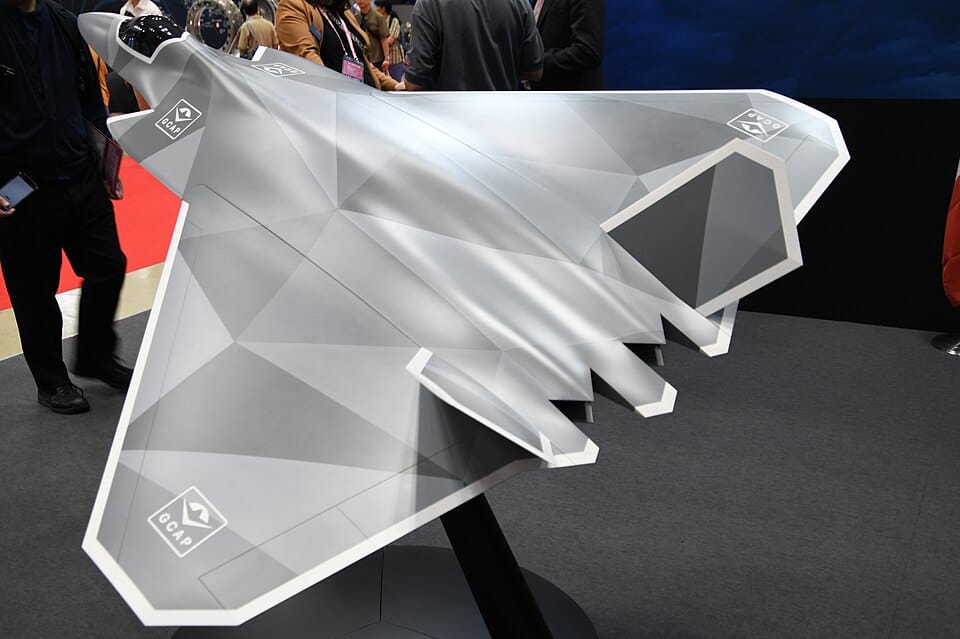
| Datos rápidos | |
|---|---|
| Programa | Global Combat Air Programme (GCAP) |
| Contract Value | £686 million ($905 million) |
| Contractor | Edgewing (joint venture: BAE Systems, Leonardo, JAIEC) |
| Partner Nations | Reino Unido, Italia, Japón |
| Generation | Sixth-generation combat aircraft |
| Target In-Service Date | 2035 |
| Reemplaza | Eurofighter Typhoon (UK, Italy) and Mitsubishi F-2 (Japan) |

Three nations. Three defence industries. One aircraft. On April 1, the programme that will define European and Japanese air power for the second half of this century passed its first real milestone: money.
The GCAP Agency — the joint body managing the Global Combat Air Programme on behalf of the United Kingdom, Italy, and Japan — awarded Edgewing a £686 million ($905 million) design and development contract. It is the first international contract the programme has ever issued, and it transforms GCAP from a political agreement into an engineering project with steel being cut and engineers being hired.
Edgewing is the trinational joint venture formed by BAE Systems (UK), Leonardo (Italy), and the Japan Aircraft Industrial Enhancement Co. (JAIEC). The contract formally establishes it as the central design authority — responsible for engineering, systems integration, airworthiness, and certification of the future combat aircraft.
What the Money Buys
The £686 million covers the initial phase of design and engineering work through June 2026. That may sound like a short runway for nearly a billion dollars, but the intent is clear: accelerate. The three partner nations want to build momentum fast, locking in design decisions and industrial workflows before political winds shift or budgets tighten.
Britain — which had been grappling with internal budget disputes over its share of the programme — secured a bridge funding arrangement just in time. Without it, the contract could not have been signed. That financial scramble, reported by Defense News, underscores a reality familiar to anyone who has followed multinational fighter programmes: the engineering is hard, but the politics are harder.
The funding will invest in what the GCAP Agency calls "key design and engineering activities" — deliberately vague language that covers everything from aerodynamic modelling and sensor architecture to the software-defined systems that will make GCAP fundamentally different from the Typhoon it replaces.

Why Sixth Generation Matters
Fifth-generation fighters — the F-35, the F-22, China's J-20 — defined air combat by combining stealth, sensor fusion, and networked warfare. Sixth generation aims to go further. The details remain classified, but the broad vision is public: an aircraft designed from the ground up to operate alongside autonomous drones, process battlefield data in real time using onboard AI, and carry weapons internally in configurations that fifth-gen jets cannot accommodate.
GCAP's target in-service date is 2035 — ambitious by any standard. The Eurofighter Typhoon, which GCAP will eventually replace in British and Italian service, took over two decades from concept to operational capability. Japan's F-2, which GCAP will replace in Tokyo's fleet, followed a similarly drawn-out development path.
The 2035 deadline is driven by strategic necessity. By the mid-2030s, Typhoon airframes will be reaching the end of their structural lives, and Japan faces a narrowing window to maintain credible air power in the western Pacific as China's military modernisation accelerates.

The Competition
GCAP is not the only sixth-generation fighter programme in development. France, Germany, and Spain are pursuing the Future Combat Air System (FCAS) under Dassault and Airbus leadership. The United States has its own Next Generation Air Dominance (NGAD) programme, though its future is uncertain after cost concerns led the Air Force to rethink its approach.
What sets GCAP apart is its trilateral structure spanning two continents. Building a fighter jet with partners in London, Rome, and Tokyo means navigating different industrial cultures, classification systems, and strategic priorities. The Edgewing joint venture is the mechanism designed to make that work — a single entity that can make engineering decisions without routing every choice through three separate governments.
From Powerpoint to Metal
Every military aircraft programme begins with glossy renders and ambitious timelines. Most of them die there. What makes this contract significant is not the amount — £686 million is a fraction of what GCAP will ultimately cost — but the fact that three nations with different political systems and defence priorities agreed to write the same cheque at the same time.
The next milestones will be harder: selecting engine suppliers, freezing the aerodynamic design, deciding how much autonomy to build into the airframe from day one. Each decision will test the partnership. But for now, GCAP has done what every next-generation fighter programme must do to survive: it has started spending real money on real engineering. That is harder than it sounds.
Sources: Breaking Defense, Defense News, The Defense Post, Interesting Engineering, Il Sole 24 Ore
Preguntas relacionadas
What is GCAP?
GCAP, the Global Combat Air Programme, is a joint effort by the United Kingdom, Italy and Japan to build a sixth-generation combat aircraft. Targeted to enter service around 2035, it will replace the Eurofighter Typhoon in Britain and Italy and the Mitsubishi F-2 in Japan.
Which countries and companies are behind GCAP?
GCAP is led by the UK, Italy and Japan, with development run through a joint venture called Edgewing — formed by BAE Systems, Italy's Leonardo, and Japan's JAIEC. Edgewing acts as the central design authority for engineering, integration and certification.
How much is the first GCAP contract worth?
The GCAP Agency awarded Edgewing a £686 million ($905 million) design and development contract — the programme's first major industrial milestone — covering the initial design phase through June 2026. Britain secured bridge funding just in time to sign.
What will GCAP replace?
GCAP will replace the Eurofighter Typhoon flown by the UK and Italy and the Mitsubishi F-2 in Japan. As a sixth-generation design it parallels rival next-generation efforts such as America's Boeing F-47.
When will GCAP enter service?
GCAP is targeted to enter service around 2035. The partners are pushing to lock in design decisions quickly, mindful that multinational fighter programmes can stall — Europe's separate FCAS effort shows how political friction can derail them.
Why are three countries building one fighter together?
The UK, Italy and Japan are pooling resources because a sixth-generation fighter is extraordinarily expensive and technically demanding. Sharing cost and industrial work makes the programme affordable, though it also makes the politics harder than the engineering.

0 Comentarios