
Part 2 of The Race for the Bomb, an Afterburner focus series. Part 1 followed the physics revolution to Leo Szilard’s traffic-light epiphany. This part is about the men who carried the idea to America — and the regime that made them refugees.
Berlin, a night near the end of March 1933. A bald Hungarian physicist boards the night train to Vienna carrying two suitcases that have stood packed by his door for years. The carriages are nearly empty. At the Austrian border, no one asks him anything. The next day, the same train is stopped at the frontier, jammed with people, and every passenger is pulled off and interrogated by the new masters of Germany.
The man on the empty train was Leo Szilard, and he drew a lesson from those twenty-four hours that he repeated for the rest of his life.
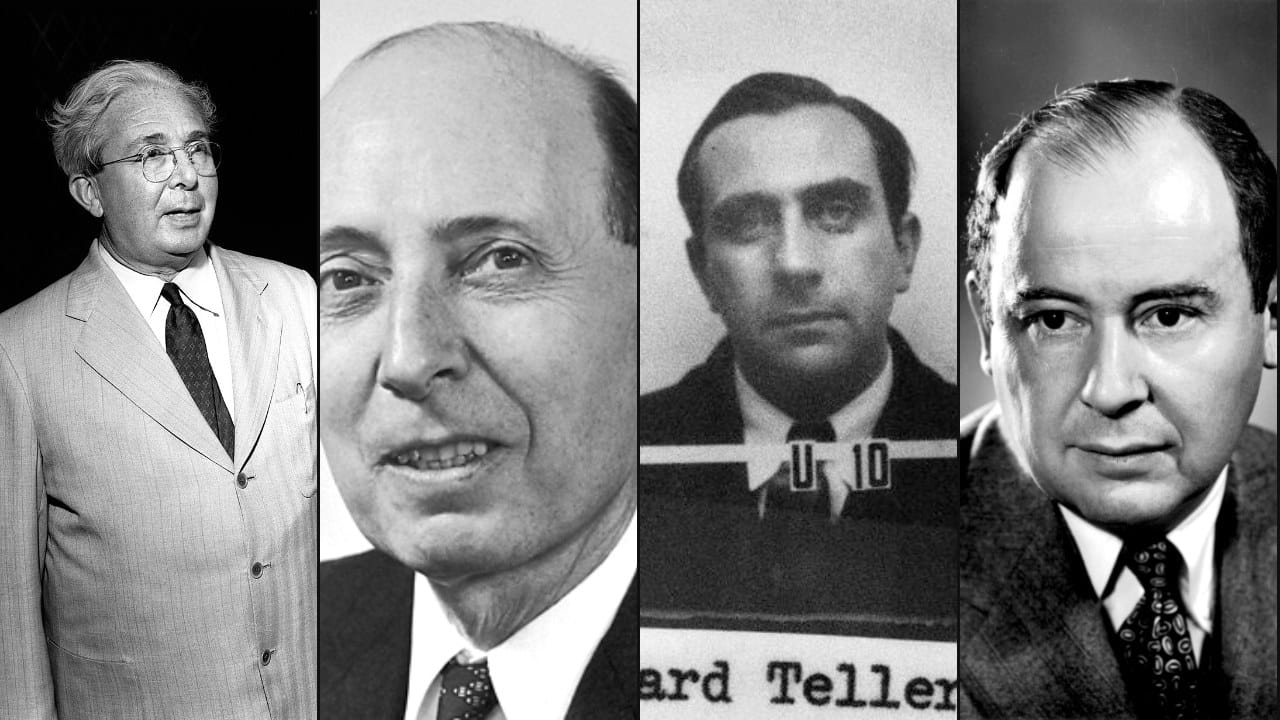
Szilard was one day earlier. So, in their own ways, were Eugene Wigner, John von Neumann, Edward Teller and Theodore von Kármán — five men born within four kilometres of each other in Budapest, who ended up so improbably clustered at the summit of American science that their colleagues joked they must be visitors from another planet. The joke stuck. They are remembered as the Martians. This is the story of how Hitler took the finest scientific establishment on earth and shipped it, one packed suitcase at a time, to his enemies.
Quick Facts: The Exodus
- Roughly 1 in 5 German university academics were driven out between 1933 and 1945; about 80 percent of dismissals were antisemitic
- 25 percent of German physicists lost their posts after the April 1933 civil-service law alone
- 11 past or future Nobel laureates were among the dismissed physicists
- 1,500+ academic refugees fled Germany and Austria
- 5 Budapest-born “Martians” — two from the same school corridor
- 46 Nobel nominations for Lise Meitner; zero prizes
- ~90 minutes — the packing time Meitner had before fleeing Berlin forever
A School on a Tree-Lined Avenue
Every legend has a nursery, and this one is a Lutheran secondary school on a leafy Budapest boulevard. The Fasori Gimnázium taught, within a few overlapping years, John von Neumann and Eugene Wigner — one year apart — plus a future Nobel economist and one of Hungary’s great mathematicians. Its secret weapon was a mathematics teacher named László Rátz, who recognised the ten-year-old von Neumann for what he was and arranged university mathematicians to tutor him. One of them, Gábor Szegő, is said to have come home from his first session with the boy with tears in his eyes.
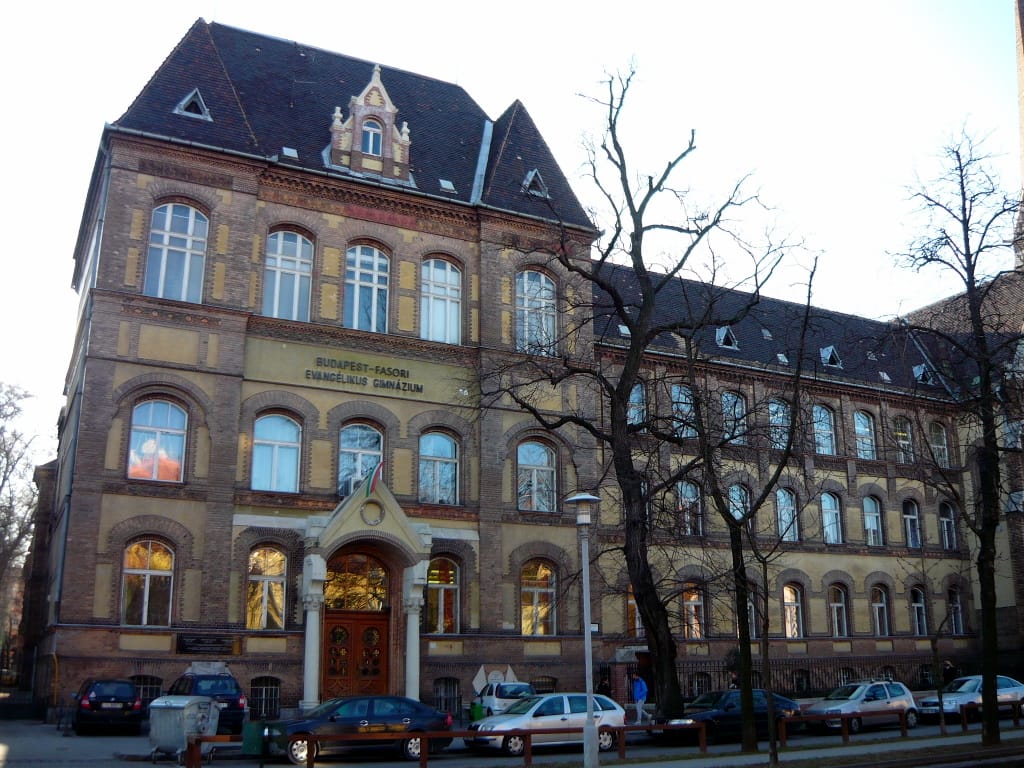
Budapest’s golden generation grew up in a city of cafes, mathematics competitions and nervous ambition — and, after 1920, under a numerus clausus law that capped Jewish university admissions. Brilliance, these young men learned early, was portable, and it had better be. Wigner went to Berlin for chemical engineering; von Neumann collected degrees in two countries simultaneously; Teller left for Karlsruhe and then Munich, where a streetcar accident took most of his right foot at age 20. He walked with a prosthesis, and on the pain he practised a lifelong stubbornness of will.
By the early 1930s the whole constellation had drifted, like everything in physics, toward Germany — the land of Planck, Einstein and Heisenberg, where a third of the world’s Nobel-class science was being done in a single language. It was the worst possible address.
The War on “Jewish Physics”
On 7 April 1933, ten weeks after Hitler took power, the Law for the Restoration of the Professional Civil Service dismissed Jewish and politically suspect officials from state service — and in Germany, every university professor was a state official. A quarter of the country’s physicists lost their jobs. Eleven were past or future Nobel laureates. The Nobel laureate James Franck, exempt as a decorated war veteran, resigned his Göttingen chair anyway in open protest; newspapers around the world reported it, and not one government or university followed his lead.
Behind the purge stood an actual ideology of race-graded science. The Nobel laureates Philipp Lenard and Johannes Stark preached Deutsche Physik — sturdy Aryan experiment against decadent “Jewish” theory, by which they meant, above all, relativity. When Max Planck went to see Hitler to plead for his Jewish colleagues, the account that surfaced in print as early as 1937 has the Chancellor replying that if dismissing Jewish scientists meant the annihilation of contemporary German science, then Germany would do without science for a few years. The mathematician David Hilbert, asked a year later by the Nazi education minister whether the famous Göttingen mathematical institute had really suffered from the departure of the Jews, gave the answer that serves as the whole era’s epitaph.
Timeline’s documentary on the European geniuses at the heart of the Manhattan Project — the Martians’ story at full length.
Exodus
Einstein was already abroad when the Reichstag burned. His ship docked at Antwerp on 28 March 1933; he went straight to the German consulate, laid his passport on the desk, and renounced the citizenship of the country he had made the capital of world physics. A Nazi magazine soon printed his photograph in a gallery of enemies with the caption “noch ungehängt” — not yet hanged.
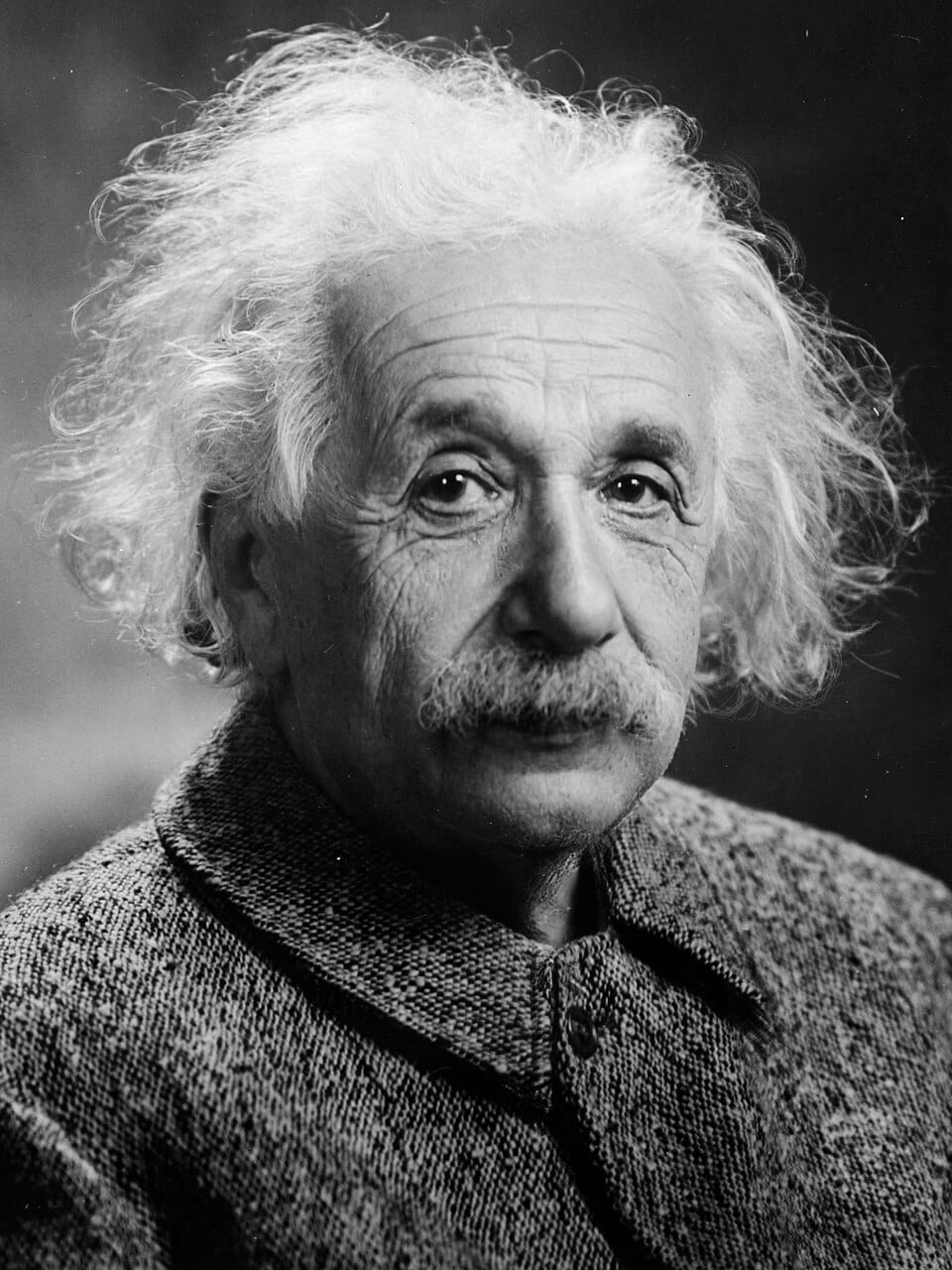
He announced his terms publicly: as long as he had any choice in the matter, he would live only in a country where civil liberty, tolerance and equality of all citizens before the law prevailed. In October 1933 he took up residence at Princeton’s Institute for Advanced Study — where von Neumann, three decades his junior, was already installed as the youngest professor on the faculty.
The exodus gathered pace with every turn of the Nazi screw. Hans Bethe, sacked from Tübingen for his Jewish mother, went via England to Cornell. Otto Frisch and Rudolf Peierls washed up in Birmingham, where in 1940 — officially distrusted as enemy aliens and barred from radar work — they would write the memorandum that told Britain an atomic bomb was actually buildable. Lise Meitner, protected for five years by her Austrian passport, lost that shield with the Anschluss; in July 1938 she fled Berlin with ninety minutes’ packing, two small suitcases of summer clothes, and a diamond ring her colleague Otto Hahn had pressed into her hand at the last moment — his mother’s, to bribe the border guards if it came to that. It never did; her train crossed into Holland unsearched. Five months later, in exile in Sweden, she would sit on a log in the snow and work out what Hahn’s Berlin laboratory had just done to the uranium nucleus.
And Enrico Fermi — not Jewish himself, but married to Laura, who was — accepted the 1938 Nobel Prize in Stockholm and simply never sailed home to Mussolini’s new racial laws. As his liner approached Manhattan on 2 January 1939 he announced to his family that they had just founded the American branch of the Fermis.
“They Call Themselves Hungarians”
Years later at Los Alamos, so the story is told, Fermi posed his famous lunchtime paradox: if intelligent extraterrestrials exist, where is everybody? Szilard had the answer ready: they are already here — they just call themselves Hungarians. Teller, whose initials were E.T., claimed to be delighted, and deadpanned that von Kármán must have been talking.
The joke worked because it explained the data. Four men from a few Budapest neighbourhoods now sat at the controls of American science: von Kármán building the aerodynamics of American air power at Caltech, Wigner designing the first industrial nuclear reactors, Teller dreaming already of fusion, and von Neumann — game theory, computing, the mathematics of implosion — regarded by his colleagues as something faintly beyond human. Hans Bethe wondered aloud whether a brain like von Neumann’s did not indicate a species superior to that of man. A colleague once tested the legend by asking him to recite A Tale of Two Cities; von Neumann began at the first sentence and continued, verbatim, until asked to stop fifteen minutes later.
Wigner, the gentlest of them, supplied the group’s manners. Princeton lore records the moment a reckless driver cut him off and the politest man in physics finally snapped, shouting after the offending car: go to hell — please.
Two Car Rides on Long Island
The Martians’ decisive contribution came in the summer of 1939, and it began with a chauffeuring problem: Szilard, the man who understood the chain reaction better than anyone alive, had never learned to drive. On 12 July, Wigner drove him out to a rented cottage near Peconic, Long Island, where Einstein was spending the summer sailing. Told that a uranium chain reaction was now plainly possible, Einstein’s reply — Daran habe ich gar nicht gedacht; I did not even think about that — may be the most consequential admission of surprise in scientific history. On 2 August, with Teller at the wheel this time, Szilard returned to collect the signature on the letter warning President Roosevelt that extremely powerful bombs of a new type had become conceivable, and that Germany had stopped selling uranium.
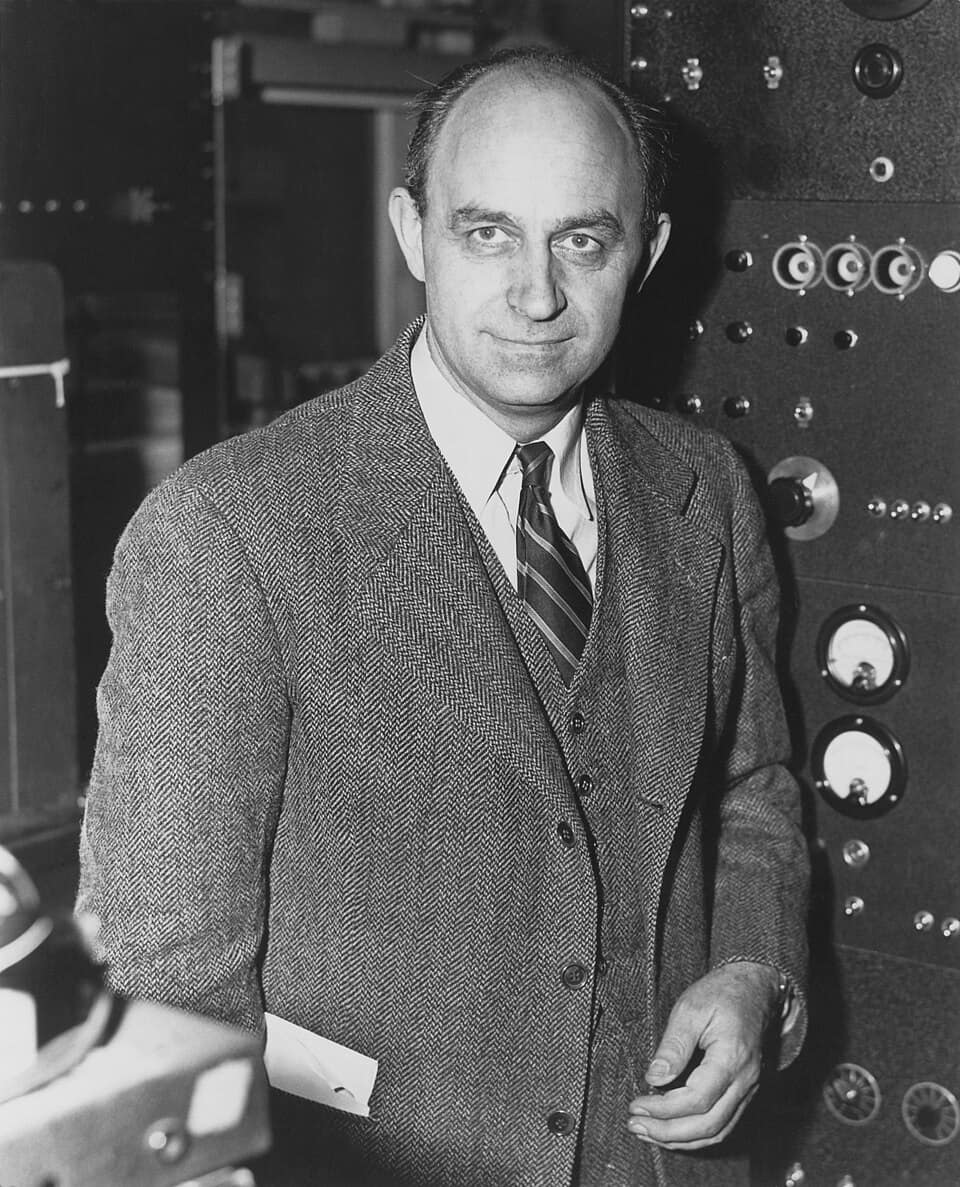
The letter reached Roosevelt in October; the story of the sluggish committee it spawned, and the British memo that finally lit the fuse, belongs to Part 3. But note who did what in the years that followed: Fermi and Szilard built the first reactor in a Chicago squash court, with Wigner presenting the Chianti; Wigner’s team designed the Hanford plutonium piles; von Neumann’s mathematics made the implosion bomb work; Bethe ran the theory division at Los Alamos; Teller went on to father the hydrogen bomb. Meitner, who had as strong a claim as anyone to the physics, was asked to join and gave the shortest answer in this series: I will have nothing to do with a bomb.
Edward Teller, interviewed by CBS in 1963 — one of the last Martians, in his own words.
The Self-Inflicted Wound
Tally the ledger of 1933. One fifth of a professoriate discarded. Eleven Nobel-class physicists exported. The chain-reaction patent, the fission interpretation, the critical-mass memorandum, the reactor, the implosion mathematics, the Einstein letter itself — every one of them the work of refugees the Reich had thrown away. Germany’s own bomb program, as we will see in Part 4, was left with brilliant men but no Szilard to imagine, no Einstein to open the White House door, and no margin for the error it went on to make.
The Reich checked the passports one day too late. The rest of this series is the bill coming due.
Sources: Wikipedia, György Marx: The Voice of the Martians, UCSD Szilard Archive, Atomic Heritage Foundation, Wigner Research Centre, National Academy of Sciences, Michael Grüttner (Journal of Contemporary History, 2022), Richard Rhodes: The Making of the Atomic Bomb.
The Race for the Bomb — an Afterburner Focus Series
Series overview: all ten parts
Previous — Part 1: Moonshine: The Idea Born at a Traffic Light
Next — Part 3: Christmas 1938: The Atom Splits
0 Comentarios