
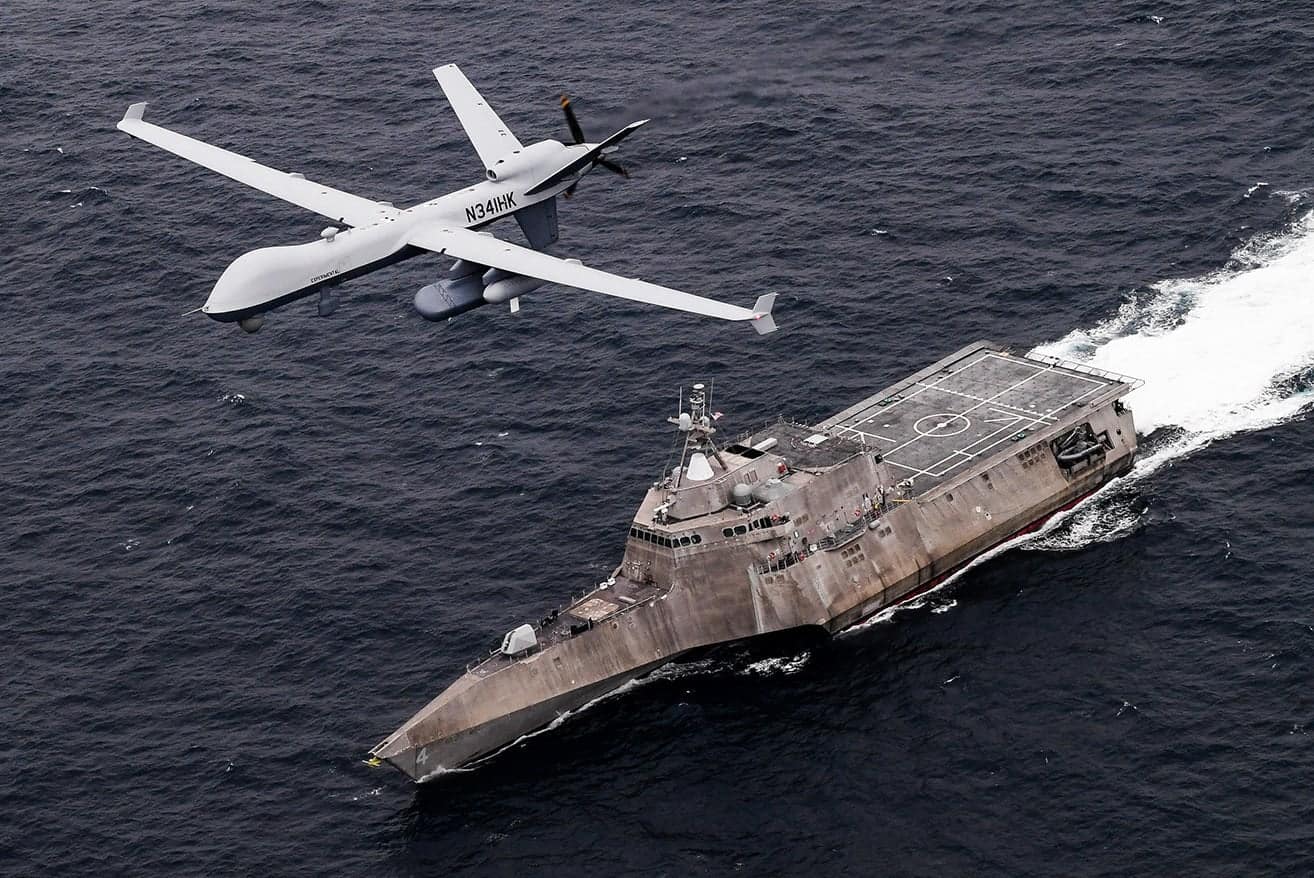
On 17 August 2026, in a New Delhi government building most people have never heard of, India signed a contract to rent two robotic aircraft for the price of a small skyscraper. The deal, worth about Rs 1,943 crore (roughly US$200 million), leases two more MQ-9B SeaGuardian drones from America’s General Atomics for the next 30 months. It reads like a procurement footnote. It is actually India quietly doubling the number of long-range robotic eyes it keeps over one of the most contested oceans on Earth.
The Navy already flew two leased SeaGuardians. Now it will fly four. And that small piece of arithmetic tells you a lot about where the Indian Ocean is heading.
Datos rápidos
- Signed: 17 August 2026, New Delhi, with General Atomics Aeronautical Systems (GA-ASI)
- Deal: Two more MQ-9B SeaGuardian UAVs leased for 30 months, ~Rs 1,943 crore (roughly US$200 million)
- Fleet effect: Takes India’s leased SeaGuardians from two to four
- Model: Contractor-owned, contractor-operated (COCO); Indian crews fly the missions, GA-ASI maintains the aircraft
- Resistencia: Up to 40 hours aloft, with maritime search radar and anti-submarine sonobuoy kit
- Bigger picture: Bridges the gap until a separate 31-aircraft MQ-9B purchase (just under US$4 billion, signed October 2024) arrives from ~2029
- 31-jet split: 15 SeaGuardians to the Navy, 8 SkyGuardians each to the Army and Air Force
A drone with a very long attention span
The MQ-9B SeaGuardian is the maritime cousin of the SkyGuardian, which is itself the grown-up evolution of the Predator B and Reaper drones that have prowled war zones for two decades. Where the Reaper hunts people, the SeaGuardian hunts ships, submarines and anything else that moves across open water.
It is a high-altitude, long-endurance machine that can stay airborne for up to 40 hours, more than a day and a half of continuous watching. It carries a centreline sea-search radar (the Indian aircraft use Leonardo’s SeaSpray unit), an automatic identification system for tracking vessels, and even a kit that drops and monitors sonobuoys to sniff out submarines. One drone flying out of Tamil Nadu can keep an unblinking eye on shipping lanes thousands of kilometres away.

Two became four
India first leased a pair of unarmed SeaGuardians back in November 2020, using a then-new fast-track acquisition rule designed to plug urgent capability gaps without waiting a decade for a full purchase. They were based at INS Rajali alongside the Navy’s P-8I sub-hunters, with Indian personnel running the missions and General Atomics handling the wrenches. The lease was meant to be short. It kept getting extended.
It has not been a completely smooth ride. In September 2024, one of the leased drones suffered a technical failure and was deliberately ditched into the sea off Chennai; General Atomics supplied a replacement by February 2025, as the contract required. The latest deal simply adds two more airframes to the arrangement and keeps the whole thing running until India’s own drones start arriving.
The main event: 31 drones and a nearly $4 billion bet
Because the lease is really a placeholder. In October 2024, India signed a far larger contract with the United States for 31 MQ-9B aircraft, a foreign military sale the State Department valued at just under US$4 billion. The split is telling: 15 SeaGuardians go to the Navy for maritime patrol, while the Army and Air Force each get eight SkyGuardians for overland surveillance and strike.
That package reportedly includes 170 Hellfire missiles, 310 precision glide bombs and a stack of sonobuoys, plus a “Make in India” maintenance hub built with Bharat Forge, the first such global depot outside the United States. Deliveries are not due to begin until around 2029 and finish near 2030, which is precisely why the Navy keeps renting in the meantime.
Why the Indian Ocean, why now
Because the neighbourhood has changed. China’s navy is now a regular visitor to the Indian Ocean, sending warships, submarines and “research” vessels that spend a suspicious amount of time loitering near Indian missile tests and undersea cables. India cannot build enough ships and crewed aircraft fast enough to watch all of it.
Persistent drones are the cheat code. A SeaGuardian orbiting for a day and a half can spot a contact, identify it and hand the coordinates to a warship or a P-8I long before anyone comes over the horizon, exactly the manned-unmanned teaming that navies now treat as gospel.
El problema
Leasing is not cheap. Some Indian analysts have grumbled that renting drones at these rates, year after year, eventually costs more than buying them outright, and they are not wrong. But capability you can fly tomorrow beats capability you will own in 2029, especially when the ocean outside your window is getting busier by the month.
So India will keep four robotic sentinels aloft over the Indian Ocean, on a lease, until the fleet it actually bought shows up. It is an expensive way to bridge a gap. It is also, right now, the only way to keep watching, and in this part of the world, blinking is the one thing nobody can afford to do.
Sources: Naval News, Naval Technology, Airforce Technology, Defence Security Asia, The Indian Express, DVIDS / U.S. Navy.
Publicaciones relacionadas


0 Comentarios