
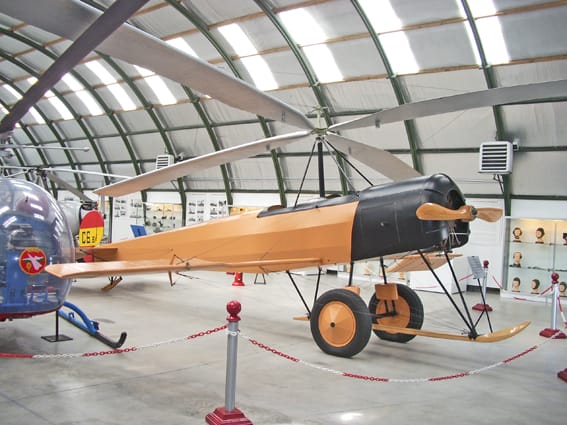
There is a particular kind of genius that begins not with ambition but with fear. Juan de la Cierva was afraid of the stall — that treacherous moment when a wing, robbed of airspeed, simply stops flying and drops its pilot out of the sky. In 1919 one of his own aircraft had done exactly that. Most engineers would have designed a better wing. Cierva decided the wing itself was the problem.
What he built instead looked like a heresy: an aeroplane wearing a windmill. Above the fuselage turned a great free-spinning rotor, driven by nothing but the air rushing through it. The Spaniard called it the Autogiro, and on a January morning in 1923 it did something no rotary-wing machine had done before. It flew — steadily, controllably, and with no intention of stalling.
It was not a helicopter. It could not hover. And yet, without it, the helicopter as we know it might never have arrived at all.
Datos rápidos
| Inventor | Juan de la Cierva y Codorníu (1895–1936), Spanish engineer |
| Primer vuelo | Cierva C.4, January 1923, near Madrid (pilot: Alejandro Gómez Spencer) |
| The breakthrough | The flapping, or articulated, rotor hinge |
| Not a helicopter | Rotor is unpowered and autorotates; a normal propeller gives thrust |
| Channel crossing | September 1928, London to Paris — first rotary-wing aircraft across |
| Fallecido | 9 December 1936, airliner crash on take-off at Croydon |
The Spaniard who feared the stall
Cierva was no garret tinkerer. Born to a wealthy Murcian family — his father had been Spain’s war minister — he took a civil engineering degree and sat, young, in the Cortes. But aeroplanes had gripped him since boyhood, when he and his friends rebuilt a crashed machine into what is remembered as the first Spanish-built aircraft.
The 1919 crash reoriented everything. He resolved to design a machine that could take off steeply, land almost vertically, and above all keep flying at speeds where an ordinary aeroplane would fall out of control. The answer, he reasoned, was a rotating wing that would go on making lift no matter how slowly the aircraft travelled. If the engine failed, the rotor would keep turning of its own accord, lowering the machine gently to earth like a sycamore seed. The engineering term is autorotation; Cierva simply thought of it as safety.

His early attempts, with rigid rotors bolted to a hub, threw the aircraft onto its side the moment it gathered speed. The machine wanted to roll over, and Cierva did not yet know why.
The hinge that changed everything
The culprit was dissymmetry of lift. As the rotor spins, the blade advancing into the airflow meets a far greater wind than the blade retreating with it — so one side of the disc lifts hard while the other goes slack, and the whole aircraft tries to capsize. It is the central problem of every rotary-wing machine, and it had defeated a dozen pioneers before him.
The solution came, by his own account, from watching small bamboo-bladed models fly serenely where his full-size rotors failed. The bamboo flexed; the rigid steel did not. As a bridge engineer he knew that a member hinged at its root carries no bending load. So he mounted each blade on a hinge, letting it flap freely up and down as it circled. Now the advancing blade rose and shed its excess lift, the retreating blade dropped and gained its own — and the forces balanced themselves, automatically, on every revolution.
That flapping hinge, first flown on the Cierva C.4 in January 1923 with Lieutenant Alejandro Gómez Spencer at the controls, is one of the quietly decisive inventions in aviation. Days later the machine’s engine failed in flight — and it floated safely down, vindicating the whole idea.
Not a helicopter, but its godfather
The distinction must be made plainly, because it is endlessly muddled. A helicopter’s rotor is driven by the engine; it can rise vertically and hang motionless in the air. Cierva’s autogiro was a different creature. Its rotor was never powered in flight — it was pulled through the air by an ordinary front propeller and spun purely by the passing wind. It could climb steeply and land in a few feet, but it could not truly hover. It was, in the most elegant sense, an aeroplane that could not stall.
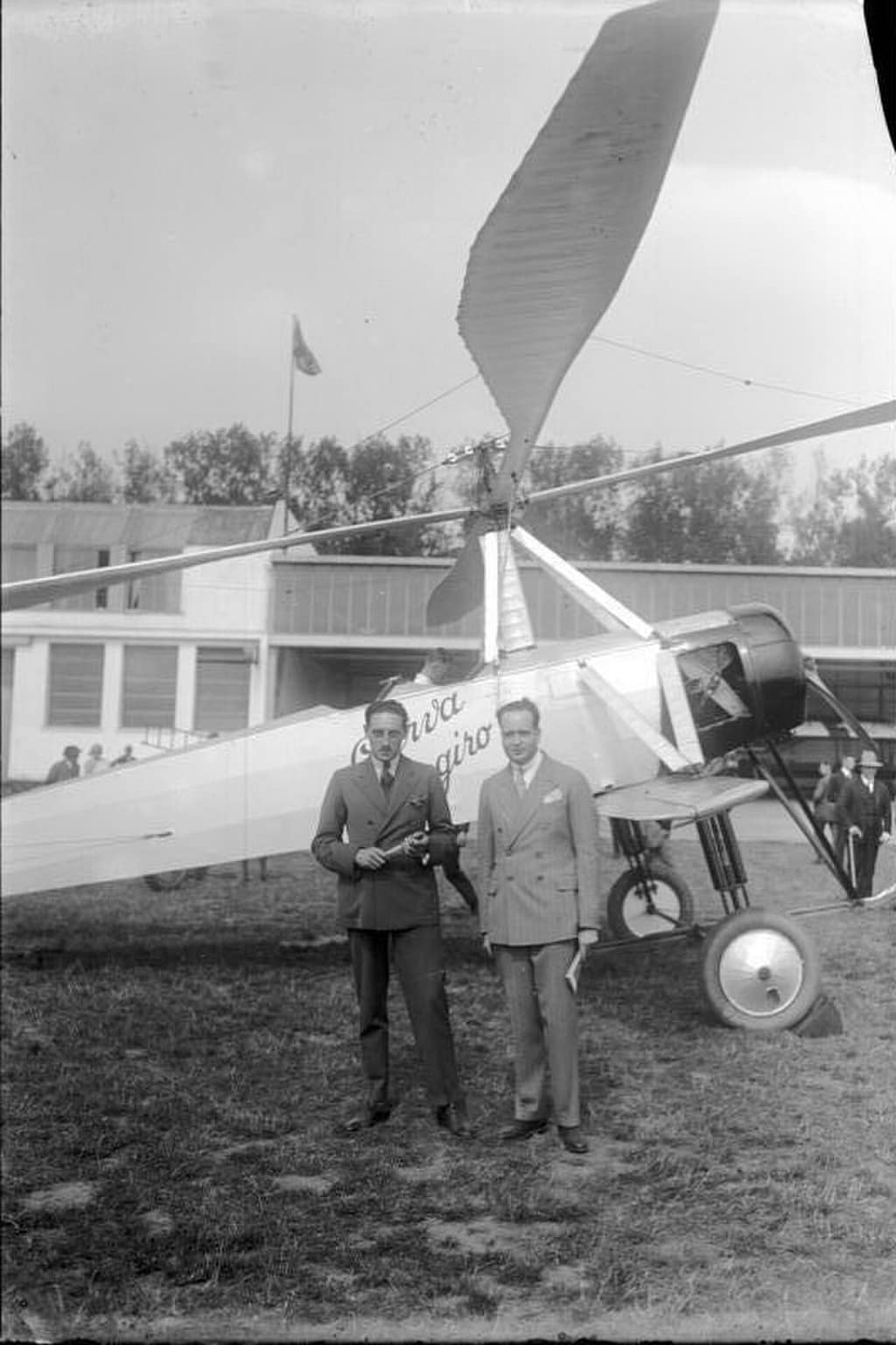
Britain saw its promise at once. Cierva demonstrated his C.6 at Farnborough in 1925, and with backing from the Scottish industrialist James Weir founded the Cierva Autogiro Company. In September 1928 he flew a C.8 from London to Paris — the first rotary-wing aircraft to cross the English Channel — and toured Europe’s capitals drawing crowds wherever the strange windmill descended.
The story ends cruelly. On 9 December 1936, in thick fog at Croydon, the airliner carrying Cierva drifted off course on take-off and struck a house. Fifteen people died, among them the man himself, aged forty-one. But Igor Sikorsky and every rotor engineer after him inherited his hinge.
Sources: Wikipedia (Juan de la Cierva; Cierva C.4); C.V. Glines, “Juan de la Cierva: Autogiro Genius,” Aviation History, September 2012 (HistoryNet).


0 Comentarios