
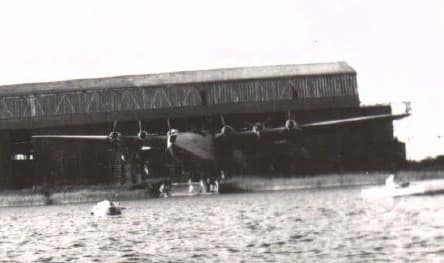
There are aircraft one admires, and there are aircraft one falls a little in love with. The Latécoère 631 belongs firmly to the second category. Conceived in Toulouse, the spiritual home of French aviation, she was the last and grandest of the great flying ocean liners the house of Latécoère ever produced. When her prototype first lifted from the water in 1942, she was, quite simply, the largest flying boat in the world.
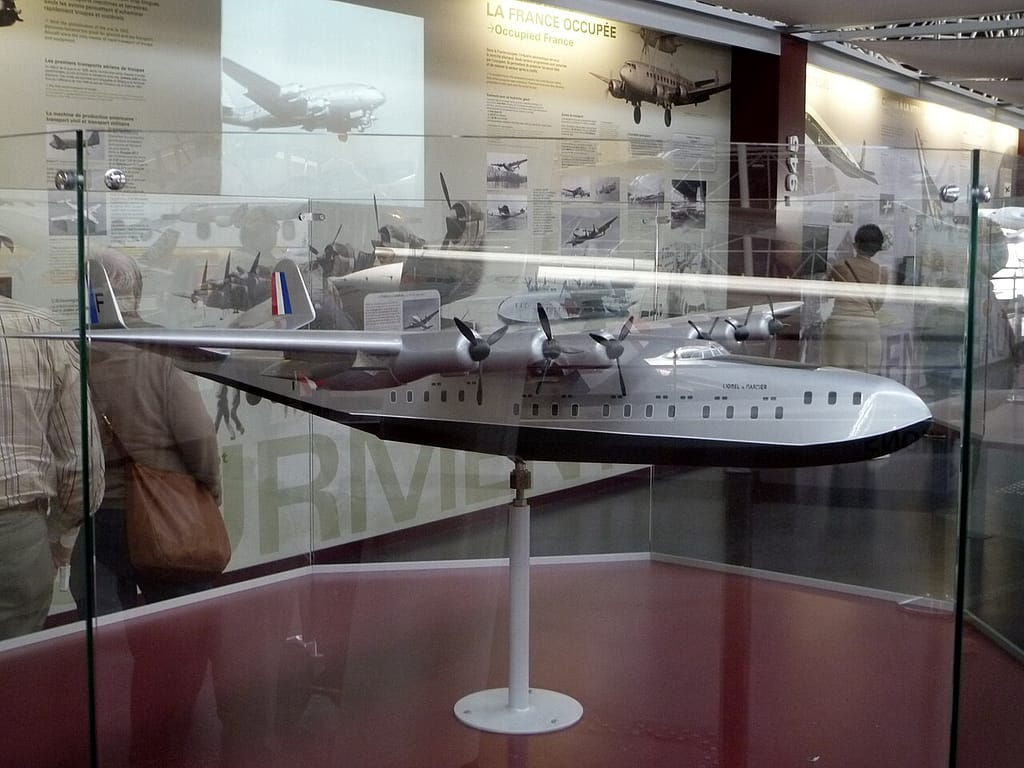
The numbers still impress. She stretched more than 43 metres from bow to tail, spread her wing across 57, and could tip the scales at 75 tonnes. Six radial engines were slung along that immense high-mounted wing, their nacelles connected by an internal passageway so that a flight engineer could walk out inside the wing to tend his machines in flight. It was engineering as architecture — a cathedral that had somehow learned to fly.
- Manufacturer: Latécoère, France — the largest flying boat in the world when it first flew
- First flight: prototype F-BAHG on 4 November 1942
- Powerplant: six Wright R-2600 radials of 1,600 hp (Gnome-Rhône engines were originally intended)
- Size: 43.46 m long, 57.43 m wingspan, up to 75,000 kg maximum weight
- Capacity: 46 passengers and 5 crew; range near 6,000 km
- Built: eleven including the prototype; Air France flew four from 1947, retired after 1955
Born in the Wrong Decade
The seed was planted in 1936, when the French authorities called for a flying boat capable of carrying at least forty passengers across some 6,000 kilometres. Latécoère’s engineers enlarged the idea into the Model 631, and a single prototype was ordered in 1938.
Then history intervened. Construction halted at the outbreak of war, resumed fitfully under occupation, and the prototype F-BAHG did not fly until 4 November 1942. Her triumph was brief: the Germans seized her, flew her to Lake Constance for testing, and there she was destroyed by RAF Mosquitoes in 1944. Originally meant to carry French Gnome-Rhône engines, she ended up with six American Wright R-2600 radials instead. Yet the story did not end — Latécoère had hidden the components of a second aircraft in the French countryside.
A Matter of National Pride
For a nation emerging bruised from occupation, that second 631 was balm for the spirit. She was living proof that French industry, French genius, still existed. For a time she was the only French airliner able to cross the Atlantic at all, and she wore that distinction with Gallic self-assurance, touring Rio de Janeiro to remind the world that Toulouse had not been silenced.
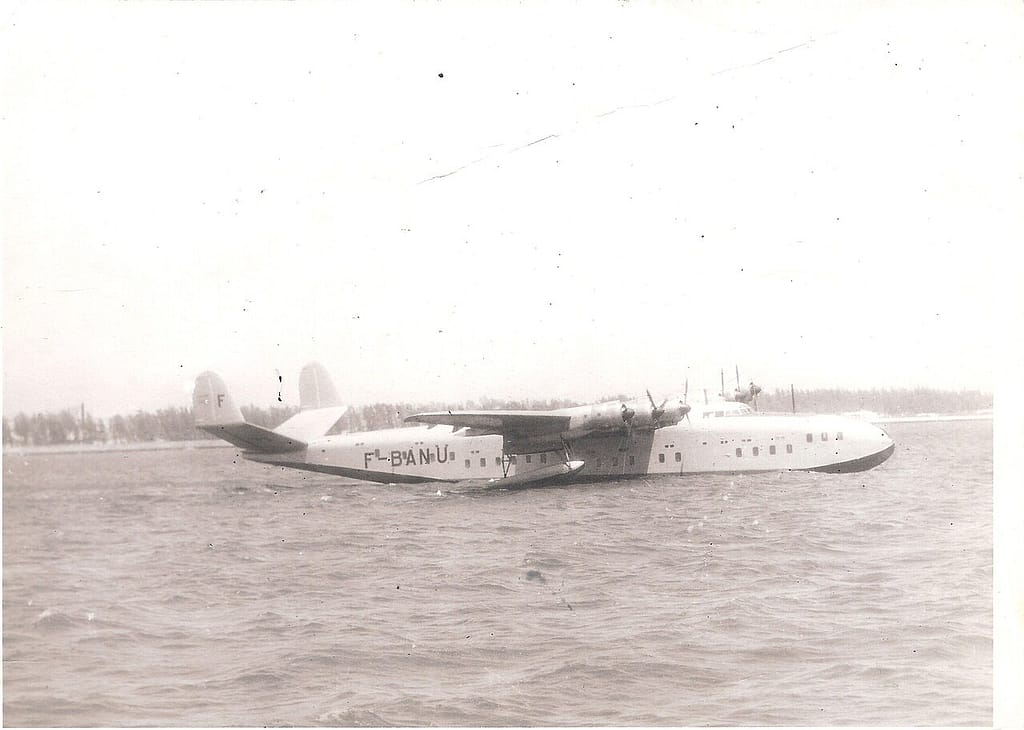
The interior matched the ambition: a lounge and bar, a proper kitchen, and a spaciousness that belonged more to a steamship than to an aeroplane. Air France took four into service, opening a route in 1947 from Biscarrosse to Fort-de-France in Martinique. For a fleeting moment, the dream of the flying ocean liner seemed real.
The Shadow Over the Water
One must be honest, for elegance is no shield against physics. The 631’s service record was unhappy. The first warning came in October 1945, when a propeller blade tore free in flight and killed two passengers before the crew managed an emergency landing.
Worse followed. In February 1948 a 631 went down in a snowstorm over the English Channel, taking all nineteen aboard. Then came the darkest day: on 1 August 1948, Air France Flight 072 vanished over the Atlantic between Martinique and Mauritania with all 52 souls on board. No cause was ever conclusively found, and Air France withdrew the remaining boats at once. In 1950 a 631 sent aloft to investigate the earlier loss itself spun into the sea, killing all twelve aboard; investigators finally traced the fault to a resonance between the propellers and the wing structure.
The Last Flight of a Legend
By now the world had moved on. The war had scattered long runways and powerful four-engine landplanes across the globe, cheaper and simpler to operate than any flying boat. The great water-borne liners were already an anachronism the day they entered service.
A few soldiered on as freighters between France and Africa. The final chapter closed in September 1955, when the last flying 631 broke apart in a tropical storm over Cameroon. Of the eleven built, one fell to enemy attack and four to fatal crashes. And yet the Latécoère 631 remains one of the most beautiful failures aviation has ever produced — a monument to French audacity, arriving a decade too late through no fault of her own.
Sources: Wikipedia (Latécoère 631); HistoryNet / Aviation History (Robert Guttman); Old Machine Press (William Pearce).
0 Comentarios