
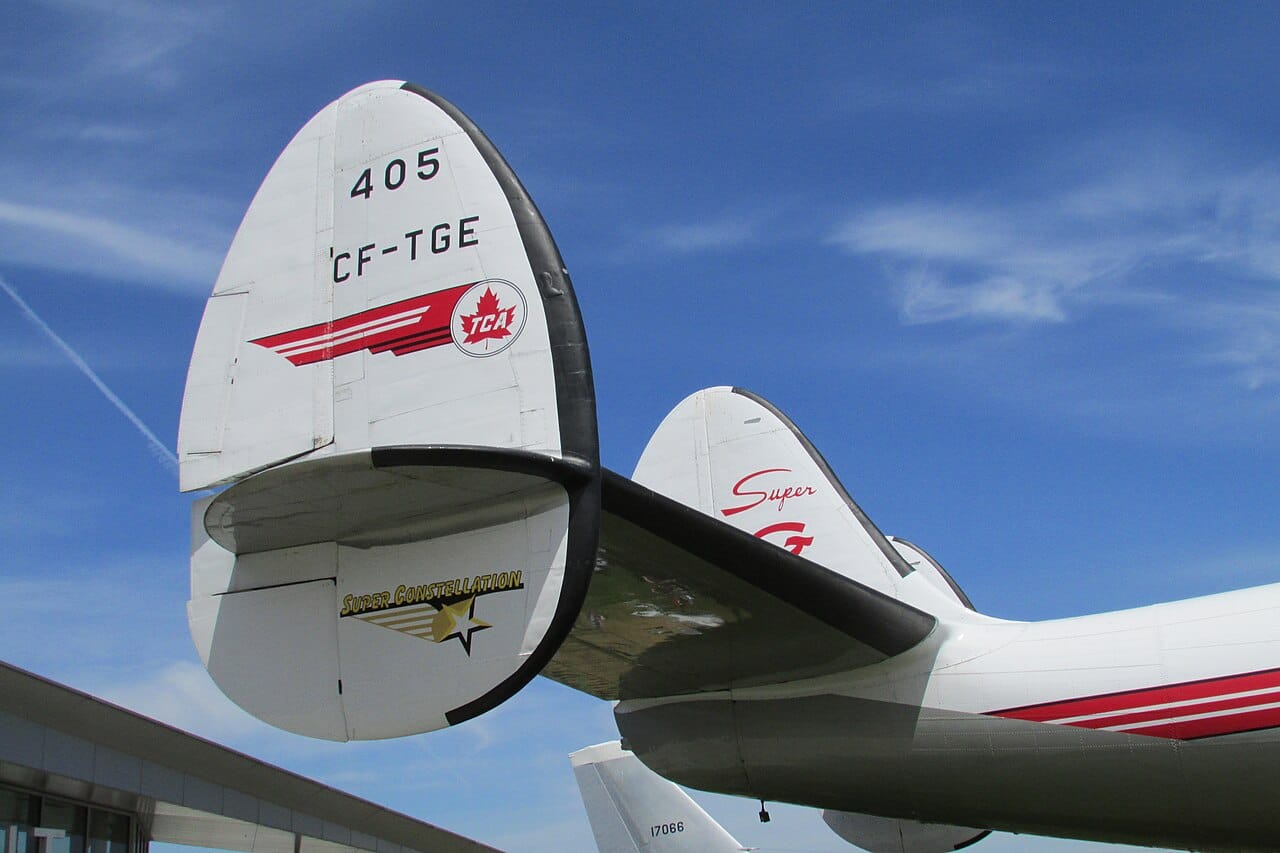
Some aeroplanes are designed. The Lockheed Constellation looks like it was sculpted — by someone who had been told, sternly, that a machine carrying forty people across an ocean had no business being ugly. That curved, dolphin-backed fuselage. Those three tail fins standing to attention. Sixty-odd years after the last one rolled out of Burbank, “most beautiful airliner ever built” remains the phrase people reach for, and honestly, few argue.
But the Connie — everyone called her Connie — was far more than a pretty silhouette. She was one of the first pressurised airliners in widespread service, she was genuinely fast, and she helped turn the transatlantic crossing from a maritime adventure into something you booked a ticket for.
She also caught fire with a certain regularity, which gave passengers, in the words of one historian, some amusement or terror depending on their anxiety level. This is the aircraft that did both things at once: gorgeous and glorious, temperamental and occasionally alarming.
Datos rápidos
| Primer vuelo | 9 January 1943 (prototype, Burbank to Muroc) |
| Manufacturer | Lockheed, Burbank, California |
| Número construido | 856 aircraft, 1943–1958 |
| Central eléctrica | Four Wright R-3350 Duplex-Cyclone radials (later turbo-compound) |
| Velocidad | Cruise ~340 mph; max over 375 mph (early models) |
| Instantly known for | Triple tail (to fit existing hangars) and the curved “dolphin” fuselage |
A silhouette you could pick out blindfolded
Start with the tail, because everyone does. Most big aircraft make do with one fin. The Constellation has three, and there is a wonderfully practical reason for it: a single fin tall enough to do the job would not have fitted inside the airline hangars of the day. Split the same tail area across three shorter fins and, problem solved, the Connie could be tucked away in buildings that already existed. Elegance born of a ceiling height.
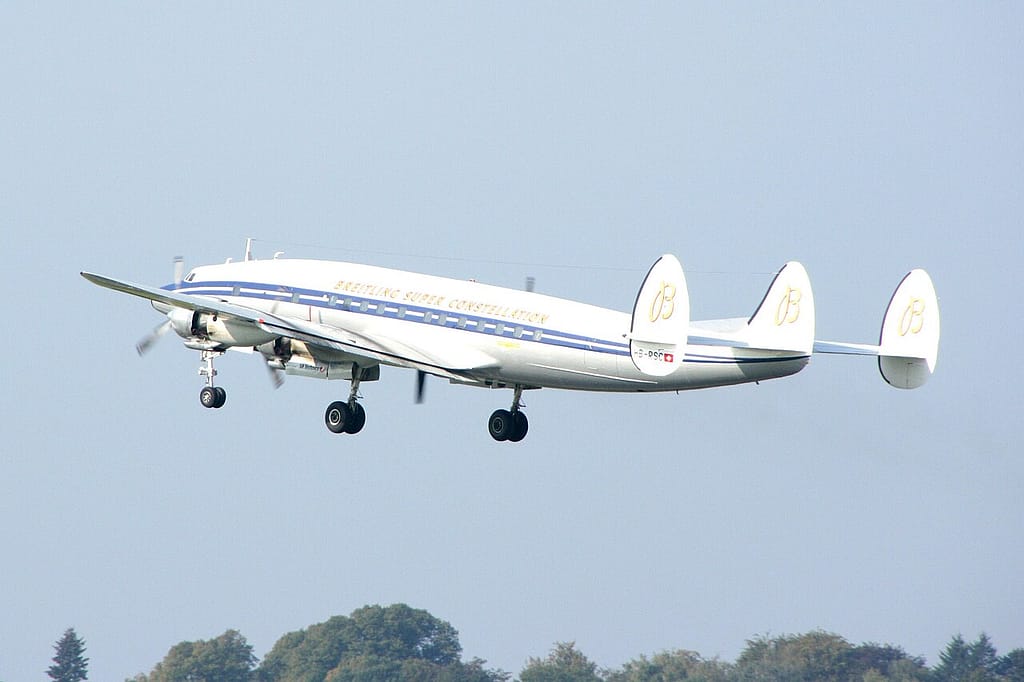
Then there is that fuselage, which curves like a fish so that, famously, no two bulkheads share the same shape. A persistent myth says the curve was an aerofoil designed to add lift. It was not. The rear sweeps up to lift the tail clear of the propeller wash, and the nose dips so the nosegear leg did not have to be absurdly long. The result was a body that was gorgeous, expensive to build, and a nightmare to tool — which is precisely why every airliner since has been a boring tube. The wing, meanwhile, was essentially a scaled-up version of the one from Lockheed’s P-38 Lightning fighter — a reminder that the Connie’s designer, Kelly Johnson, was the same restless genius who would later give the world the U-2 and the SR-71 Blackbird.
Hughes, TWA, and making the Atlantic ordinary
The Constellation exists because of one demanding, deep-pocketed customer. In 1939, TWA — nudged along by its major stockholder, a young aviator named Howard Hughes — asked Lockheed for a forty-passenger airliner that could cross the continent non-stop, with a range of 3,500 miles. That was well beyond anything then flying.
Legend inflated Hughes into the aircraft’s designer. He was not. He specified the range and the speed he wanted; Lockheed’s Kelly Johnson and Hall Hibbard did the actual designing. Hughes did fly it, though — and Johnson, along for a record-setting 1944 dash across the country, was distinctly unimpressed with the boss’s stick-and-rudder skills.
War rerouted everything. The TWA order was converted to military C-69 transports, and the prototype first flew on 9 January 1943. Only after the war did the Connie become what it was born to be. TWA opened New York–Paris Constellation service in 1946, and as one of the first pressurised airliners in regular use, it made high, smooth, long-haul travel feel almost civilised. The ocean, for the first time, became something ordinary people simply flew over.
Four engines, roughly three working at any time
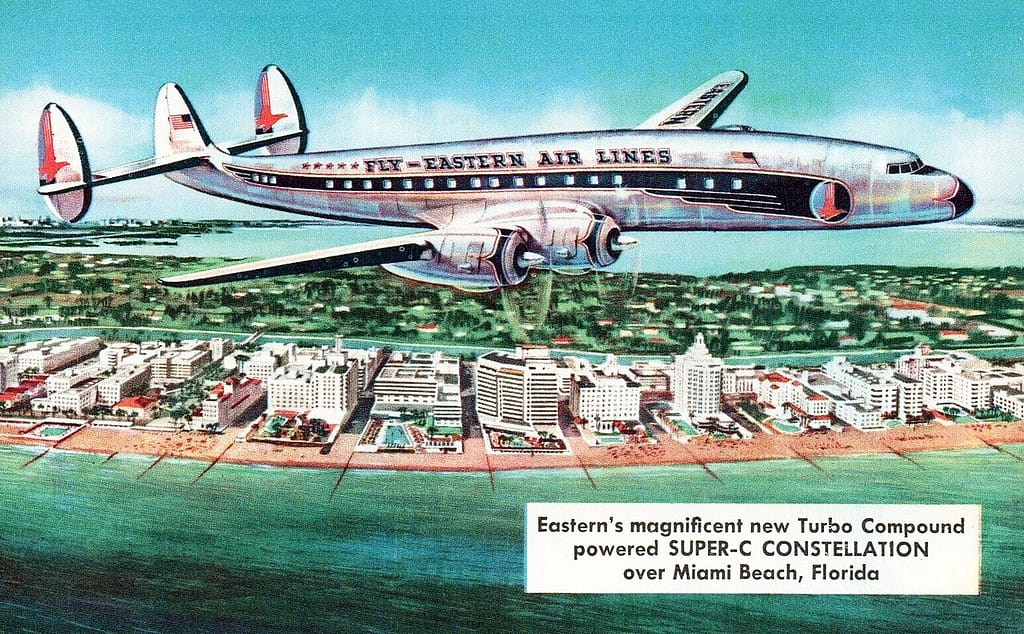
Now, about those engines. Four Wright R-3350 Duplex-Cyclones, later fitted with clever turbo-compound turbines that scavenged energy from the exhaust for extra horsepower. On paper, brilliant. In practice, gloriously complicated, maintenance-hungry, and prone to catching fire — at night they trailed long blue tongues of flame from the exhausts, so Lockheed armoured the wing leading edges with stainless steel to stop them scorching.
This is the root of the old joke that the Connie was “the world’s best three-engine airliner,” because one of the four was so often shut down. It is a great line — and it is mostly folklore. Boeing’s Stratocruiser had far more engine trouble, and plenty of Connie pilots flew for years without ever feathering one. The reputation outran the reality, as reputations do.
The aircraft aged into a remarkable second career. The stretched Super Constellation and the record-setting Starliner pushed piston airliners about as far as they could go. The military bought nearly forty per cent of all Connies built: the EC-121 Warning Star, with its great rotating radar dome, was a direct ancestor of today’s AWACS jets, and Navy examples flew until 1982. Three even served President Eisenhower as the “Columbine.” Beautiful, brilliant, slightly flammable — and impossible to forget.
Sources: Wikipedia (Lockheed Constellation; Wright R-3350 Duplex-Cyclone); Stephan Wilkinson, “Call Her Connie,” Aviation History / HistoryNet.

0 Comentarios