
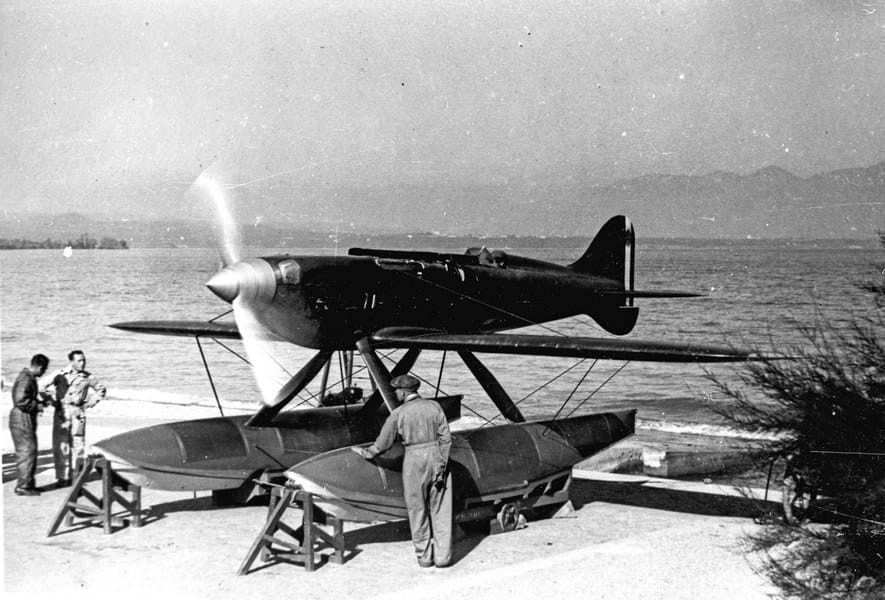
On a grey October afternoon in 1934, the mountains above Lake Garda heard something they would never hear again. A scarlet machine sat low on the water at Desenzano, twin floats trembling, and then its engine spoke — not a drone but a detonating roar that rolled off the Alpine slopes and came back doubled. Warrant Officer Francesco Agello opened the throttle, the lake blurred to a silver smear, and the M.C.72 lifted into legend.
Four laps later he had flown at 709.209 km/h — 440.68 mph — faster than any seaplane driven by a piston engine had gone before, or has gone since. Ninety years on, the record still stands. No propeller-driven floatplane has ever caught it.
This is the story of how a beautiful, murderous little aircraft, born to win a race it never flew, instead wrote its name into the record books for good.
Datos rápidos
| Manufacturer | Aeronautica Macchi (Italy) |
| Diseñador | Mario Castoldi |
| Motor | Fiat AS.6 — two coupled V-12s, 24 cylinders, contra-rotating propellers |
| Record speed | 709.209 km/h (440.68 mph), 23 October 1934 |
| Record pilot | Francesco Agello |
| Preserved at | Italian Air Force Museum, Vigna di Valle |
Built to beat the British
By the late 1920s the Schneider Trophy had become a proxy war fought at three hundred miles an hour. Italy had tasted glory — Macchi’s M.39 took the cup in 1926 — but then Supermarine’s sleek British racers began an unbroken run of victories, and Rome could not abide it.
The commission fell to Mario Castoldi, Macchi’s gifted chief designer, the same pen that would later shape the Folgore fighters of the Second World War. What flowed from it was exquisite: a diminutive floatplane of clean, tapering lines, its wings and floats skinned in flush surface radiators because the powerplant to come would run murderously hot. The aircraft was ready in 1931 for what would prove the final Schneider contest. Instead, it never reached the starting line.

The engine that killed
The heart of the M.C.72 was the Fiat AS.6, and it was less an engine than an act of defiance. Fiat took two of its AS.5 V-12s and coupled them in tandem — twenty-four cylinders in a single slender nose — producing something on the order of 2,500 horsepower, later coaxed beyond 3,000. A conventional propeller could never have absorbed that torque; the aircraft would have rolled itself into the lake on take-off. Castoldi’s answer was elegant: two coaxial propellers spinning in opposite directions, each cancelling the other’s twist.
The engine, however, was not tamed so easily. On the bench the AS.6 ran faultlessly; in the air it backfired and, at times, exploded. Development cost two men their lives — Captain Giovanni Monti in August 1931 and Lieutenant Stanislao Bellini that September, both over Lake Garda. Accounts differ on the precise mechanics, but the engine’s violence is the common thread.
Italy asked to postpone the 1931 race. The British refused. The Regia Aeronautica withdrew, and the Schneider Trophy passed to Britain for good. The M.C.72 had failed at the only task it was built for.

A record that would not fall
Mussolini, sensing prestige, ordered the work continued. It fell in part to a British engineer, Rod Banks, to blend the exotic high-octane fuel that finally calmed the AS.6. With the engine tamed, Agello took the machine to 682 km/h in April 1933. Eighteen months later he went back for more, and on 23 October 1934 averaged 709.209 km/h over the three-kilometre course. His gold-medal citation honoured him as a pilot of “exceptional valor and ardor.” The M.C.72 never flew again.
Let us be precise about what that record is. Landplanes soon flew faster — a Messerschmitt in 1939, a hot-rodded Mustang in our own century. But among seaplanes turning a propeller, nothing has ever equalled it. Agello’s aircraft, its scarlet paint still bright, waits at Vigna di Valle: the fastest seaplane ever built, holding a mark that has outlived everyone who made it.
Sources: Wikipedia (Macchi M.C.72; Fiat AS.6; Francesco Agello); Vintage Aviation News (Luigino Caliaro); HistoryNet; This Day in Aviation.
Publicaciones relacionadas

0 Comentarios