
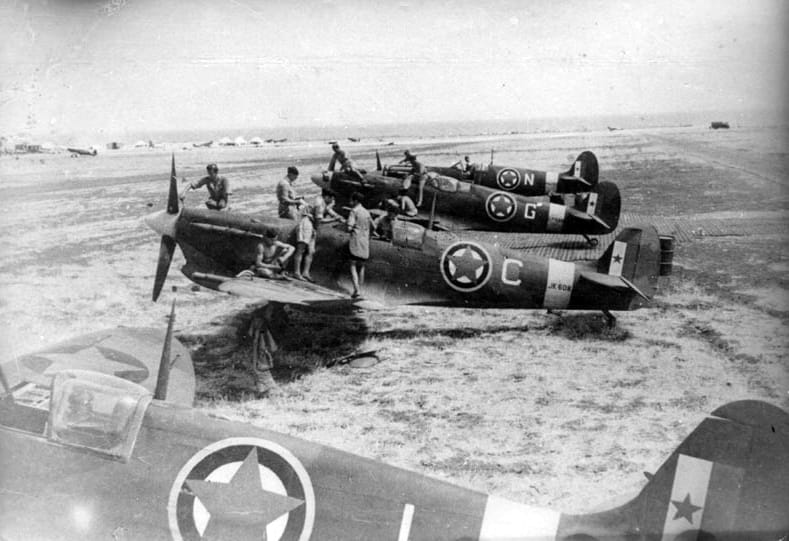
Look closely at the tail of the Spitfire and something is wrong — gloriously, deliberately wrong. Beside the familiar red-white-blue fin flash of the Royal Air Force sits a five-pointed communist red star. This is a British fighter, in British service, flying under a British squadron number. And it wears the mark of Tito’s partisans.
No. 352 (Yugoslav) Squadron was one of the strangest units the RAF ever fielded: a fighter squadron manned entirely by Yugoslav airmen loyal to the communist-led resistance, flying Spitfires with red stars painted over the King’s roundels. Officially they answered to the RAF. In their hearts they flew for the mountains they came from.
It is one of the great forgotten stories of the air war — and it produced the only resistance movement in occupied Europe with an air force of its own.
Datos rápidos
| Unidad | No. 352 (Yugoslav) Squadron RAF — “First Yugoslav Squadron” |
| Formed | 22 April 1944, Benina, Libya |
| Aeronave | Hawker Hurricane IIc, then Supermarine Spitfire Mk V |
| First combat mission | 18 August 1944, from Canne, Italy |
| Forward base | Island of Vis, in the Adriatic |
| Registro | 367 operations, ~1,210 sorties |
| Costo | Ten pilots killed, including Franjo Kluz |
| Destino | Disbanded from RAF 16 May 1945; became 1st Fighter Regiment, Yugoslav Air Force |
A squadron born in the Libyan desert
The unit formed at Benina, near Benghazi in Libya, on 22 April 1944. Its pilots were an unlikely mix: former Royal Yugoslav Air Force officers, and partisan volunteers — some of whom had defected from Axis-aligned units with their aircraft to join Tito’s fight. They trained first on tired Hawker Hurricanes, then in June began converting to the Supermarine Spitfire Mk V.
In August the squadron moved to Canne, in the heel of Italy, and joined No. 281 Wing. On 18 August 1944 it flew its first combat mission. From that day until the end of the war in Europe, the First Yugoslav Squadron was almost continuously in action.
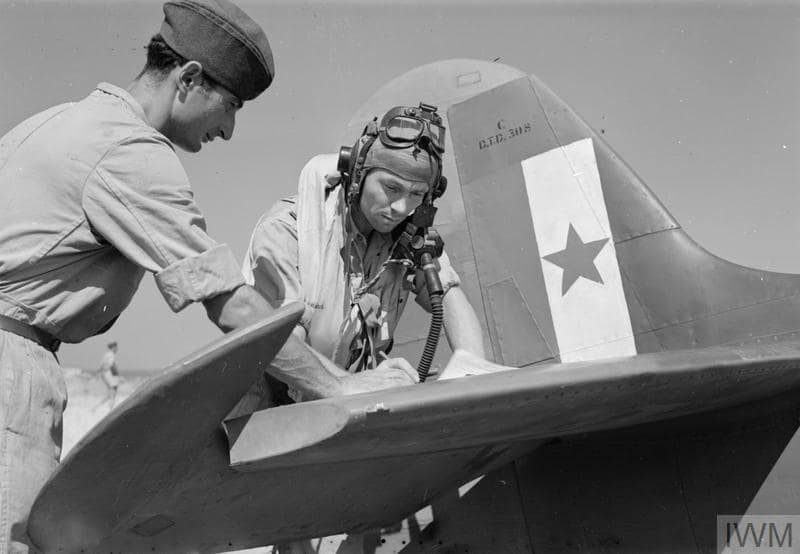
The footage below shows the squadron’s Spitfire Mk Vs at Canne in the summer of 1944 — the actual aircraft, the actual airfield, weeks into the unit’s war.
The red star over the roundel
What set 352 apart was painted on every airframe. The Yugoslav national marking — a red star — was superimposed on the centre of the RAF roundel and on the white band of the tail flash. No other RAF squadron wore anything like it. It was a political statement rendered in dope and paint: these were Britain’s aircraft, but they belonged to Tito’s National Liberation Army.
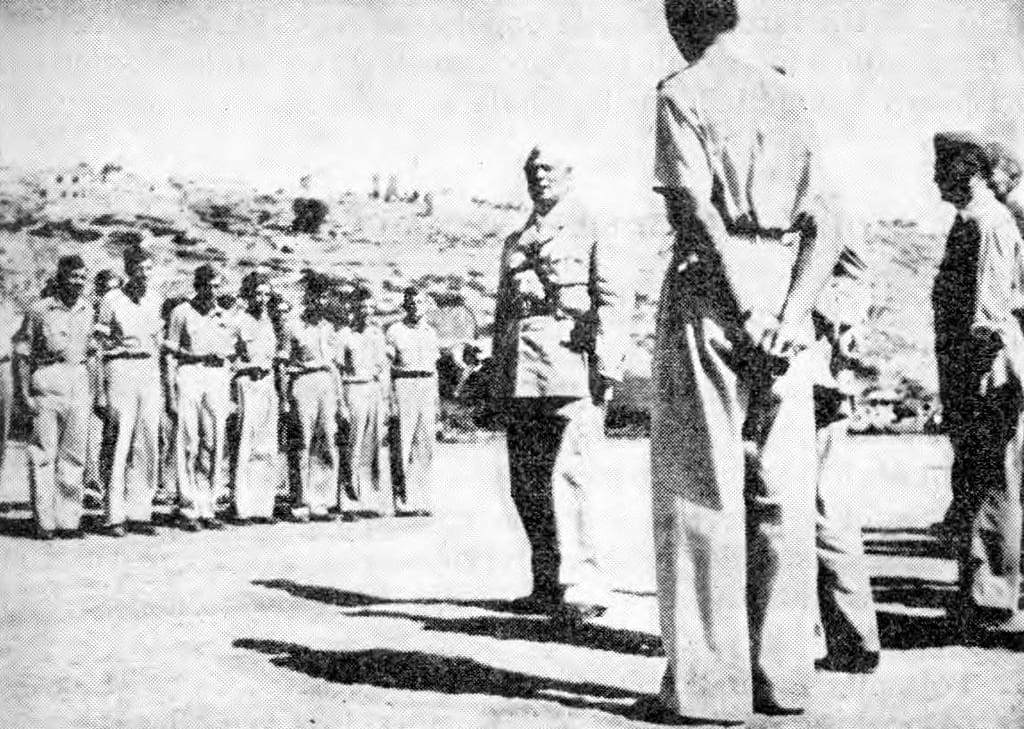
That marking was more than symbolism. Alone among the resistance movements of occupied Europe, the Yugoslav partisans ended the war with their own air arm — two RAF-trained fighter squadrons, 352 and its sister unit 351, the latter flying Hurricanes. When Marshal Tito came to the island of Vis to address his airmen in 1944, he was speaking to something no other partisan leader possessed.
Blood over the Adriatic
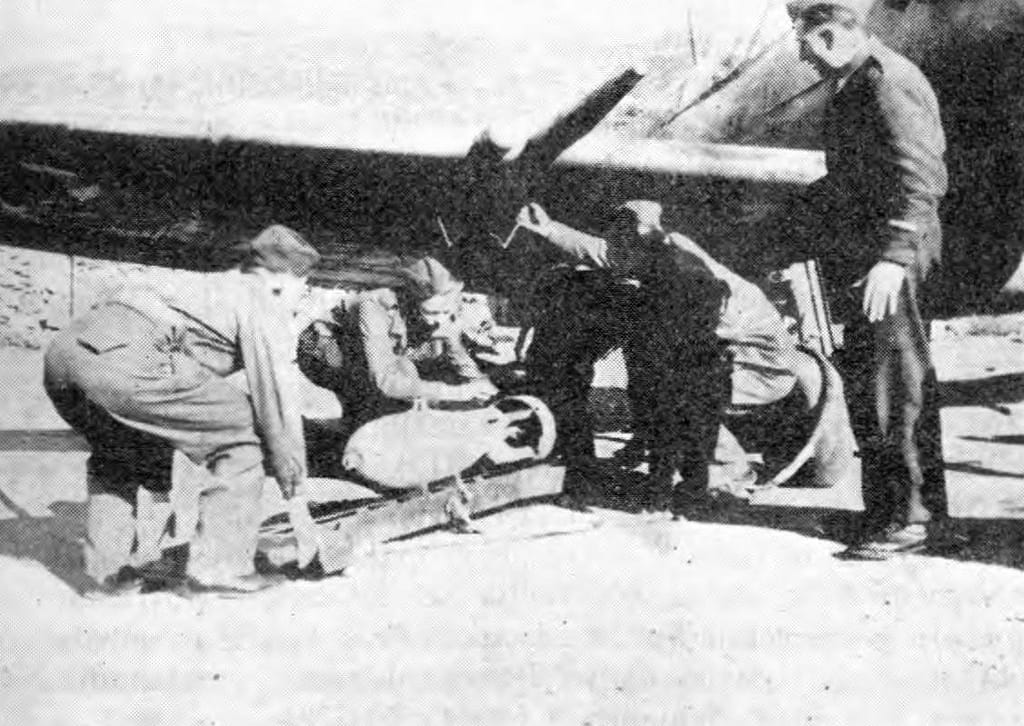
The flying was brutal. Operating in the fighter-bomber and escort role, the squadron used the island of Vis — the one Adriatic island the Germans never took — as a forward base, first for detachments and, from the start of 1945, permanently. From there its Spitfires struck German columns, shipping and strongpoints up and down the Yugoslav coast in support of partisan troops fighting their way north.
Low-level ground attack against a defended enemy is among the deadliest work in aviation, and the casualty list proved it. The first squadron commander, Captain Mileta Protic, and both original flight commanders, Ratko Jovanovic and Arkadije Popov, were all dead by the end of 1944. So too was Franjo Kluz — the first partisan to fly against the Axis, and a national hero of Yugoslavia — shot down by German flak over Omis on 14 September 1944.
Across nine months the squadron flew 367 operations and well over a thousand sorties. Ten of its pilots did not come home. The rare wartime footage below captures the partisan war from which these airmen came.
From RAF squadron to a national air force
As the front moved onto Yugoslav soil, so did the squadron. Its headquarters crossed to the mainland in April 1945, and on 16 May 1945 — days after victory in Europe — No. 352 Squadron was disbanded from the RAF. Two days later it merged with 351 Squadron to form the 1st Fighter Regiment of what became the Yugoslav Air Force.
The red star that had ridden, incongruous, alongside RAF roundels was now the only marking left. What began as a borrowed British squadron had become the seed of a nation’s air force — and the preserved partisan Spitfire in the clip below still carries that history into the present.
Eighty years on, No. 352 Squadron remains one of the most unusual entries in the RAF’s roll: British aircraft, British training, British numbers — flown by men who painted a red star over the roundel and went to war for home.
Sources: No. 352 Squadron RAF and Franjo Kluz (Wikipedia); Aeroflight (John Hayles); Imperial War Museum; asisbiz. Figures follow the squadron’s operational record; casualty counts vary slightly between sources.
Publicaciones relacionadas
0 Comentarios