
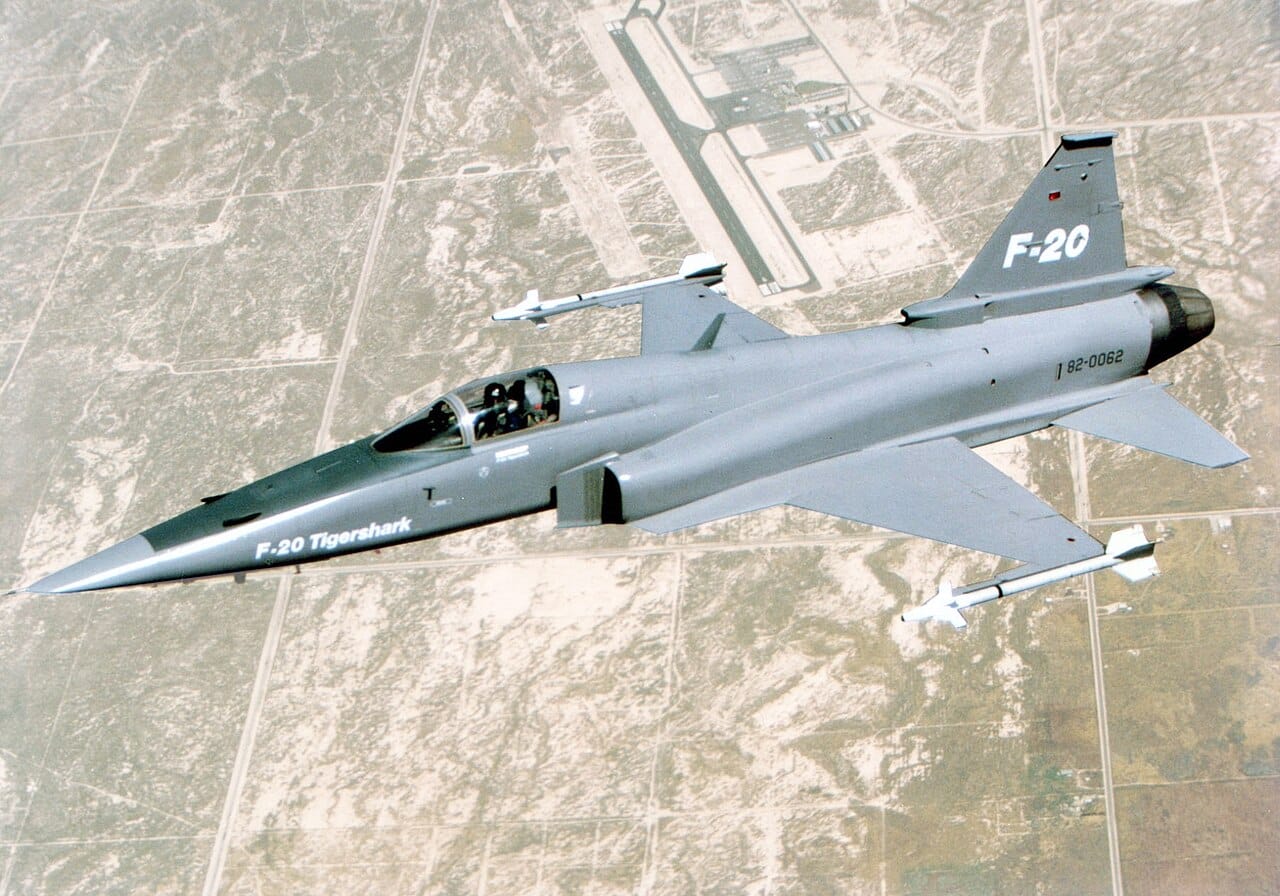
It could out-climb an F-16, scramble from cold to airborne in under half a minute, and fire a radar missile years before its rival could. It was cheap to run, brilliant to fly, and paid for entirely out of one company’s own pocket. And it sold exactly none.
The Northrop F-20 Tigershark is the great "what if" of Cold War fighters — a superb little jet that arrived at precisely the wrong moment and was killed not by any flaw of its own, but by politics.
DATOS RÁPIDOS
| Role | Light multirole fighter (export) |
| Primer vuelo | 30 August 1982 |
| Central eléctrica | 1 × General Electric F404 turbofan, 17,000 lbf |
| Velocidad máxima | ~Mach 2 |
| Número construido | 3 (plus one partial) |
| Destino | Cancelled 1986 with zero sales |
A Tiger with a new heart
The Tigershark began life as the F-5G, a re-engined version of Northrop’s hugely successful F-5 Tiger II. Out went the two modest J85 engines; in went a single General Electric F404 — the same class of engine as the F/A-18 Hornet’s — with roughly 60% more thrust. The result transformed the aircraft. Thrust-to-weight jumped past 1.1, the ceiling climbed beyond 55,000 feet, and the jet could go from a cold cockpit to airborne in about 22 seconds.
Northrop skipped the designation "F-19" entirely, jumping to F-20 — partly to put clear water between it and the odd-numbered Soviet MiGs, partly for marketing punch. It hired the most famous test pilot alive, Chuck Yeager, to sell it.
Yeager did not hold back. Having flown almost everything with wings, he called the Tigershark simply "magnificent."
The right jet at the wrong time
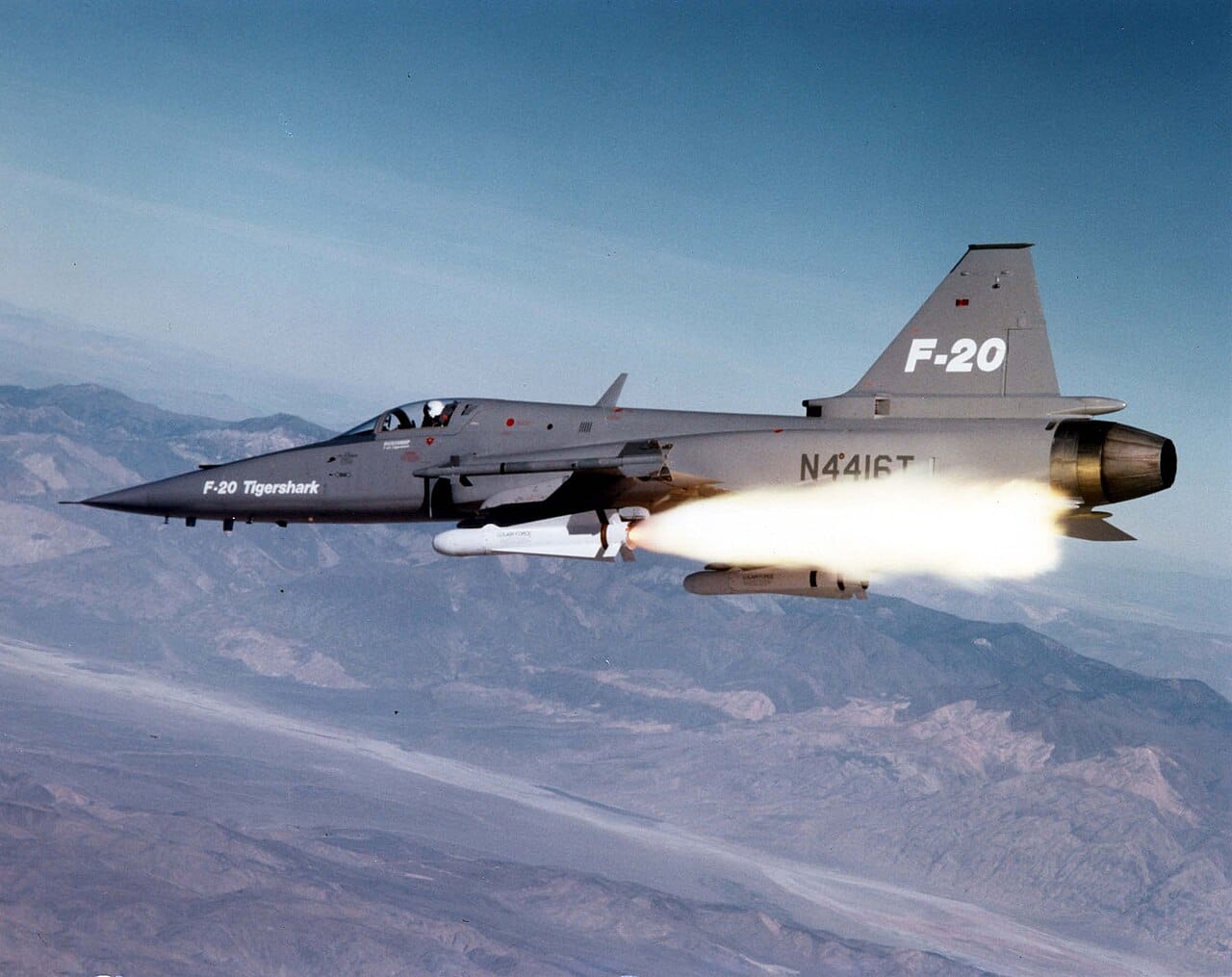
The F-20 was built for a very specific policy. Under the Carter administration’s "FX" export rules, America wanted a capable fighter it could sell to allies without handing over its most sensitive front-line technology. The Tigershark fit perfectly — privately funded by Northrop, it could be marketed abroad without exposing the crown jewels.
Then the rules changed. The Reagan administration relaxed export policy and let allies buy the real thing: the F-16. Overnight, the F-20’s entire reason to exist evaporated. Why buy a superb export-only fighter when you could have the same jet the US Air Force flew? A promised sale to Taiwan collapsed under the 1982 US–China communiqué. The final blow came on 31 October 1986, when the US Air Force itself chose the F-16 for the Air National Guard.
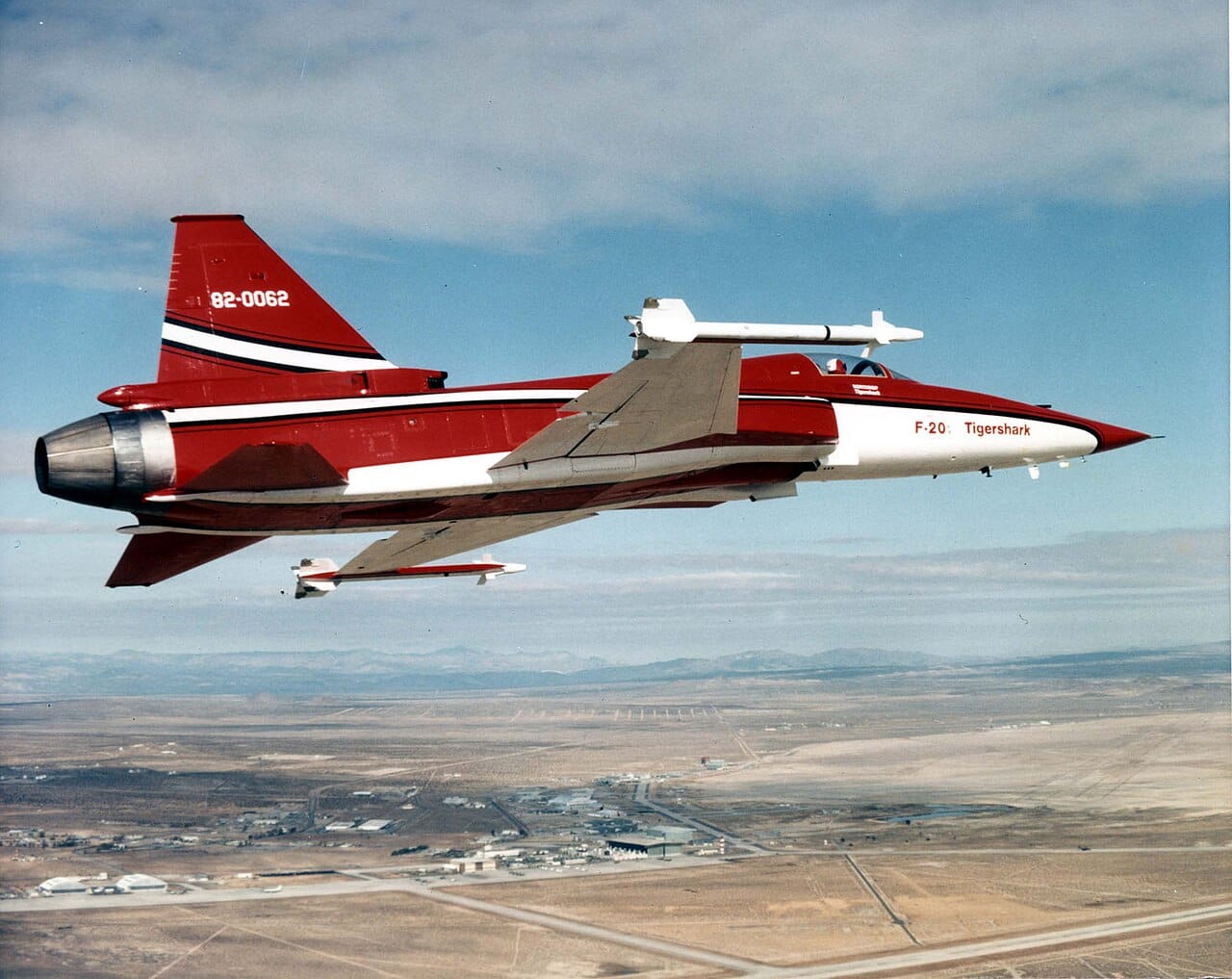
Northrop had spent around $1.2 billion of its own money. Two of the three prototypes were lost in crashes — both traced to pilot G-induced loss of consciousness during punishing airshow routines, not to any fault in the aircraft. In late 1986, with not a single order on the books, Northrop pulled the plug.
The verdict has hardened into legend. The Tigershark was faster to react than an F-16, cheaper to operate, and armed for the beyond-visual-range fight before its rival was. It lost anyway — beaten not in the air, but in the corridors where export policy is written. The sole survivor sits today in a Los Angeles museum: a reminder that in the fighter business, being the better aircraft has never been enough.
Sources: Wikipedia; Steve Pace, "X-Fighters"; Popular Mechanics; California Science Center.
Publicaciones relacionadas
El avión supersónico que Gran Bretaña desechó
F-22 Raptor: El avión ganador que Estados Unidos dejó de fabricar.
0 Comentarios