
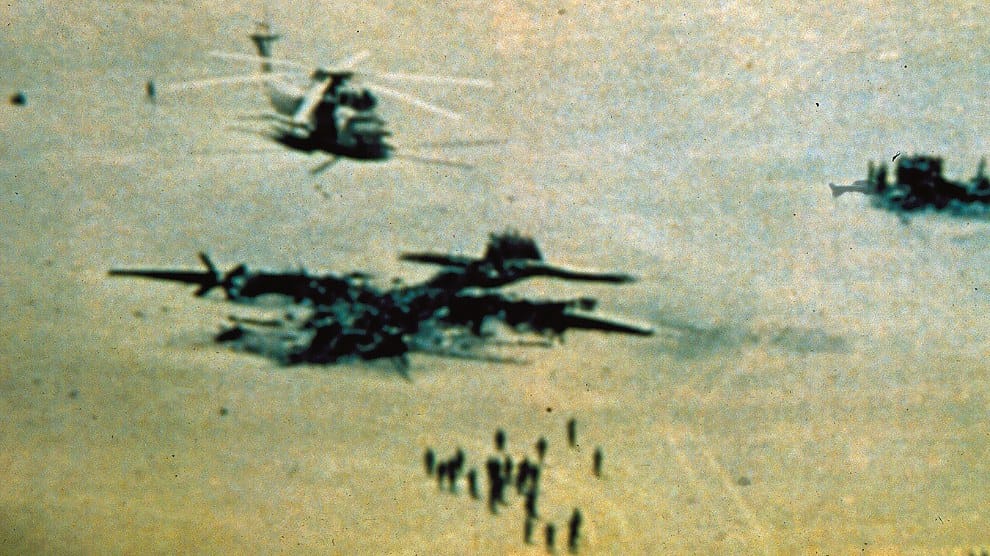
At 22:47 on 24 April 1980, a blacked-out MC-130 thumped down on a salt flat 200 miles (320 km) southeast of Tehran, and the most secret mission in America promptly met the public. Headlights. A Mercedes bus, forty-plus Iranian civilians aboard, rolling straight through the middle of a landing zone that officially did not exist. Rangers stopped it at gunpoint.
Minutes later a fuel tanker ignored orders to halt and took a shoulder-fired rocket instead. It went up like a torch, a column of flame visible for miles, so the covert refuelling point in the Dasht-e Kavir now had its own beacon. Somewhere out in the dark, eight Sea Stallion helicopters were fighting their way towards it. Not all of them would arrive.
Datos rápidos
- Night of 24-25 April 1980 — attempt to rescue 52 Americans held in Tehran since the embassy seizure of 4 November 1979
- Eight RH-53D Sea Stallions (Bluebeard 1-8) launched from USS Nimitz; six C-130 variants flew in from Masirah, Oman, with 132 assault troops
- Two helicopters lost en route; a third reached Desert One with failed hydraulics — five left, six required
- President Carter confirmed the abort after the force had spent some two and a half hours on the ground
- During repositioning, Bluebeard 3's rotor struck EC-130E Republic 4: eight dead, five helicopters abandoned
- Fallout: the Holloway Commission, JSOC, the 160th SOAR "Night Stalkers", and USSOCOM (operational April 1987)
- The hostages came home on 20 January 1981, after 444 days
The Operations Room reconstructs the raid, from the Nimitz launch to the fire at Desert One.
The mission was five months in the making. On 4 November 1979, revolutionary students had stormed the US Embassy in Tehran; 52 Americans were still hostages. Delta Force, the counter-terror unit Colonel Charlie Beckwith had built and barely finished training, drew the job of getting them out. Entebbe, four years earlier, had shown a rescue like this could work. Entebbe, however, had one runway, one building and one night. This plan had layers on layers.
Night one: eight Navy RH-53D Sea Stallions, call signs Bluebeard 1 through 8, launch from the carrier USS Nimitz and fly 600 miles (1,000 km) to Desert One, where six C-130 variants from Masirah, Oman, wait with fuel bladders and 132 assault troops. Night two: helicopters lift the force from a hide site to the embassy walls, Delta storms the compound, everyone flies out from a captured airfield. Every piece had to work. The desert had other ideas.
The Desert Fights Back
Two hours into the flight, a cockpit sensor in Bluebeard 6 flagged a possible cracked rotor blade. The crew set down, abandoned the aircraft and rode on with Bluebeard 8. Seven left. Then the sky itself turned against them: a haboob, a vast suspended cloud of talcum-fine dust, invisible to forecasts and nearly opaque to pilots wearing early night-vision goggles.
Inside that murk, Bluebeard 5 lost critical flight instruments and turned back to the Nimitz. Six left, the exact minimum the planners had set. Then Bluebeard 2 staggered into Desert One at 01:00 with its secondary hydraulic system dead. The senior helicopter pilot, Ed Seiffert, refused to fly it into Tehran. Beckwith refused to cut his assault force to fit five aircraft. The arithmetic was brutal and nobody could argue it away: five flyable helicopters, six required.
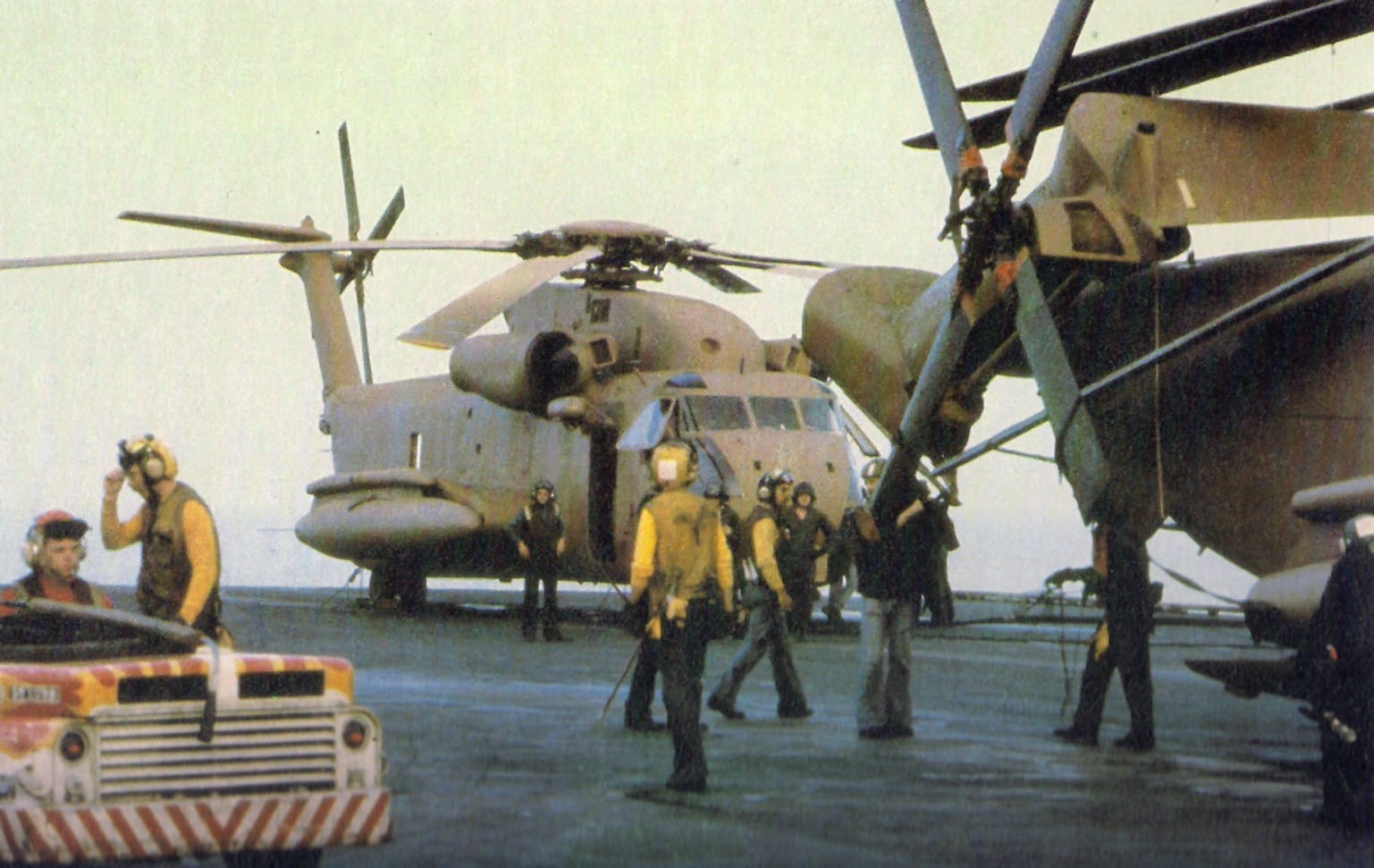
The recommendation to abort went by satellite from the on-scene commanders through Major General James Vaught to the White House. President Carter, who had agonised over every detail, accepted it. After roughly two and a half hours on the ground, the force prepared to leave the way it came. Frustrating, embarrassing, but survivable. Everyone was still alive.
Then came the manoeuvre that turned failure into tragedy. Bluebeard 3 had to reposition so a fuel-critical EC-130E, Republic 4, could depart. With a suspect nose gear and soft sand underfoot, the helicopter lifted into a hover. Its rotor wash blasted a wall of dust over the combat controller guiding it; the pilot, losing his only visual reference, drifted where he believed he was steady. The main rotor sliced into the transport's vertical stabiliser, and the Sea Stallion came down on the wing root of an aircraft filled with fuel and forty-one men.
The fireball rose 300 feet (90 m). Five airmen on the EC-130E died: Major Harold Lewis Jr., Major Richard Bakke, Major Lyn McIntosh, Captain Charles McMillan and Technical Sergeant Joel Mayo. Three Marines died in the helicopter: Staff Sergeant Dewey Johnson, Sergeant John Harvey and Corporal George Holmes Jr. Thirty-eight men got out of the burning transport, some through a single door against a current of flame. The helicopter's two badly burned pilots were its only survivors.
Ammunition was cooking off in the wreck and the remaining helicopters could not be safely destroyed; they were loaded with ordnance. The force crowded aboard the surviving C-130s and flew out, leaving five nearly intact RH-53Ds, classified documents, and eight of their own behind.
The Longest Morning After
At 01:00 Washington time, the White House announced the failure. A few hours later Carter went on television and did something politicians rarely do: he took it all.
Tehran celebrated. Khomeini declared that the sands themselves had been "agents of God," and Iranian television broadcast the charred wreckage to the world. The hostages were scattered across Iran to make a second raid impossible. Secretary of State Cyrus Vance, who had opposed the mission on principle, resigned. And an Iranian F-4, sent to strafe the abandoned equipment the next day, killed the local Revolutionary Guard commander investigating the site — Iran's own casualty of the affair.
The Pentagon's reckoning was the Holloway Commission, chaired by former Chief of Naval Operations Admiral James L. Holloway III. Its report was measured and devastating: improvised command and control, four services stitched together without joint training, weather intelligence that never reached the pilots, helicopter crews trained for minesweeping rather than long-range covert penetration. The failure was not one broken part. It was the absence of a system.
What Rose from the Sand
So America built the system. The Army stood up Task Force 160 in 1981, an aviation unit that did nothing but fly special operations at night until they were the best on earth; today it is the 160th Special Operations Aviation Regiment, the Night Stalkers. Joint Special Operations Command followed in December 1980, and in April 1987 the whole architecture was capped by US Special Operations Command. Mogadishu's Black Hawk crews, the bin Laden raid's stealth helicopters, every night raid of the last four decades sits on foundations poured at Desert One.
And then there is the sequel nobody would believe as fiction. Planning for a second rescue produced Operation Credible Sport: a C-130 Hercules fitted with thirty rocket motors so it could land inside a Tehran soccer stadium, across the street from the embassy, and blast its way out again with everyone aboard.
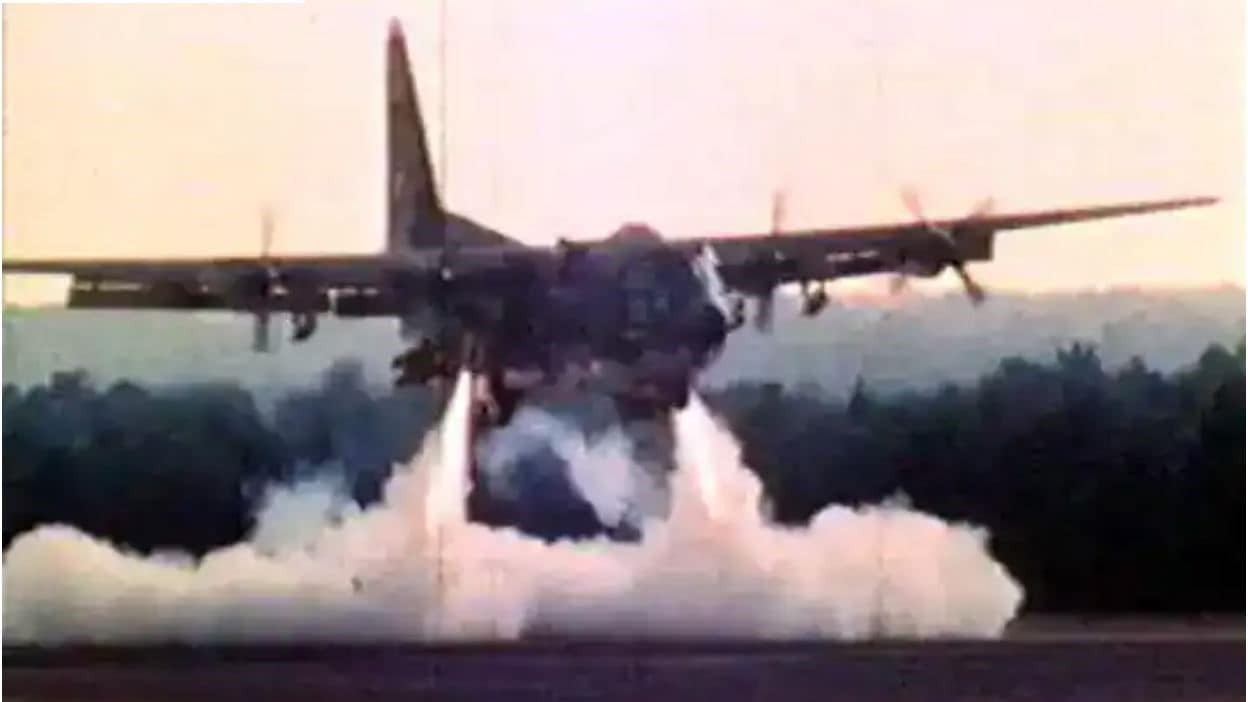
The modified aircraft flew, and the takeoff tests were astonishing: airborne in about 100 feet (30 m). On 29 October 1980, during a full-profile demonstration in Florida, the braking rockets fired early, the aircraft slammed down, the right wing tore off and the airframe burned. The crew walked away. Weeks later Carter lost the election, and the project died with the crisis.
Because the ending, when it came, needed no helicopters at all. On 20 January 1981, minutes after Ronald Reagan took the oath of office, Iran released all 52 hostages, 444 days after the embassy fell. The men of Desert One are remembered with a white marble memorial at Arlington. The lesson they paid for is remembered every time a special operations helicopter lifts off, in the dark, and works.
Period test footage of the rocket-boosted Credible Sport C-130 — the sequel Desert One almost got.
Sources: Wikipedia, Miller Center, The Aviation Geek Club, Task and Purpose, The Aviationist
Preguntas relacionadas
What was Operation Eagle Claw?
Operation Eagle Claw was the failed US military mission on 24–25 April 1980 to rescue 52 American hostages held in Tehran since the embassy seizure of 4 November 1979. The complex night operation, staged from a desert airstrip codenamed "Desert One," was aborted after mechanical failures and ended in a fatal crash.
What happened at Desert One?
At the Desert One refueling site, too few helicopters remained serviceable to continue, so commanders aborted the mission. During the withdrawal, a helicopter collided with an EC-130 tanker, and the resulting fire killed eight servicemen. Five helicopters were abandoned in the Iranian desert.
Why did Operation Eagle Claw fail?
The plan required six working helicopters, but eight RH-53D Sea Stallions launched from USS Nimitz and two were lost en route, while a third reached Desert One with failed hydraulics — leaving only five. President Carter confirmed the abort after the force had spent roughly two and a half hours on the ground.
How many people died in Operation Eagle Claw?
Eight American servicemen were killed when a helicopter's rotor struck an EC-130E tanker aircraft during repositioning at Desert One, igniting a fire. No hostages were rescued. The disaster was a profound embarrassment for the United States and weighed heavily on President Carter's remaining time in office.
How did Operation Eagle Claw change the US military?
The failure drove sweeping reform. The Holloway Commission investigated the disaster, leading to Joint Special Operations Command (JSOC), the 160th special operations aviation regiment (the "Night Stalkers"), and ultimately US Special Operations Command, which became operational in April 1987. It reshaped how America conducts special operations.
When were the Iran hostages finally released?
The 52 hostages were freed on 20 January 1981, after 444 days in captivity, as Ronald Reagan was inaugurated. Their release came through diplomacy rather than a military rescue, months after the failed Desert One attempt. Later American operations, such as the raid on Libya, drew on the hard lessons learned.
Publicaciones relacionadas
0 Comentarios