
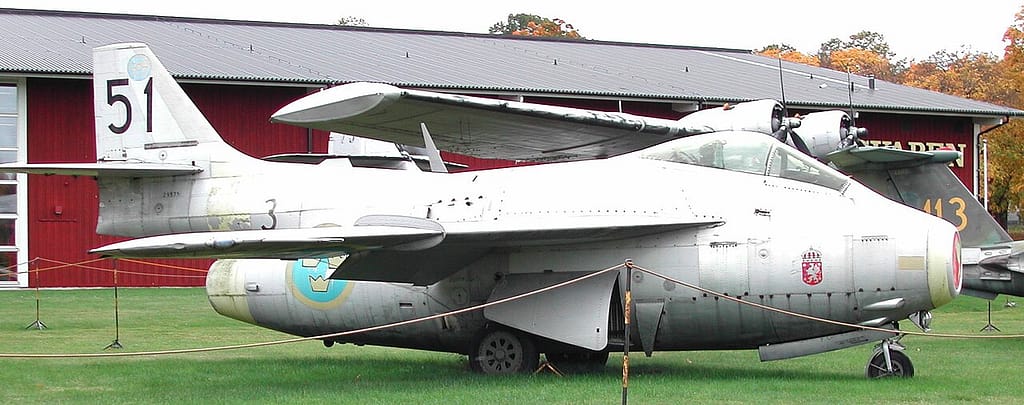
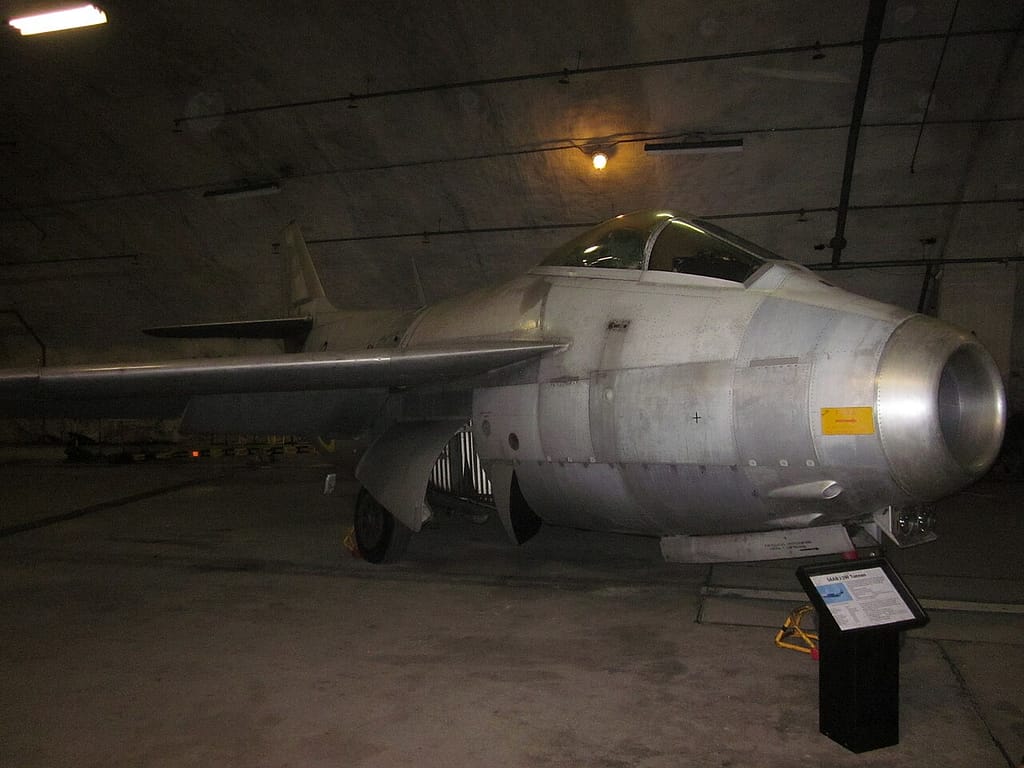
It looked like a beer barrel with wings, and the Swedes said so themselves — they called it Flygande Tunnan, the “Flying Barrel.” But behind that comical shape hid a serious pioneer: the first swept-wing fighter to enter squadron service anywhere in Western Europe.
The Saab 29 Tunnan beat Britain's Hunter and France's Mystère into service, gave neutral Sweden a genuinely modern jet fighter, and — in one of the Cold War's odder chapters — went to war under a blue United Nations flag over the Congo.
Datos rápidos
- Tipo: Sweden's first swept-wing jet fighter
- Apodo: Flygande Tunnan (“Flying Barrel”)
- Primer vuelo: 1 September 1948; in service from 1951
- Motor: de Havilland Ghost turbojet (~22 kN)
- Armamento: Four 20 mm Hispano cannons; speed over 1,200 km/h
- Construido: Around 660 — Saab's most numerous fighter
- Combat: UN service in the Congo, 1961–1963
A barrel with a secret
When the Saab 29 Tunnan first flew on 1 September 1948, its fat, stubby fuselage drew immediate laughter. But that rotund shape wrapped one of the most advanced ideas of the era: a thin, 25-degree swept, laminar-flow wing, paired with a compact de Havilland Ghost turbojet. The result could exceed 1,200 km/h and carried four hard-hitting 20 mm cannons.
Sweden had quietly beaten the aviation establishment. The Tunnan entered service in 1951 as the first swept-wing fighter in Western European squadrons — ahead of the Cazador de halcones y el Mystère IV — a remarkable feat for a small, neutral nation.
The story of Saab's Flying Barrel.
The Flying Barrel goes to war — for the UN
Sweden famously stays out of other people's wars, which makes the Tunnan's combat record unique. In 1961, the United Nations needed air power for its ONUC mission in the newly independent, war-torn Congo. Sweden answered by deploying J 29Bs and photo-reconnaissance S 29Cs as the F 22 wing; the first four aircraft reached Léopoldville on 4 October 1961.
Over the next two years the Tunnans flew ground-attack and reconnaissance sorties with cannon and rockets in support of UN troops. Despite heavy ground fire, the barrels proved tough — and it remains the only time Swedish jets have fired shots in anger.
A surviving Tunnan still flies the airshow circuit today.
The jet that put Sweden on the map
The Tunnan established a pattern that continues to this day: a small country building world-class fighters entirely on its own terms, from the Draken and Viggen to the Gripen. For an aircraft everyone first laughed at, that is quite a legacy — and one Sweden's aerospace industry has never stopped building on.
Sources: Wikipedia (Saab 29 Tunnan); Simple Flying; Aeroseum; Hush-Kit; National Security Journal.
Publicaciones relacionadas
El diseñador que superó en velocidad a los mustangs en su propio avión de combate.
0 Comentarios