
The sirens came before the sunrise. In Manama's old quarters and along Kuwait City's waterfront towers, the same rising wail that Gulf residents have learned by heart this year pulled families out of bed and into stairwells in the small hours of Wednesday morning.
This time the warning was Iran's answer to America. Hours after CENTCOM finished striking more than 80 targets along Iran's southern coast, Tehran turned its launchers toward the two Gulf states that host the most visible symbols of US military power: Bahrain, home port of the Navy's Fifth Fleet, and Kuwait, where Ali Al Salem Air Base has anchored American airlift in the region for decades.
Kuwait's army posted its statement on X while the explosions were still echoing: "Kuwaiti air defenses are currently engaging hostile missile and drone attacks," it said, assuring residents that the booms overhead were interceptions, not impacts. In Bahrain, the Interior Ministry activated sirens across the kingdom and urged people toward the nearest safe room. Then the region did what it always does on these mornings: it waited.
Datos rápidos
- Air raid sirens sounded across Bahrain and Kuwait in the early hours of Wednesday 8 July 2026
- Kuwait's army said its air defenses were engaging hostile missile and drone attacks; explosions heard were interceptions
- The IRGC claims it "pounded 85 key US military facilities" in Bahrain and Kuwait — a claim no independent source has verified
- Iran's regular army separately claimed drone attacks on Sheikh Isa Air Base in Bahrain; the IRGC claims it downed a US MQ-9 over Bushehr province
- No deaths, injuries or damage at US facilities had been confirmed by Wednesday morning; the Pentagon has not commented
- In a similar exchange on 28 June, an Iranian strike damaged a residential building in Muharraq, near Bahrain's airport, with no deaths
Firstpost live coverage of the US strikes on Iran and Tehran's retaliation against Bahrain and Kuwait.
The Claim and the Quiet
What Tehran says happened and what can be verified are, as ever, two different stories. The Islamic Revolutionary Guard Corps announced that its navy and aerospace forces, in a joint missile-and-drone operation, "pounded 85 key US military facilities in Salman Port, the US Fifth Fleet in Bahrain, and the Ali Al Salem Air Base in Kuwait," according to Iran's Fars news agency. Iran's regular army separately claimed its drones struck "gathering centres" of American forces at Sheikh Isa Air Base in Bahrain, and an IRGC spokesperson claimed an American MQ-9 drone was shot down over Khormuj in Bushehr province.
None of it has been independently confirmed. The Pentagon has not commented on the claims, and as of Wednesday morning no government in the region had reported deaths, injuries or damage to any US facility. These maximalist tallies are a pattern: after a similar exchange in late June, the IRGC claimed to have "destroyed" eight American military sites in Kuwait and Bahrain, a boast no evidence ever supported. The claims are best read as messages to a domestic audience burying its supreme leader this week, not as bomb damage assessments.
The June precedent also shows where these salvoes actually tend to land. On June 28, an Iranian strike damaged an eight-storey residential building in Muharraq, near Bahrain's international airport, blowing out windows and filling the top floor with rubble; mercifully, no one was killed. Kuwait that morning intercepted Iranian drones and two ballistic missiles. The bases were untouched. The apartment block was not.

A Ceasefire Living on Borrowed Time
All of this unfolds inside a peace process that keeps shooting at itself. The memorandum of understanding signed on June 17 was supposed to silence the guns while negotiators worked out the future of the Strait of Hormuz, sanctions relief and Iran's uranium stockpile. Instead, Tuesday brought attacks on three tankers, an American oil-license revocation, 80 US airstrikes, and now Iranian missiles over the Gulf.
The diplomats are still talking, but through gritted teeth. Iran's deputy foreign minister, Kazem Gharibabadi, says Washington's strikes and sanctions are "blatant violations" of the memorandum and warns that Iran "will take decisive actions to safeguard its national interests and security." His boss, Foreign Minister Abbas Araghchi, drew the line a day earlier: "Negotiations on final Deal will not commence if threats continue," he wrote, adding a pointed instruction to the White House: "Honor your signature."
President Trump, at the NATO summit in Ankara, sounded ready to oblige. Asked Wednesday whether the ceasefire deal was finished, he said it was, calling further dealings with Tehran a "waste of time," according to CNN. Qatar, whose LNG carrier Al Rekayyat burned in Monday's tanker attack, condemned the strike on its vessel and said it holds Iran legally responsible.
The People Under the Flight Paths
Lost in the ledger of claims and counterclaims are the people who live where the missiles fly. Bahrain is a small island; the Fifth Fleet's piers sit minutes from neighborhoods where American sailors' families shop alongside Bahraini ones. Kuwait has already buried one victim of this war: an Indian worker killed when drones struck the international airport in early June. Every siren since carries that memory.
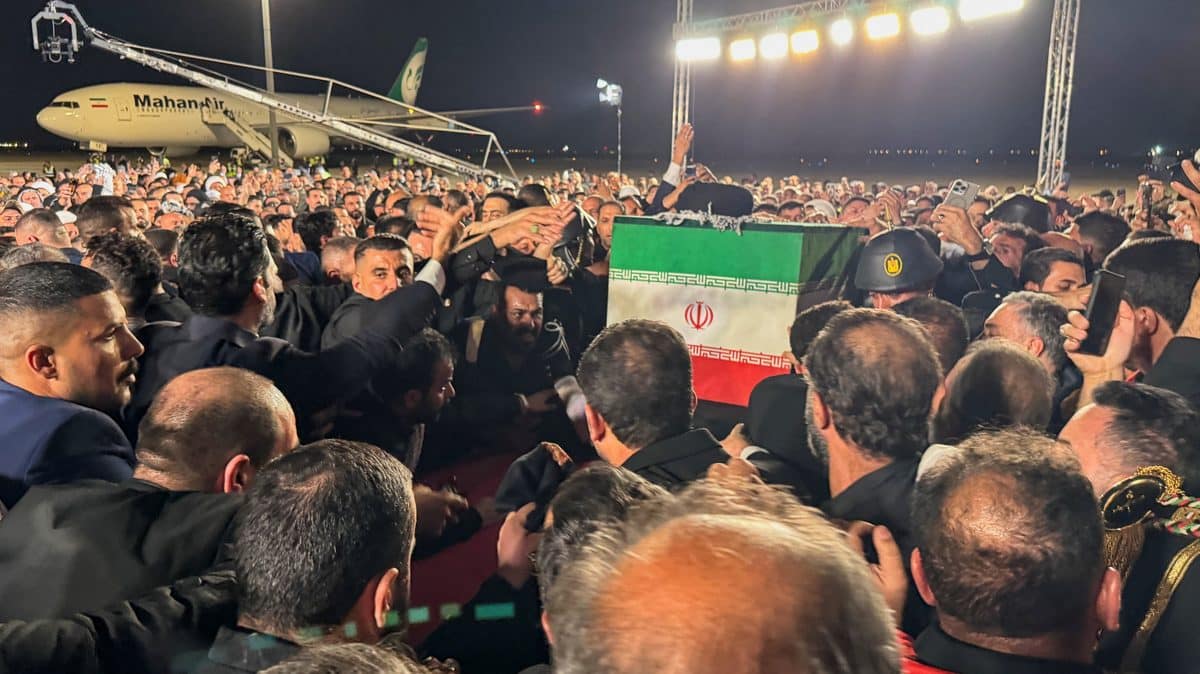
And in Iran, the funeral goes on. The coffin of Ayatollah Ali Khamenei, killed on the war's first day in February, arrived in the Iraqi city of Najaf on Tuesday night and is due for burial in Mashhad on Thursday. Mourners chant for vengeance; negotiators plead for time. On Wednesday, somewhere between the two, the Gulf held its breath again — and, at least by morning's light, was spared.
Sources: Al Jazeera, Associated Press, PBS News, Reuters, CNN, Euronews
Preguntas relacionadas
Why did air raid sirens sound in Bahrain and Kuwait?
In the early hours of Wednesday 8 July 2026, Iran launched missiles and drones at Bahrain and Kuwait in retaliation for CENTCOM strikes on more than 80 targets along Iran's southern coast hours earlier. Both Gulf states host major US military facilities, and their air defences engaged the incoming attacks.
What did Iran claim to have hit?
Iran's IRGC claimed it 'pounded 85 key US military facilities' in Bahrain and Kuwait — a claim no independent source has verified. Iran's regular army separately claimed drone attacks on Sheikh Isa Air Base in Bahrain, and the IRGC claimed it shot down a US MQ-9 drone over Bushehr province.
Were there casualties in the Iranian attack on Bahrain and Kuwait?
No deaths, injuries or damage at US facilities had been confirmed by Wednesday morning, and the Pentagon had not commented. Kuwait's army said the explosions residents heard were its air defences intercepting hostile missiles and drones.
Why is Bahrain strategically important to the US?
Bahrain is the home port of the US Navy's Fifth Fleet, which oversees naval operations across the Persian Gulf, Red Sea and Arabian Sea. That makes the small island kingdom one of the most visible symbols of American military power in the region — and a natural target for Iranian retaliation.
What is Ali Al Salem Air Base?
Ali Al Salem is an air base in Kuwait that has anchored American airlift operations in the Middle East for decades. Alongside Bahrain's Fifth Fleet headquarters, it is among the most significant US military facilities within reach of Iranian missiles and drones.
Has Iran attacked US bases in the Gulf before?
Yes. In a similar exchange on 28 June 2026, an Iranian strike damaged a residential building in Muharraq near Bahrain's airport, with no deaths — and Iran has struck at US bases in past confrontations as well. Gulf residents have learned the sound of the sirens by heart this year.


0 Comentarios