
It was supposed to be an ordinary Tuesday. Southwest Airlines Flight 1380 lifted off from New York’s LaGuardia Airport on the morning of 17 April 2018, bound for Dallas with 149 people aboard. First Officer Darren Ellisor was flying the leg; in the left seat, Captain Tammie Jo Shults was monitoring. Nothing about the departure hinted at what was coming.
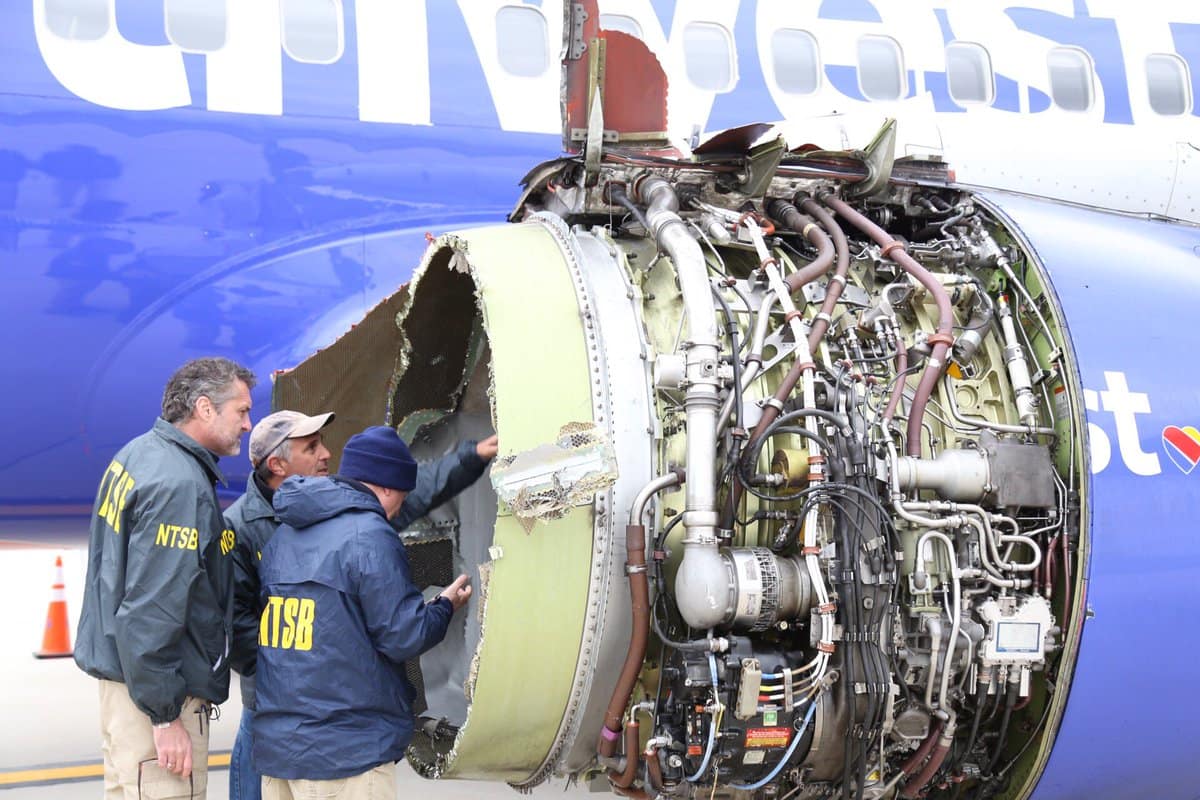
About thirty minutes in, the jet was climbing through roughly 32,000 feet when the left engine let go. Not a flameout, not a quiet shutdown — a violent, uncontained failure. Deep inside the CFM56, a fan blade had cracked at its root from metal fatigue and snapped off. The blade slammed into the fan case, and the impact ripped the engine cowling apart in the airstream.
- Date: 17 April 2018, en route New York LaGuardia to Dallas Love Field
- Aircraft: Boeing 737-700, registration N772SW, two CFM56-7B engines
- Aboard: 149 people — 1 fatality, 8 minor injuries
- Failure: a fan blade fractured from metal fatigue, an uncontained engine failure at ~32,000 ft
- Crew: Captain Tammie Jo Shults (former US Navy fighter pilot) and First Officer Darren Ellisor
- Outcome: a single-engine emergency landing at Philadelphia, 17 minutes after the failure
The window and the fight in the cabin
Debris from the disintegrating nacelle struck the fuselage. A piece of the cowling hit the aircraft near a cabin window and knocked it out. In an instant the cabin lost its pressure. The aircraft rolled hard to the left — the recorders later measured a bank of more than 41 degrees — while smoke poured into the cockpit and alarms lit up.
This is the part of the story that must be told plainly. Jennifer Riordan, a passenger seated by the shattered window, was partially drawn out by the rushing air. Fellow passengers and the flight attendants fought to pull her back inside. She was taken to a hospital in Philadelphia, where she died — the only fatality of the accident, and the first passenger death on a US commercial airline in more than nine years. Everything that follows about airmanship is shadowed by that loss.
Trained for exactly this moment
When the engine failed, Captain Shults took control while Ellisor ran the emergency checklists. Both pilots pulled on their oxygen masks and started an emergency descent toward breathable air. The 737 was flying on one engine, badly out of balance, with a hole in the side of the cabin.
Shults was, in a very real sense, built for this. Before Southwest, she had flown fighters for the US Navy and was among the first women to fly the F/A-18 Hornet in naval service. That world — asymmetric thrust, high workload, staying analytical when the airplane is trying to depart controlled flight — was familiar territory. Together the crew worked the problem methodically rather than fighting it.
Calm on the radio
What captured the public’s imagination afterward was the audio. Across the whole emergency, Shults’s voice on the radio stayed level, almost conversational, as she coordinated the diversion into Philadelphia. When a controller asked whether the aircraft was on fire, she answered that it was not — but that part of the airplane was simply gone.
Seventeen minutes after the failure began, Flight 1380 touched down safely. A crippled twinjet, one engine destroyed, a cabin breach, and a full load of frightened passengers — and it landed. The airmanship on display, from both pilots and from the cabin crew who never stopped working, is exactly the kind of quiet competence this magazine exists to celebrate.
Why the engine came apart
The National Transportation Safety Board spent months tracing the failure to its root: a low-cycle fatigue crack hidden in the dovetail where the fan blade seats into the disk, invisible from the outside. Uncomfortably, there was precedent — twenty months earlier, another Southwest 737 had suffered a strikingly similar fan blade fracture on the same engine type.
In the days after the accident, regulators issued emergency airworthiness directives mandating ultrasonic checks of the CFM56 fleet, and Southwest began inspecting every engine it operated. The NTSB’s final report went further, pushing for the engine and cowling to be redesigned so that a lost fan blade could never again turn into a breached cabin.
What the flight left behind
Flight 1380 changed how a huge fleet of the world’s most common airliner is inspected, and in time how its engine cowlings are built. That is a real and lasting legacy of safety, paid for at a terrible price. Jennifer Riordan is remembered by a family and a community, and no landing, however skilful, undoes that.
What the crew gave the other 148 people aboard was a future. Tammie Jo Shults and Darren Ellisor did not perform magic that morning — they performed training, discipline, and judgement under a kind of pressure most of us will never face. That is what professional aviation looks like at its finest.
Sources: Wikipedia (Southwest Airlines Flight 1380); NTSB/AAR-19/03; NPR; Philadelphia Inquirer.
0 Comentarios