
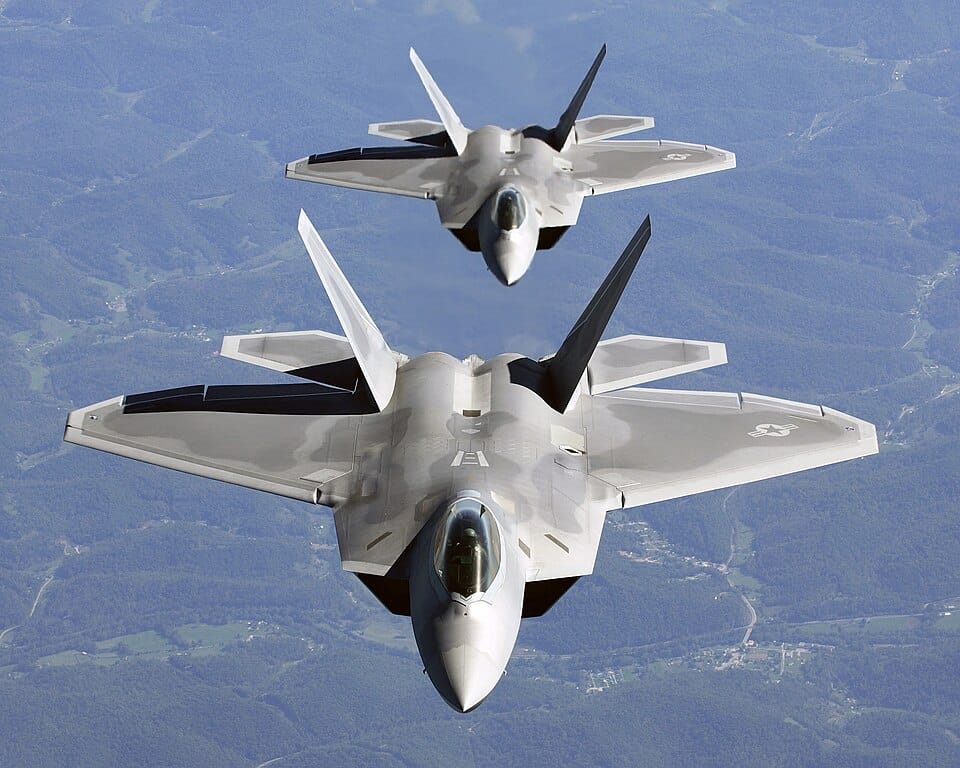
Every so often a fighter comes along that wins its contest so completely that the argument simply stops. The Lockheed Martin F-22 Raptor is that aircraft. It out-flew a rival prototype, rewrote what a fighter was supposed to do, and entered service as the most capable air-superiority machine on the planet. And then something strange happened: the country that built it decided to stop.
This is the paradox at the heart of the Raptor story. It is, by almost any measure, the finest air-to-air fighter ever fielded — and it is also one of the shortest production runs in modern American fighter history. The jet that was meant to number in the hundreds was capped at fewer than 200. To understand how that happened, you have to go back to a fly-off in the Mojave Desert and a procurement plan that kept shrinking for two decades.
So buckle in. This is the tale of a triumph and a truncation, of supercruise and stealth, of a winner that Washington quietly benched.
• Type: single-seat, twin-engine, all-weather stealth air-superiority fighter
• Origin: descended from the Lockheed YF-22, winner of the USAF Advanced Tactical Fighter (ATF) fly-off against the Northrop YF-23
• YF-22 first flight: 29 September 1990
• Production F-22 first flight: 7 September 1997
• Service entry: 15 December 2005, as the F-22A
• Engines: two Pratt & Whitney F119 afterburning turbofans with thrust vectoring
• Signature trick: supercruise — sustained supersonic flight without afterburner
• Built: 195 total (8 test aircraft, 187 operational)
• Export: banned by US law
From a desert competition to a Raptor
The F-22 was born from the US Air Force’s Advanced Tactical Fighter programme, a Cold War effort to build a stealthy replacement for the F-15 Eagle capable of defeating projected Soviet fighters and air defences. Two industry teams were chosen to build demonstrators: Lockheed with the YF-22, and Northrop with the YF-23.
The Lockheed YF-22 made its maiden flight on 29 September 1990. In testing it demonstrated the whole wish-list — supercruise, high angle-of-attack manoeuvring, and the firing of air-to-air missiles from internal weapons bays. When the dust settled, the YF-22 was declared the winner, and Lockheed’s design was developed into the production Raptor. That first production-standard F-22 took to the air on 7 September 1997, and after a long and expensive development the type formally entered US Air Force service on 15 December 2005 as the F-22A.
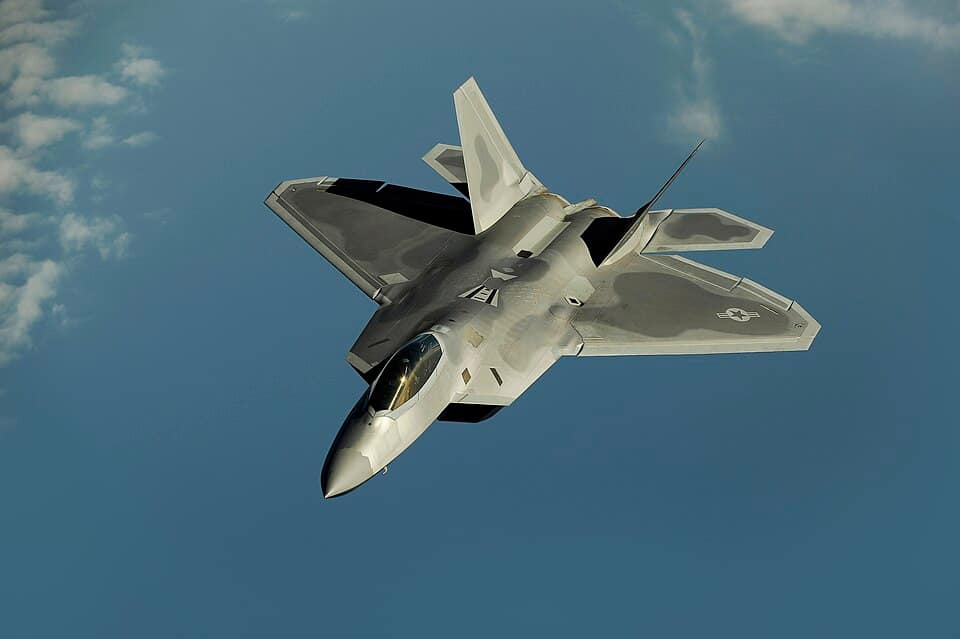
What emerged was unlike anything before it. The Raptor fused low-observable stealth, sensor fusion, and raw kinematic performance into a single airframe. It was designed to see first, shoot first, and vanish — and in the air-superiority role it began replacing the venerable F-15 across many active-duty units.
Two engines and one impossible trick
The beating heart of the Raptor is a pair of Pratt & Whitney F119 afterburning turbofans. These engines do two remarkable things at once. First, their nozzles vector thrust up and down, letting the jet point its nose with an authority that leaves conventional fighters flailing. Second — and this is the party trick — they give the F-22 supercruise: the ability to hold supersonic speed without lighting the afterburner.
A full-length documentary on the F-22 Raptor and the YF-23 that lost the ATF fly-off.
Supercruise is not a gimmick. Cruising supersonically without afterburner means the Raptor covers ground faster, gives enemy missiles far less time to solve the intercept problem, and does it all while sipping fuel that an afterburning jet would gulp. The man who commanded the Air Force at the time understood the point better than most, because he strapped in and flew it himself.
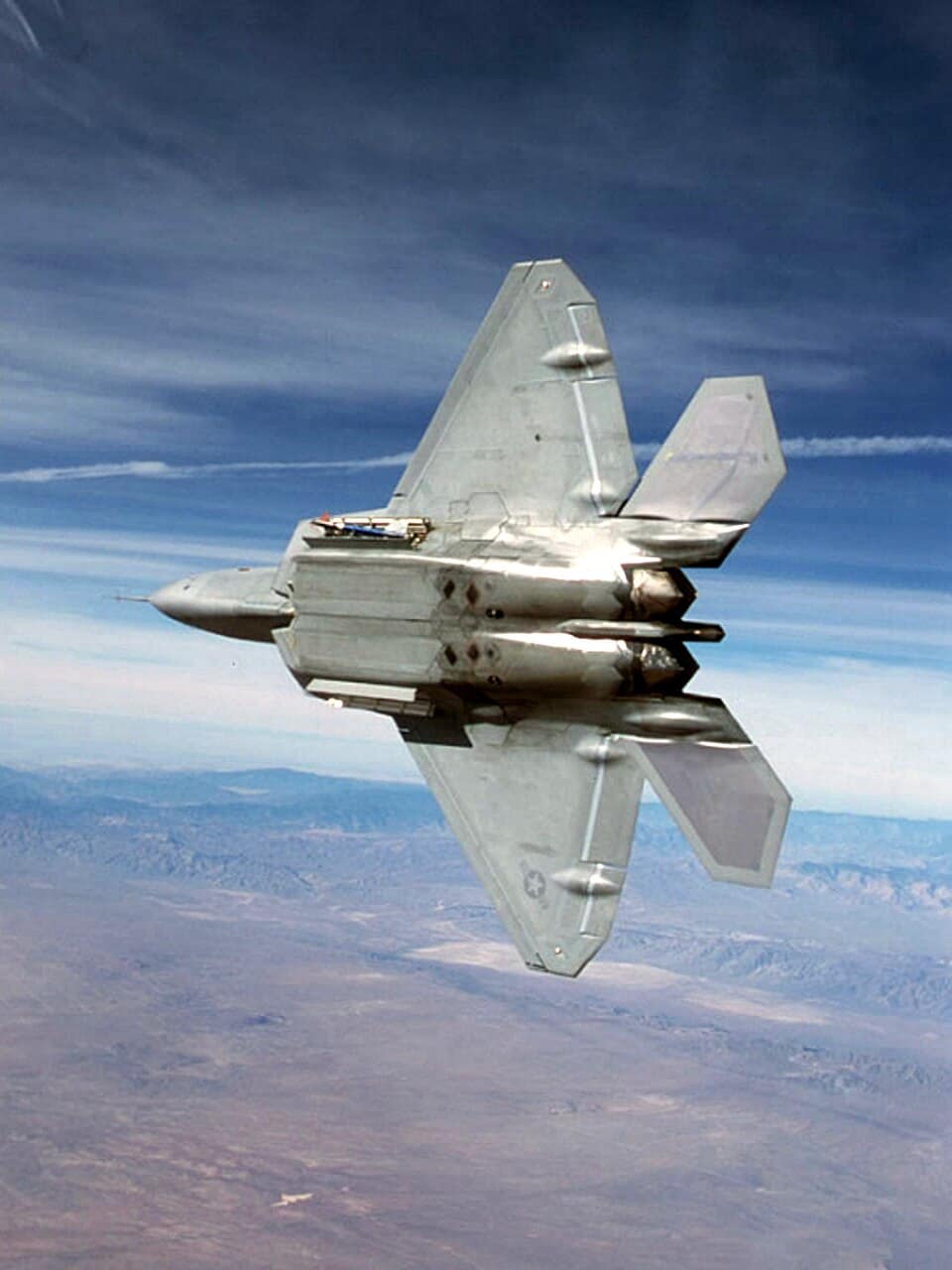
Combine that speed with a radar cross-section reportedly the size of a marble, an integrated avionics suite that fuses sensor data into a single clear picture, and weapons carried internally to preserve stealth, and you have a fighter built to win the first engagement before the other side even knows it is in one.
The fly-off: YF-22 versus the ghostly YF-23
No account of the Raptor is complete without its defeated twin. The Northrop YF-23 — nicknamed the Black Widow II — was arguably stealthier and faster than the YF-22, a sleek, diamond-winged apparition that looked like it had flown in from a decade later. The two prototypes represent one of the great what-if moments in aviation, and the Raptor’s victory is a permanent chapter in the great fighter fly-offs that shaped American air power.
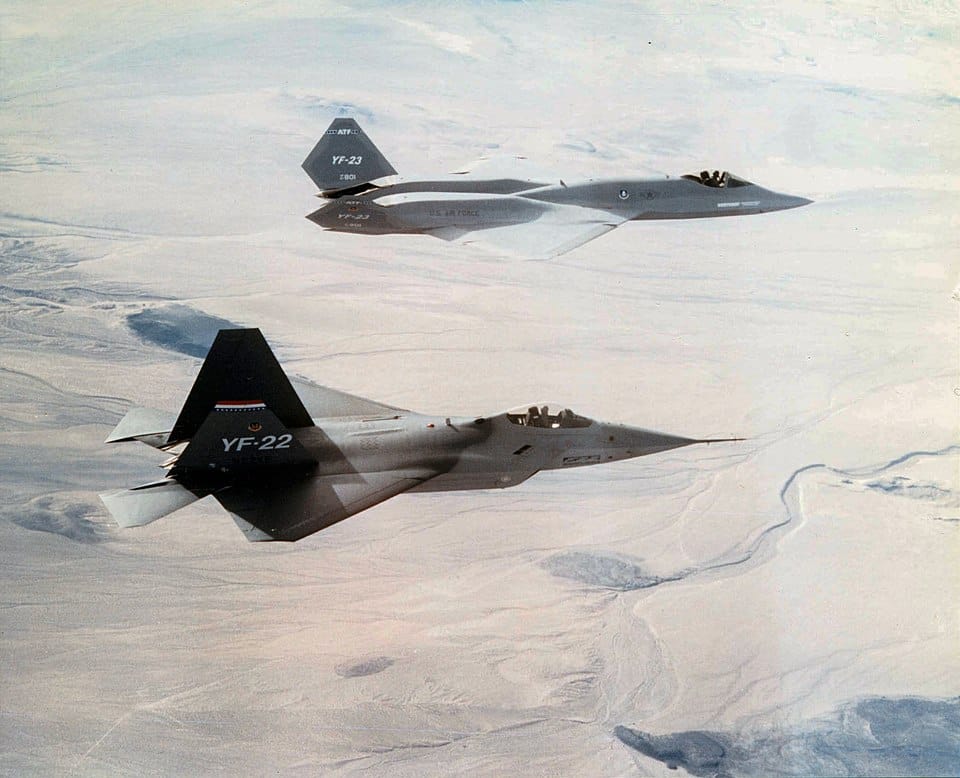
Why did the more exotic-looking YF-23 lose? The official reasoning was never solely about raw numbers. The Air Force judged the Lockheed design to offer a better balance of manoeuvrability, lower risk, and lower cost, and Lockheed’s bid and programme approach were seen as the safer path to an operational aircraft. The YF-23 was, by many accounts, the more radical machine — but radical is not always what a service buying hundreds of jets wants to hear. Both YF-23 airframes survive in museums today, silent reminders of the road not taken.
The incredible shrinking order: from 750 to 187
Here is where the triumph curdles into cautionary tale. When the Air Force first envisioned the ATF, it wanted a fleet of roughly 750 aircraft. That number never survived contact with reality. The 1990 Major Aircraft Review trimmed it to 648. After the Cold War ended and the Soviet Union dissolved, the 1993 Bottom-Up Review cut it again to 442, and the Air Force eventually settled on a requirement of 381 Raptors.
But 381 was a ceiling the programme kept falling away from. Funding instability and cost overruns dragged the planned total down through the late 1990s and early 2000s. Then, with the Pentagon focused on counter-insurgency wars in Iraq and Afghanistan, procurement was slashed toward 183 production aircraft — even as the Air Force still insisted it needed far more. A 2008 defence bill nudged the figure up to 187.
The final blow came in 2009. Defense Secretary Robert Gates, arguing that the Raptor was a costly solution to a threat that had not materialised, called for production to end. He got his way that summer, and the line was capped for good. When the last airframe was completed, the tally stood at 195 aircraft built — 8 test jets and 187 operational Raptors. A fighter conceived in the hundreds ended its run at fewer than 200.
There was one more twist that sealed the Raptor’s rarity: it was, and remains, forbidden from export. US law has prohibited foreign sales of the F-22 since the late 1990s, to protect its classified stealth and avionics technology. Allies including Japan, Australia and Israel expressed interest over the years; all were turned away, and most eventually bought the exportable F-35 instead. No other nation has ever flown a Raptor.
The legacy of a winner cut short
The bitter irony arrived on schedule. Within a few years of the line closing, a resurgent Russia and a rapidly modernising China made the “no near-peer threat” argument look badly timed. By then the tooling was mothballed and restarting production was judged prohibitively expensive; a 2017 Air Force study estimated it would cost roughly 50 billion dollars to build fewer than 200 more. The Raptor fleet the country had would be the Raptor fleet it kept.
So the F-22 occupies a peculiar throne. It is still, two decades after entering service, widely regarded as the premier air-superiority fighter in the world — a jet other air forces design their tactics around. It won its fly-off decisively, delivered on nearly every promise, and then became a case study in how budgets, timing and shifting threats can clip even the finest aircraft’s wings. The Raptor did not lose to a rival. In the end, it was outmanoeuvred only by a spreadsheet.
Sources: Wikipedia (Lockheed Martin F-22 Raptor; Northrop YF-23; Pratt & Whitney F119); U.S. Air Force (af.mil), 2005; GlobalSecurity.org; reporting on Secretary Gates and the F-22, 2009.
Related Questions
What is the F-22 Raptor?
The Lockheed Martin F-22 Raptor is a single-seat, twin-engine, all-weather stealth air-superiority fighter, widely regarded as the finest air-to-air fighter ever fielded. It entered US Air Force service in December 2005 as the F-22A. Despite its dominance it had one of the shortest production runs in modern American fighter history, with fewer than 200 built.
Who built the F-22 Raptor and which competitor did it beat?
Lockheed built the F-22, which descended from the YF-22 that won the US Air Force's Advanced Tactical Fighter fly-off against the Northrop YF-23. The YF-22 first flew on 29 September 1990. These winner-take-all contests, part of the great military aircraft competitions, decided the shape of American air power.
What is supercruise?
Supercruise is the ability to hold supersonic speed without using afterburner. The F-22's two Pratt & Whitney F119 engines let it cruise past Mach 1.7 dry, covering ground faster, giving enemy missiles less time to solve an intercept, and saving fuel that an afterburning jet would gulp. It is one of the Raptor's defining tricks.
When did the F-22 Raptor enter service?
The F-22 entered US Air Force service on 15 December 2005 as the F-22A. The production Raptor first flew on 7 September 1997, following the YF-22 demonstrator's maiden flight in 1990. Its arrival marked the world's first operational fifth-generation stealth fighter.
What engines power the F-22 Raptor?
The F-22 is powered by two Pratt & Whitney F119 afterburning turbofans with thrust-vectoring nozzles. The nozzles pivot the exhaust up and down, letting the jet point its nose with authority that leaves conventional fighters flailing, while also enabling supercruise — sustained supersonic flight without afterburner.
How many F-22 Raptors were made and can more be built?
Only 195 F-22s were built (8 test aircraft plus 187 operational). Production ended in 2009 and the jet is barred from export by US law. Restarting the line was later judged cost-prohibitive, so the fleet is frozen — a scarcity that helped the F-15 outlast it.
Why did America stop building the F-22?
The US halted F-22 production in 2009 for reasons of cost and strategy, not performance. The Raptor was extremely expensive, the Cold War peer threat it was built to beat had seemingly evaporated, and America was fighting counterinsurgencies where a stealth interceptor had limited use. Defense Secretary Robert Gates capped the fleet at 187 operational jets.
0 Comments